Thank you for visiting this site. This article explains Network Theory.
Anything that has “connections” — people, organizations, computers, cities — can be analyzed as a network. The structure of that network determines how information spreads, how diseases propagate, and how influence is distributed.
The History of Network Theory
The mathematical origins of network theory trace back to Leonhard Euler’s 1736 solution of the Königsberg Bridge Problem. Euler proved that there was no route through Königsberg (now Kaliningrad) that crossed each of its seven bridges exactly once — using what became the foundation of graph theory (the mathematical basis of network theory).
Research on social networks developed in the 1960s–70s. Stanley Milgram’s “six degrees of separation” experiment (1967) and Mark Granovetter’s “The Strength of Weak Ties” (1973) were important turning points.
From the late 1990s onward, the spread of the internet and advances in computing made it possible to analyze large-scale network data. Universal properties of real-world network structures were revealed: Barabási and Albert’s scale-free networks (1999) and Watts and Strogatz’s small-world networks (1998).
Nodes and Edges
The basic units of network theory are nodes and edges.
Node (vertex): A constituent element of the network. People, computers, cities, genes, web pages, and academic papers can all be nodes.
Edge (link): A connection between nodes. Friendships, communication links, roads, protein interactions, and citation relationships are all edges.
- Undirected graph: Edges have no direction (friendships, road networks)
- Directed graph: Edges have direction (web page links, citation relationships)
- Weighted graph: Edges have weights (call duration, trade volume)
The number of edges a node has is called its degree. In directed graphs, “in-degree” (incoming links) and “out-degree” (outgoing links) are distinguished. The distribution pattern of degrees fundamentally determines the structural properties of the network.
Random Graphs vs. Scale-Free Networks
Two contrasting structural models exist for networks.
Random graph (Erdős–Rényi model): Each pair of nodes is connected by an edge with a fixed probability p, independently. The degree distribution follows a Poisson distribution, producing a “homogeneous network” where most nodes have roughly the same number of connections.
Scale-free network (Barabási–Albert model): In many real-world networks — the internet, social media, citation networks, airline routes, power grids — the degree distribution follows a power law.
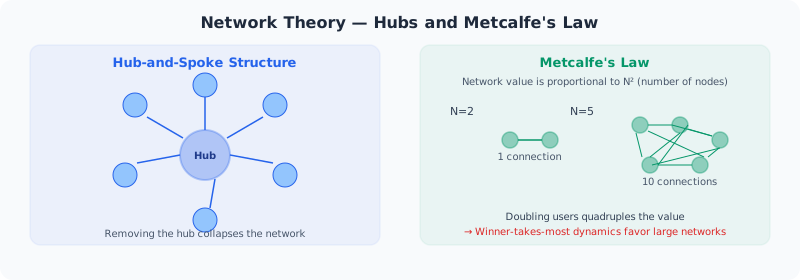
A small number of nodes serve as “hubs” with very many connections, while the vast majority have only a few.
This power-law structure emerges from a growth mechanism called preferential attachment. When a new node joins the network, it preferentially connects to nodes that already have many connections — the “rich get richer” structure.
Web page example: Popular pages attract more links, making them even more discoverable. Follower counts on social media, citation counts in academic literature, and airline route counts at airports all show similar distributions.
Robustness and Vulnerability of Scale-Free Networks
Scale-free networks have structurally interesting properties.
Robustness to random failures: Even if a large fraction of the many small-degree nodes are randomly removed, the overall connectivity of the network is maintained. Since most nodes have few connections, removing them has little effect on the network as a whole.
Vulnerability to targeted attacks: Conversely, removing hubs causes the network to rapidly lose functionality. Attacks on major internet routers, key power grid substations, or hub airports represent the vulnerability of scale-free structure.
Application to pandemic control: Isolating or vaccinating superspreaders (high-degree nodes) is highly effective at suppressing outbreak by removing hubs from the infection network. The strategy of prioritizing healthcare workers and schoolteachers (high-degree nodes) for flu vaccination is based on this logic.
Metcalfe’s Law and Network Effects
Metcalfe’s Law is the empirical observation that the value of a network is proportional to the square of its number of users N (N²). Named after Robert Metcalfe, inventor of Ethernet and co-founder of 3Com.
Intuitive explanation: With N users, the number of possible connection pairs is N×(N−1)/2 ≈ N²/2. When the number of users doubles, the value roughly quadruples.
Consider fax machines. A single fax machine is worthless. Two machines create one communication pair. One hundred machines create 4,950 possible pairs. The more users there are, the more pairs are possible, and the more the network’s value grows.
This property means network-type businesses tend toward “winner takes most.” Telephone, email, social media, matching platforms, and payment infrastructure are more valuable the larger the service, causing markets to naturally concentrate among a few players.
Direct vs. indirect network effects:
- Direct network effects: More users of the same service benefits everyone (LINE, WhatsApp, Zoom)
- Indirect network effects: Two distinct user groups benefit from each other’s size (Uber: more drivers → shorter wait times for riders → more riders; more riders → higher driver earnings)
Small Worlds and Six Degrees of Separation
Psychologist Stanley Milgram’s 1960s experiments gave rise to the concept of six degrees of separation.
The experiment: residents of Nebraska were asked to relay a letter by passing it through acquaintances to reach a specific person in Massachusetts (a stockbroker). At each step, participants could forward only to someone they personally knew who seemed closer to the target. The study measured how many steps it took.
On average, the letter arrived in about six steps — leading to the hypothesis that “any two people in the world are connected through an average of six acquaintances.”
Watts and Strogatz mathematically analyzed this “small-world” phenomenon in 1998, establishing the concept of the small-world network.
Small-world networks combine two properties:
- High clustering coefficient: Friends of friends tend to also be friends (cluster structure with many triangles)
- Short average path length: The shortest path between any two nodes is short
Many real-world social networks, protein interaction networks, and power grids exhibit this small-world property.
A 2016 Facebook study found the average distance between all active users worldwide was 3.57 hops — far shorter than six. The internet and social media have made the world even “smaller.”
While this short distance enables the rapid spread of information (virality), misinformation, infectious diseases, and financial crises propagate at nearly the same speed.
The Strength of Weak Ties
Sociologist Mark Granovetter presented a counterintuitive insight in his 1973 paper “The Strength of Weak Ties.”
Strong ties: Relationships with frequent contact and emotional closeness (family, close friends). Weak ties: Acquaintance-level relationships with occasional contact.
Granovetter’s study of how people found new jobs showed that important information (job leads) more often came from weak ties than strong ties.
Why? Strong ties (close friends, family) belong to the same community and tend to share the same information. Weak ties (acquaintances) bridge different communities and bring in new information that isn’t available within your own community.
Granovetter further argued that “the more weak ties that bridge different communities, the higher the information diffusion and social mobility.” On social media, “followers who are numerous but not intimate” can be interpreted as a large-scale version of weak ties.
Structural Holes
Sociologist Ronald Burt proposed the concept of structural holes — demonstrating the strategic advantage of occupying a brokering position between different groups.
When two distinct groups are not connected to each other and you are the only one connected to both, you acquire power as an information broker.
If Granovetter’s weak ties are “bridges,” the person who fills a structural hole is the “owner” of that bridge.
People with many structural holes:
- Can access up-to-date information from different communities first
- Hold influence by brokering information from one community to another
- Tend to advance more rapidly in their careers (Burt’s empirical results)
This is a form of social capital. The insight that “not the quantity but the structural position of your connections” determines value provides practical guidance for career design and organizational design.
Network Centrality
Measures that quantify how “important” a specific node is within a network are called centrality measures.
Degree centrality: Importance measured by number of connections. Nodes with many direct links rank highly. Equivalent to follower counts on social media.
Betweenness centrality: Measured by the fraction of all shortest paths between any two nodes that pass through a given node. Nodes that function as “bridges” rank highly. Used to identify gatekeepers and information brokers.
Eigenvector centrality: A recursive definition that values nodes connected to other important nodes. The concept underlying Google’s PageRank, which evaluates the “quality” of connections.
Closeness centrality: The inverse of the average shortest distance to all other nodes. Nodes that can spread or receive information quickly rank highly.
These measures are applied to identifying social media influencers, detecting superspreaders in epidemics, identifying key members of terrorist networks, and locating key people within organizations.
Summary
This article explained Network Theory. We hope it was useful.
“Not who you are connected to, but where you are positioned within the network (structural position)” determines influence, information access, and vulnerability. This perspective applies equally across organizational theory, marketing, pandemic control, and internet businesses.
The concepts of scale-free networks, small worlds, weak ties, and structural holes reveal the universal structures underlying complex social phenomena.


To return to the framework list and game theory overview, see the links below.
Thank you for reading. We hope to see you in the next article.
Also popular with readers
📚 Series: Strategic Thinking Frameworks (16/16)