Thank you for visiting this site. This article explains Expected Utility Theory.
When comparing risky alternatives, simple expected values alone cannot explain human behavior. Expected utility theory holds that people choose based on the expected value of subjective satisfaction (utility) from outcomes — not their objective monetary value. It is the foundation of modern economics, finance theory, and decision science.
The Problem That Expected Value Alone Cannot Explain
First, let us review the concept of “expected value.”
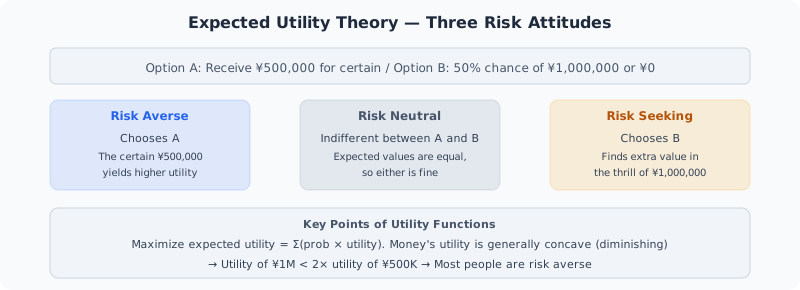
A lottery with 50% probability of ¥1,000,000 and 50% probability of ¥0 has an expected value of: ¥1,000,000 × 0.5 + ¥0 × 0.5 = ¥500,000
Asked to choose between this lottery and a certain ¥500,000, most people choose the certain ¥500,000. Why, if the expected value is identical?
Consider a more complex question: a lottery paying 50% probability of ¥2,000,000 and 50% of ¥0 (expected value ¥1,000,000) versus a certain ¥1,000,000. If asked “if you chose the lottery, what is the minimum guaranteed amount you’d accept to give it up?”, answers vary widely across individuals. Some wouldn’t trade even for ¥950,000; others might give up the lottery for ¥700,000.
The fact that different people evaluate alternatives with the same expected value differently cannot be explained by expected value alone.
The St. Petersburg Paradox
The problem that directly gave birth to expected utility theory is the St. Petersburg Paradox, presented in 1738 by Swiss mathematician Daniel Bernoulli.
The game: flip a coin repeatedly until it lands heads for the first time. If heads on the first flip, win ¥1; if first heads on the second flip, win ¥2; on the third flip, ¥4; on the n-th flip, ¥2^(n−1).
How much should a rational person pay to play this game?
Computing the expected value:
- First flip heads (probability 1/2): ¥1 × 1/2 = ¥0.50
- First heads on second flip (probability 1/4): ¥2 × 1/4 = ¥0.50
- First heads on third flip (probability 1/8): ¥4 × 1/8 = ¥0.50
- … continuing indefinitely
Total expected value = 0.50 + 0.50 + 0.50 + … = infinity
Therefore, a “rational agent” maximizing expected value should pay an infinite price to play. Yet in reality, no one would pay even a few hundred thousand yen.
Bernoulli proposed a resolution: evaluate not the prize itself (the monetary amount) but a quantity proportional to the logarithm of the utility derived from it. This was the prototype of expected utility theory.
Using a logarithmic utility function u(x) = log(x), the expected utility of the St. Petersburg game converges to a finite value, yielding a realistic admission fee (on the order of a few coins to a few hundred yen).
Bernoulli’s Utility Function and Diminishing Marginal Utility
The core of Bernoulli’s proposal is the law of diminishing marginal utility.
As wealth increases, the additional satisfaction (marginal utility) obtained from the same increment decreases.
Compare the increase in satisfaction from:
- Wealth rising from ¥0 to ¥10,000
- Wealth rising from ¥1,000,000 to ¥1,010,000
- Wealth rising from ¥100,000,000 to ¥100,010,000
Even though the increment is the same ¥10,000 in each case, the increase in satisfaction is greatest in the first case and smallest in the third.
This property — the utility function is concave — is the mathematical basis for risk-averse behavior.
With a concave utility function, the expected utility of an uncertain alternative (a lottery) is less than the utility of the certain alternative (receiving the expected value for sure). This is the behavioral pattern of a risk-averse individual.
Conversely, a person with a convex utility function is risk-seeking (preferring a lottery to a certain amount of equal expected value), and a person with a linear utility function is risk-neutral (deciding by expected value alone).
The Von Neumann-Morgenstern Axioms
The modern mathematical foundations of expected utility theory were provided by John von Neumann and Oskar Morgenstern in their 1944 book Theory of Games and Economic Behavior.
They proposed four axioms that “a rational decision-maker should satisfy”:
1. Completeness: For any two alternatives, either A is preferred to B, B is preferred to A, or the person is indifferent between them. There is no “incomparable” situation.
2. Transitivity: If A is preferred to B and B to C, then A is preferred to C. Preferences are consistent.
3. Continuity: If A is preferred to B and B is preferred to C, there exists a probability p such that a lottery pA + (1−p)C is indifferent to B.
4. Independence: Replacing part of either alternative with the same third alternative does not change the original preference ordering.
These four axioms imply that any preference relation satisfying them can be represented as “the expected value of a utility function” — this is the von Neumann-Morgenstern theorem (expected utility theorem).
Put the other way: a “rational decision-maker” who accepts these four axioms necessarily maximizes expected utility.
Risk Aversion and the Risk Premium
The most important application of expected utility theory is the quantitative analysis of risk aversion.
Risk premium: The difference between the expected value of an uncertain alternative and the amount this person is willing to give up to eliminate the uncertainty.
Example: a lottery with 50% probability of ¥1,000,000 and 50% of ¥0 (expected value ¥500,000). If a person is indifferent between this lottery and a certain ¥350,000, the risk premium is ¥500,000 − ¥350,000 = ¥150,000.
Certainty equivalent: The certain amount that is indifferent to an uncertain alternative (¥350,000 in the example above).
Economics uses two measures of risk aversion:
- Absolute risk aversion (ARA): −u”(x)/u’(x) (curvature of the utility function). Constant absolute risk aversion (CARA) when this does not change with wealth.
- Relative risk aversion (RRA): x × ARA. The proportion of risk tolerance relative to wealth.
These measures are used in portfolio theory, insurance design, and pension system design to optimize asset allocation.
The Rational Case for Insurance
Insurance is the most typical practical example of risk aversion, and expected utility theory explains why purchasing it can be rational.
Suppose the probability of a car accident is 1%, with repair and liability costs of ¥5,000,000 in the event of an accident. Expected annual loss: ¥50,000. If the annual premium is ¥70,000, purchasing insurance is “a ¥20,000 loss” in expected value terms.
Yet when there is a 1% chance of a sudden ¥5,000,000 loss, the utility impact of that ¥5,000,000 (collapse of one’s financial foundation, inability to repay loans) is far greater than the utility cost of the ¥70,000 premium.
From an expected utility perspective, paying a risk premium to avoid a large loss is rational. Insurance companies profit by pooling the risks of many customers, smoothing out individual risks.
The same logic explains:
- Preferring diversified investment (portfolios) over individual stock picks
- Preferring low-return, low-risk deposits over high-risk investments with potential for large losses
- Small businesses using hedging to smooth revenue volatility
The Allais Paradox and the Limits of Expected Utility Theory
Despite its power, expected utility theory was shown to conflict with actual human behavior by the “Allais Paradox” presented by Maurice Allais in 1952.
Problem A:
- Option A1: Receive ¥1,000,000 with certainty
- Option A2: 89% probability of ¥1,000,000, 10% probability of ¥5,000,000, 1% probability of ¥0 (expected value ¥1,390,000)
Problem B:
- Option B1: 11% probability of ¥1,000,000, 89% probability of ¥0 (expected value ¥110,000)
- Option B2: 10% probability of ¥5,000,000, 90% probability of ¥0 (expected value ¥500,000)
By expected utility theory (the independence axiom), someone who prefers A1 over A2 should prefer B1 over B2; someone who prefers A2 over A1 should prefer B2 over B1.
Yet experiments consistently show many people choosing A1 > A2 and B2 > B1 simultaneously. This violates the independence axiom.
The Allais Paradox reveals that people have a tendency to overweight “certainty” (a change from 1% to 0%) — the “certainty effect.” This cannot be explained by expected utility theory.
Other phenomena that expected utility theory struggles to explain:
Ellsberg Paradox: When probabilities are known (risk) versus unknown (uncertainty), human preferences are inconsistent — people tend to avoid ambiguity in a way the theory doesn’t predict.
Overweighting of small probabilities: Buying lottery tickets (probability of winning: 1 in 10,000,000) is hard to rationalize under expected utility maximization. This is explained by prospect theory’s probability weighting function.
Applications of Expected Utility Theory
Despite its theoretical limits, expected utility theory is used across many practical fields.
Portfolio theory: Markowitz’s mean-variance approach optimizes the trade-off between expected return and risk (variance), building on investor risk aversion. Selecting a portfolio on the efficient frontier is the problem of maximizing the investor’s utility function.
Actuarial science: Setting insurance premiums, pricing risk transfers, and designing reinsurance combine expected utility theory with statistical risk models.
Policy evaluation: Designing regulatory changes, infrastructure investments, and social security systems employs social welfare functions based on expected utility theory, accounting for the different marginal utilities of different income groups.
Decision analysis: Investment decisions, R&D strategy, and M&A valuations in business use “decision analysis” — a combination of decision trees and expected utility.
Summary
This article explained Expected Utility Theory. We hope it was useful.
Expected utility theory is a normative theory showing “how a rational decision-maker should choose under uncertainty” — the foundation of finance, insurance, and policy design.
“Consider not just the expected value but also the subjective satisfaction (utility) of outcomes” — this insight enables more realistic decision-making in insurance, investment, and personal finance. The limits revealed by the Allais Paradox also serve as the starting point for the more advanced research of prospect theory and behavioral economics.
To return to the framework list and game theory overview, see the links below.
Thank you for reading. We hope to see you in the next article.

Also popular with readers
📚 Series: Strategic Thinking Frameworks (12/16)