Thank you for visiting this site. This article explains Prospect Theory.
A decision theory published in 1979 by psychologists Daniel Kahneman and Amos Tversky, it systematically explains the actual patterns of human choice that rational expected utility theory cannot account for. Kahneman received the Nobel Prize in Economics in 2002 (Tversky had passed away before the award and was therefore ineligible).
Background and Origins
Prospect theory was born from doubts about expected utility theory.

Expected utility theory is a normative theory — “a rational decision-maker will behave in ways that satisfy four axioms (completeness, transitivity, continuity, independence)” — but experimental evidence beginning with the Allais Paradox (1952) showed systematic discrepancies from actual human choices.
Through a series of psychology experiments in the 1970s, Kahneman and Tversky demonstrated that these discrepancies were not random errors but arose from systematic cognitive biases. Their 1979 paper “Prospect Theory: An Analysis of Decision under Risk” is one of the most-cited papers in the history of economics.
In 1992, they refined the theory into Cumulative Prospect Theory, extending it to explain a broader class of decision-making phenomena.
Three Features of the Value Function
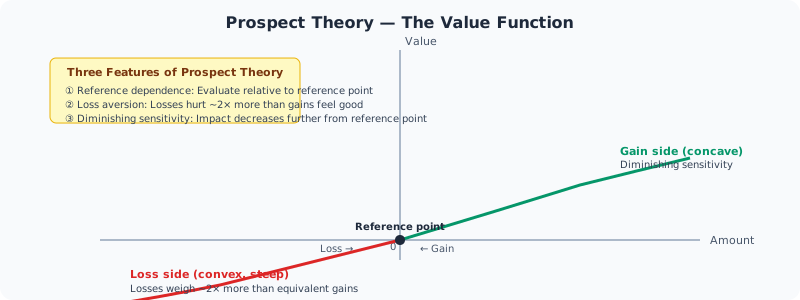
The heart of prospect theory is the value function — a concept that replaces the traditional utility function. It has three key features.
1. Reference Dependence
Humans evaluate outcomes not in absolute terms, but as gains or losses relative to a reference point.
A reference point is a context-dependent baseline — typically the current state, an expected level, yesterday’s price, or a comparison with others.
Concrete example: Person A’s annual salary rose from ¥5,000,000 to ¥5,500,000. Person B’s annual salary fell from ¥6,000,000 to ¥5,500,000. Objectively both earn ¥5,500,000, but A feels happy while B feels dissatisfied — because their reference points differ.
Reference points are not fixed; they change with time, context, and how information is presented. This is the basis of the framing effect.
2. Loss Aversion
The psychological impact of a loss is approximately 2 to 2.5 times greater than the equivalent gain, as shown in many experiments.
The pain of “losing ¥10,000” is greater than the pleasure of “gaining ¥10,000.”
Kahneman and Tversky’s experiments used these choice problems:
Problem 1: Compare a 50% probability of gaining ¥10,000 and 50% of nothing (expected value ¥5,000) versus a certain ¥5,000. Most people choose the certain ¥5,000 (risk aversion).
Problem 2: Compare a 50% probability of losing ¥10,000 and 50% of losing nothing (expected value −¥5,000) versus a certain loss of ¥5,000. Now most people choose the “gamble” (50% chance of losing ¥10,000) — risk seeking.
The asymmetry — risk-averse in the gain domain, risk-seeking in the loss domain — cannot be explained by expected utility theory. Prospect theory explains it through the shape of the value function (concave for gains, convex for losses).
Loss aversion explains many economic behaviors:
- Investors who cannot “cut losses” on underwater positions (strong resistance to realizing a loss)
- Golf putting success rates being higher for bogey-avoidance putts than birdie putts (loss aversion drives harder focus on avoiding bogey)
- Status quo bias (change feels like a “loss,” so people avoid it)
- The endowment effect: the pain of giving up something already owned exceeds the pleasure of acquiring it
3. Diminishing Sensitivity
Both for gains and losses, the psychological impact of each additional unit diminishes as the outcome moves further from the reference point.
Going from ¥10,000 to ¥20,000 feels large, but going from ¥1,000,000 to ¥1,010,000 feels small. This mirrors the Weber-Fechner law of psychophysics relating physical magnitude to perceived sensation.
The same applies to losses. The pain of losing ¥10,000 is large, but after already losing ¥990,000, the additional pain of losing another ¥10,000 is smaller.
This diminishing sensitivity generates risk-seeking behavior in the loss domain. When already facing a large loss, people tend to prefer risky options (“maybe I can recover”) — even if those options could make things worse. This is the psychological explanation for speculative behavior and “all-or-nothing” bets.
The Probability Weighting Function
Prospect theory expresses how people transform objective probabilities into subjective weights using the probability weighting function.
Key features:
Overweighting small probabilities: A 0.1% probability feels more like 1%; a 1% probability feels more like 3–5%. This explains buying lottery tickets (overweighting the tiny winning chance) and excessive insurance against extremely rare disasters.
Underweighting large probabilities: A 95% probability feels more like 90%; a 90% probability feels more like 80%. Even “nearly certain” outcomes carry a residual uncertainty that feels larger than it is.
Special treatment of 0% and 100% (the certainty effect): Absolute zero (impossible) and 100% (certain) are overweighted. The psychological shift from 99% to 100% is greater than from 50% to 51%. This explains the Allais Paradox’s “certainty effect.”
Resulting behavioral patterns from probability weighting:
| Probability size | Gains | Losses |
|---|---|---|
| Small probability | Risk seeking (buying lottery tickets) | Risk avoiding (insurance against small losses) |
| Large probability | Risk avoiding (choosing the certain gain) | Risk seeking (taking a chance to avoid a large certain loss) |
The Asian Disease Problem and the Framing Effect
The most famous experiment in prospect theory is Kahneman and Tversky’s Asian Disease Problem.
Setup: An unusual disease originating in Asia is expected to kill 600 people. Two alternative programs to combat the disease have been proposed.
Positive frame (lives saved):
- Option A: 200 people will be saved with certainty
- Option B: 1/3 probability that all 600 people will be saved, 2/3 probability that no one will be saved
Negative frame (lives lost):
- Option C: 400 people will certainly die
- Option D: 1/3 probability that no one will die, 2/3 probability that all 600 people will die
Objectively, A = C (200 survive, 400 die, for certain) and B = D (identical probability distribution). The problems are completely identical.
Yet experimental results show:
- Presented in the positive frame: 72% choose Option A (the certain saving)
- Presented in the negative frame: 78% choose Option D (the chance that everyone survives)
Presenting identical content as “gains” versus “losses” reverses people’s choices. This is one of the most powerful demonstrations of the framing effect.
Practical Applications
Prospect theory can be applied in many practical contexts.
Pricing and framing:
“A ¥1,000 discount” has greater perceived impact than “a ¥1,000 increase” (because losses feel stronger than gains). Conversely, framing price increases as small and discounts as large is effective.
Credit card fees are often displayed as “a surcharge for card payment” rather than “a discount for cash payment” — the former is perceived as a loss by consumers, generating stronger resistance.
Describing a ¥980/month subscription as “about ¥32 per day” changes the reference point, reducing the sense of loss.
Negotiation strategy:
Being aware of the other party’s reference point is crucial. If the other party perceives they are gaining something additional while keeping the status quo, a gain frame is more acceptable. Conversely, if they are already aware of a potential loss, the loss-avoidance frame — “this deal prevents that loss” — can be effective.
Managing investment behavior:
Loss aversion causes investors to hold losing positions (avoiding realizing a loss). A practical remedy is shifting the reference point: evaluate from “the current price” rather than “the purchase price.” Evaluating the whole portfolio’s profit/loss (rather than individual positions) also reduces emotional attachment to specific holdings.
Policy design:
Framing can be “a penalty for non-compliance” or “forfeiture of a discount” — the latter can be more effective at changing behavior. Environmental taxes framed as “unapplied green discounts” may be more acceptable than “carbon taxes.”
Limitations of Prospect Theory
Prospect theory describes human behavior well as a descriptive theory, but it has limitations.
Indeterminacy of the reference point: Because reference points change with context, predicting which reference point will be used is difficult.
Aggregation problem: It is not clear how to aggregate an individual decision theory to market-wide or group-level behavior.
Does not provide normative guidance: Prospect theory describes “how humans behave” but does not say “how they should behave.” Improving decisions requires combining it with expected utility theory.
Summary
This article explained Prospect Theory. We hope it was useful.
Prospect theory systematically describes actual human decision-making patterns while experimentally refuting the economic assumption of “rational agents.”
Reference dependence, loss aversion, diminishing sensitivity, and probability weighting — these four elements explain diverse behavioral phenomena — the inability to cut investment losses, lottery ticket purchases, framing effects, and status quo bias — within a single framework.
Developing the habit of asking whether your decision-making is being distorted by prospect theory patterns is the first step toward more rational judgment.
To return to the framework list and game theory overview, see the links below.
Thank you for reading. We hope to see you in the next article.


Also popular with readers
📚 Series: Strategic Thinking Frameworks (13/16)