Thank you for visiting this site. This article explains Nudge Theory.
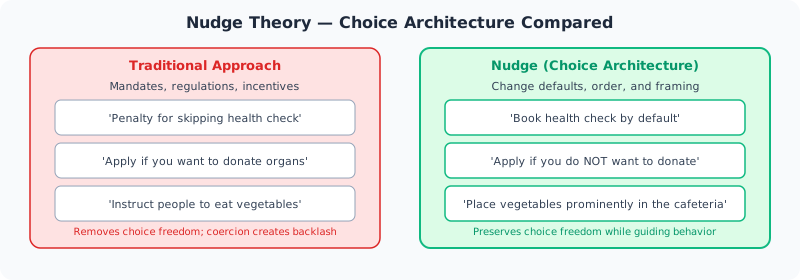
A “nudge” means a gentle push with the elbow. In policy and design, it refers to an approach that steers people toward better choices by designing the context of choice — without coercion or financial incentives.
The Birth and Background of Nudge Theory
Nudge theory is a practical framework for applying behavioral economics insights to policy and institutional design. It was systematically proposed in 2008 by economist Richard Thaler and legal scholar Cass Sunstein in their book Nudge: Improving Decisions About Health, Wealth, and Happiness.
Thaler received the Nobel Prize in Economics in 2017. The selection committee recognized him for “incorporating psychologically realistic assumptions into analyses of economic decision-making.”
The backdrop for nudge theory was a demand for “more flexible and cost-effective policy tools than rational regulation and taxation.” Traditional policy instruments (laws, penalties, subsidies, taxes) are coercive and expensive, so nudges — which can produce behavior change merely by thoughtfully designing the choice context — attracted attention as an appealing alternative.
Libertarian Paternalism
Nudge is grounded in the concept of libertarian paternalism.
- Libertarian side: What a person ultimately chooses is their freedom. No options are eliminated, and no choice is penalized.
- Paternalist side: The choice environment is structured to help people make better decisions.
“Design an environment in which people can make better judgments for themselves — without removing their choices.”
This is a middle position: neither purely utilitarian (outcomes matter, so we intervene) nor fully libertarian (people are perfectly rational, so leave them alone). It holds that “humans are not fully rational, but their autonomy deserves respect.”
Choice Architecture
The central concept of nudge is choice architecture.
How people choose is heavily influenced by how choices are presented. The design of this “presentation method, context, and environment” is called choice architecture.
The important point is that choice architecture is always present. The order of options, default settings, and format of information presentation — all of these are designed by someone and influence behavior whether intentionally or not. Nudge theory holds that if this influence is unavoidable, it should be designed consciously for good outcomes.
Main elements of choice architecture:
1. Defaults: The option that applies if no active choice is made.
2. Order and layout of options: What appears first or is easiest to reach tends to be selected more often.
3. Framing: Presenting identical content in different ways changes how it is evaluated.
4. Simplification and visualization of information: Presenting complex information clearly promotes better judgment.
5. Social comparison and social norms: Providing information about others’ behavior (“90% of your neighbors have switched to energy-saving settings”).
6. Commitment devices: Options that bind your future self (automatic savings deductions, etc.).
Empirical Examples of the Default Effect
The most powerful tool in choice architecture is the default effect. Due to status quo bias, loss aversion, and limited attention in behavioral economics, most people tend not to change default settings.
Organ donation consent rates: Dramatic differences arising from default settings have been empirically documented.
Johnson and Goldstein’s 2003 study compared organ donation consent rates across European countries.
- Opt-in countries (default: do not donate): Germany 12%, Netherlands 28%, UK 17%
- Opt-out countries (default: donate): Austria 99%, France 99.9%, Hungary 99.9%
The policy content (everyone may freely choose) is identical, but the default setting changes consent rates from 10–20% to over 99% — a striking difference.
Green electricity plans at utility companies: In US utility company nudge experiments, simply changing the default from “standard electricity” to “green electricity (renewable energy)” raised green electricity enrollment rates from a few percent to 60–80%.
Retirement Savings and Auto-Enrollment
Improving enrollment in US employer-sponsored retirement plans (401k) is one of nudge’s most successful applications.
Thaler and Shlomo Benartzi’s Save More Tomorrow (SMarT) program:
- Ask employees in advance to agree to “automatically direct a fixed percentage of future raises to retirement savings”
- Start small, with the savings rate automatically increasing with each raise
- Participants can opt out or change at any time
Empirical results from companies that implemented this program show average savings rates rising from 3.5% to 11.6%. The design — combining hyperbolic discounting (starting in the future means no sense of sacrifice today) with automation (lowering behavioral costs) — achieves this without coercion.
Similarly, changing pension defaults to “everyone is automatically enrolled; those who want to opt out must apply” has substantially increased enrollment rates at many companies and in many countries.
Social Comparison and Norm Nudges
A social norms nudge promotes behavior change by presenting information about others’ behavior.
Opower (now Oracle Utilities Analytics) electricity conservation nudge: Simply displaying “your energy use compared to similar nearby households” on electricity bills produced measurable reductions in energy consumption (averaging 2–3%) across many households. No penalties or incentives — just comparison information.
The message “75% of residents in your area are cooperating with water conservation” increases water-saving behavior. It exploits the human psychology of feeling uncomfortable when deviating from social norms (conformity to social norms).
However, social comparison can unintentionally reinforce norms of bad behavior. “More than 85% of taxpayers in your area have already filed on time” promotes on-time filing, but the implied “15% have not” could be interpreted in ways that inadvertently normalize non-compliance.
Physical Environment Nudges
Nudges can be applied not just to how choices are presented but to the design of physical environments.
School cafeteria experiments: Research by Brian Wansink and colleagues at Cornell University found that simply placing salad bars near the entrance and moving desserts farther away increased vegetable consumption in school cafeterias. A New York City school experiment reportedly increased milk consumption by 18% by placing milk at the front of refrigerators.
Staircase use in offices: Placing “use the stairs for your health” signage at the staircase entrance rather than by the elevator is more effective — it addresses the behavioral timing problem of “being reminded at the elevator when it’s already too late to turn back.”
Plate and portion size effects: Research shows that changing the size of plates, spoons, and portion containers changes how much people eat (unconscious food quantity control).
The Behavioural Insights Team (BIT)
The most organized institutional application of nudge theory is the UK government’s Behavioural Insights Team (BIT).
Established in 2010, BIT — also called the “nudge unit” — runs experiments and evaluations applying behavioral economics insights to government policy. Major achievements:
Tax filing improvement: Simply adding “more than 80% of people in your tax area have already filed” to reminder notices improved filing rates among late filers.
Increased charitable giving: Changing “please write your donation amount” to “choose between £10, £25, or £50, or write your own amount” increased the average donation.
Reduced missed medical appointments: Changing from “please call if you need to cancel your appointment” to “can you keep today’s appointment? (yes/no)” reduced cancellation rates.
BIT now has independent offices in Australia, Singapore, New York City, and elsewhere, leading the application of behavioral economics to policy.
UI Design and Dark Patterns
Nudge thinking is widely applied to digital product UI design.
Examples of good nudge UI design:
- Password strength meters to improve security
- Smartphone screen time notifications for self-regulation
- “Goal” features in savings apps to encourage purposeful saving
However, nudges can also be misused by companies to steer consumers toward choices that benefit the company. This is called a dark pattern.
Examples of dark patterns:
- Intentionally hiding the subscription cancellation button in an obscure location
- Setting “recurring subscription” as the default, making “one-time purchase” hard to find
- Making the “agree” button prominent (large font, bright color) while making “decline” small and faded
- Deliberately complicating the cancellation flow
The EU’s GDPR and US FTC regulations have begun regulating these dark patterns, and societal scrutiny of how nudges are used is intensifying.
Criticisms and Ethical Issues
Nudge theory has attracted the following criticisms.
The paternalism problem: Who decides what the “desired behavior” is? What a designer judges to be “good” is not necessarily good from the perspective of the person being nudged. Defining “desirable” in a society with diverse values is particularly challenging.
Lack of transparency: There are ethical concerns about steering behavior in ways people are not aware of. Nudges work precisely because they are difficult to notice, creating a trade-off between transparency and effectiveness.
Threat to autonomy: Even a “gentle push” raises concerns about eroding the autonomy of decision-making.
Ethical standards for nudge use, as proposed by Thaler and Sunstein themselves: use nudges for the benefit of those being nudged, not the designer; be transparent (disclose that nudging is occurring); and leave freedom of choice fully intact.
Summary
This article explained Nudge Theory. We hope it was useful.
Nudge is a practical framework applying behavioral economics insights to institutional and environmental design. The insight that “what appears to be a small design choice — what to set as the default — produces large differences in behavior” is broadly applicable to policy-making, organizational design, and UI/UX design.
At the same time, the ethical question of “whose nudge is this for?” always deserves attention. The perspective of asking “is my behavior truly my own will, or am I being steered by design?” is also valuable for rational decision-making.
To return to the framework list and game theory overview, see the links below.
Thank you for reading. We hope to see you in the next article.
Also popular with readers
📚 Series: Strategic Thinking Frameworks (10/16)