Thank you for visiting this site. This article explains Information Asymmetry.
A state in which the parties to a transaction hold different amounts of information is called information asymmetry. When one party knows more than the other, markets stop functioning efficiently. George Akerlof, Michael Spence, and Joseph Stiglitz received the Nobel Prize in Economics in 2001 for their contributions to the economics of information.
What Is Information Asymmetry?
Standard economic models assume that all market participants have complete information (knowledge of all relevant facts). In reality, information gaps (asymmetries) exist between parties in transactions.
Typical situations where information asymmetry arises:
Quality information about goods or services: Only the seller knows whether a used car is good or defective. Only a doctor knows the quality of medical services being provided.
Agent behavior and effort: An employer cannot observe whether an employee is truly working hard. An insurer cannot observe an insured person’s behavior after the policy is issued.
Personal characteristics and attributes: An employer cannot observe a job candidate’s true ability. Only the applicant knows their own health risk when applying for insurance.
When information asymmetry exists, markets become unfair to the less-informed party, ultimately reducing overall market efficiency. Akerlof and his colleagues’ contribution was to systematically explain these market failure mechanisms.
The Lemons Market
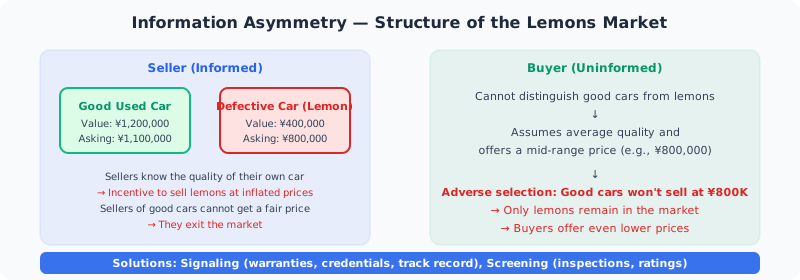
Akerlof’s 1970 paper “The Market for Lemons” explained, using the used-car market as an example, the mechanism by which information asymmetry destroys markets.
In American slang, a defective product is called a “lemon” (looks fine on the outside but sour inside). Good used cars are called “peaches” and defective ones “lemons.”
Information asymmetry in the used-car market:
- Seller: knows whether their car is a peach or a lemon
- Buyer: cannot tell from appearance
The market collapse mechanism (adverse selection spiral):
- Because buyers cannot distinguish peaches from lemons, they will only pay a price reflecting average quality (say, $7,000)
- Owners of peaches (who know their car is worth more) find $7,000 insufficient and exit the market
- Only lemons remain, further lowering average quality
- Buyers offer only a lower price (say, $5,000)
- Owners of the better remaining cars also exit
- The market becomes filled with lemons or collapses entirely
This “adverse selection” mechanism is found not just in used-car markets but broadly across markets with information asymmetry: health insurance, life insurance, labor markets, financial markets, online retail, and peer-to-peer lending.
Akerlof’s paper was initially rejected by three journals. One reason given was: “If this theory is correct, the used-car market should not exist, but it does.” This actually points to the fact that real markets generate institutions (warranties, inspections, regulations) to overcome information asymmetry — which later spawned the research on “solutions to information asymmetry.”
Adverse Selection in Detail
Adverse selection is the phenomenon in which information asymmetry causes unfavorable counterparties (high-risk parties) to self-select into transactions.
Adverse selection in health insurance:
When insurers cannot charge risk-differentiated premiums (e.g., due to regulations requiring uniform premiums regardless of risk), people in poor health are more eager to enroll than healthy people.
As the average health risk in the insured pool rises, insurers raise premiums. Higher premiums cause healthy people to cancel, leaving only the sicker enrollees. This vicious cycle is the “adverse selection spiral.”
This adverse selection problem was one reason many Americans were unable to obtain insurance before the Affordable Care Act in 2010.
Adverse selection in financial markets:
When banks cannot accurately assess borrowers’ credit risk, setting high interest rates causes low-risk borrowers (who could get better terms elsewhere) to drop out, leaving only high-risk borrowers (willing to pay high rates). This is adverse selection in credit markets.
Collateral requirements, credit scores, and track-record reviews are the screening mechanisms banks use to avoid adverse selection.
Moral Hazard
Moral hazard is a problem that arises after a transaction when information asymmetry prevents one party from observing or controlling the other’s actions. It is positioned as a post-transaction problem, in contrast to pre-transaction adverse selection.
Moral hazard in insurance:
After purchasing auto insurance, knowing that “accidents are covered by insurance” may lead a driver to take more risks than they would uninsured. Because the insurer cannot monitor each driver’s behavior, this problem arises.
Similarly:
- With comprehensive health insurance, overuse of medical services and reduced cost consciousness can occur
- Employees receiving a salary may shirk when out of their employer’s sight
- A bank judged “too big to fail” may take on excessive risk
Too Big to Fail and moral hazard:
In the 2008 financial crisis, major financial institutions were criticized for taking excessive risks under the implicit guarantee (Too Big to Fail) that the government would not let them fail. This is a classic case of an implicit government guarantee creating moral hazard.
The Principal-Agent Problem
The principal-agent problem is an important special case of moral hazard.
When a principal (the party in charge) delegates work to an agent (the representative), the problem arises because the principal cannot fully observe the agent’s actions or effort.
Shareholders and executives (the classic example): Shareholders (principals) want executives (agents) to maximize firm value. But executives may, out of sight of shareholders, prioritize their own position, compensation, prestige, or comfortable working conditions.
Doctors and patients: Patients (principals) want doctors (agents) to recommend the best treatment for their health. But doctors may recommend excessive tests and procedures for financial gain (overtreatment problem).
Politicians and citizens: Citizens (principals) want politicians (agents) to represent the interests of the whole population, but politicians may prioritize re-election, personal gain, or the interests of their supporters.
Solutions include mechanism design (aligning incentives), monitoring, reputation systems, and competitive pressure on agents. Stock compensation and stock options are examples of incentive design that aligns executives’ interests with shareholders’.
Signaling Theory
One solution to information asymmetry is signaling, proposed by Michael Spence (part of the 2001 Nobel Prize research).
The informed party (seller, worker, insurance applicant) sends signals to the uninformed party (buyer, employer, insurer) indicating their quality, ability, or risk level.
For a signal to work, it must be cheap for high-quality parties and costly for low-quality parties. This asymmetric cost means that low-quality parties find it unprofitable to imitate the signal, making the signal credible as information.
University education and signaling:
The classic example Spence analyzed is the university degree. Even if the content learned at university is not directly used in the workplace, the cost of obtaining a degree (time, money, effort, opportunity cost) is relatively lower for high-ability individuals (who can achieve outcomes with the same learning effort more easily).
Therefore, the fact of having obtained a degree functions as a signal that “this person has high ability.” Because the cost of obtaining a degree is too high for low-ability individuals, degrees function as a reasonably reliable signal.
Other signaling examples:
- Warranties: Only companies confident their products last long can afford long warranties
- Brand advertising investment: Only brands confident in their quality can invest heavily in advertising (low quality means no repeat customers and no return on investment)
- Certifications and credentials: Credentials with high acquisition costs signal ability
- Disclosure of track records: Past results can be transparently disclosed only when they are good
- IPO underpricing: Only companies confident in their future prospects can afford to IPO at a low price and gain as the stock price rises later
Screening
Conversely, when the less-informed party (buyer, employer, insurer) actively elicits information, this is screening. Stiglitz made important contributions through his analysis of insurance markets.
The principle of screening is “designing a self-selection menu.” It presents the informed party with “choices that make it rational to voluntarily reveal their true type.”
Insurance screening example:
Offer a plan with “high deductible, low premium” suited to low-risk customers alongside a plan with “low deductible, high premium” suited to high-risk customers.
Low-risk individuals rarely use insurance, so they can tolerate a high deductible and prefer the low premium. High-risk individuals are more likely to use insurance, so they prefer the low deductible even at a higher premium.
This self-selection separates customers by risk level (separating equilibrium), allowing the insurer to achieve a degree of risk identification.
Screening in employment:
Probationary periods and internships are screening mechanisms where employers directly observe ability. Setting probationary periods may encourage high-ability candidates to accept (“I can demonstrate my ability during the probation”) while deterring low-ability candidates (who fear being exposed during the probation) — though this does not work perfectly.
Market-Based Solutions to Information Asymmetry
The information asymmetry problem often leads markets to spontaneously generate solutions.
Reputation systems and reviews: Amazon reviews, Airbnb’s mutual rating system, and TripAdvisor hotel ratings mitigate information asymmetry through third-party evaluation. Accumulating and publishing past transaction information enables quality assessment of future transaction partners.
Warranties and trials: “One month free trial” and “30-day return guarantee” eliminate quality uncertainty.
Certification and licensing systems: Medical licenses, bar admissions, food safety inspections, and ISO certifications are signals where a third party has pre-screened quality.
Intermediaries and platforms: Real estate agents, recruitment agencies, insurance brokers, and freelance marketplaces are intermediaries whose core business model centers on information asymmetry.
Repeated transactions and relational capital: Long-term trading relationships mitigate information asymmetry problems more than one-shot transactions. The repeated-game logic of “betrayal ends the relationship” promotes honest behavior.
Government Regulation and Information Asymmetry
When market-based solutions alone are insufficient, government regulation addresses information asymmetry.
Disclosure regulations: Mandatory food ingredient labels, financial product prospectuses, and environmental impact assessments mitigate information asymmetry through disclosure requirements.
Minimum standards regulations: Food safety standards, building codes, and auto safety standards prevent the “lemons market” problem by setting quality floors.
Mandatory insurance: Compulsory auto liability insurance resolves the adverse selection problem (only healthy people buy insurance) by requiring universal enrollment.
Licensing for professionals: Because users find it difficult to evaluate the quality of professional services in advance, national licensing systems that certify minimum standards address information asymmetry for doctors, lawyers, and similar professions.
Summary
This article explained Information Asymmetry. We hope it was useful.
Information asymmetry is a fundamental problem lurking in every type of transaction: buying and selling, employment, insurance, finance, and healthcare. The four phenomena of lemons markets, adverse selection, moral hazard, and the principal-agent problem all arise from the asymmetric information structure of “one party knowing more than the other.”
“What does the other party know that I don’t, and what should I communicate to them?” — being mindful of this question is an indispensable perspective in transactions, negotiations, and institutional design. Signaling and screening are practical tools for closing that information gap.
To return to the framework list and game theory overview, see the links below.
Thank you for reading. We hope to see you in the next article.

Also popular with readers
📚 Series: Strategic Thinking Frameworks (9/16)