Thank you for visiting this site. This article explains Pareto Efficiency (Pareto Optimality).
A state in which it is impossible to make at least one person better off without making anyone else worse off is called Pareto efficiency (or Pareto optimality). The concept was proposed by nineteenth-century Italian economist Vilfredo Pareto. It is a foundational concept in game theory, welfare economics, negotiation theory, and resource allocation theory.
Vilfredo Pareto and His Contributions to Economics
Vilfredo Pareto (1848–1923) was an Italian-born economist and sociologist. One of the pioneers who brought mathematical rigor to economics, he was a leading figure in the Lausanne School (the tradition of general equilibrium theory).
Beyond economics, Pareto is known for the “80/20 rule (Pareto principle).” Derived from the observation that 80% of Italy’s land was owned by 20% of the population, this empirical pattern has wide applicability: “80% of revenue comes from the top 20% of customers,” “80% of defects stem from the top 20% of causes,” and so on.
Pareto efficiency (Pareto optimality) was proposed as a rigorous standard for discussing economic “efficiency” while avoiding the problematic assumption used by Marshall and others that compared utility across different individuals (comparing satisfaction levels across people).
Pareto Improvement and Pareto Optimality
First, let us clarify the terminology.
Pareto Improvement: A change from one state to another in which no one is made worse off and at least one person is made better off. This includes cases where everyone improves simultaneously.
Pareto Optimality (Pareto Efficiency): A state in which no further Pareto improvement is possible. In the sense that making anyone better off necessarily makes someone else worse off, it is an efficient state in which resources are allocated without waste.
Pareto Dominance: State A Pareto-dominates state B when A is “at least as good for every individual and strictly better for at least one.”
Intuitively: “A Pareto-inefficient state still contains room for everyone to become better off.”
Numerical example: Suppose person A has 10 apples and person B has 5 oranges. If both want some of what the other has, exchanging some of each gives both a gain (Pareto improvement). The state after exchange where “no further exchange can benefit one without harming the other” is Pareto optimal.
The Pareto Frontier
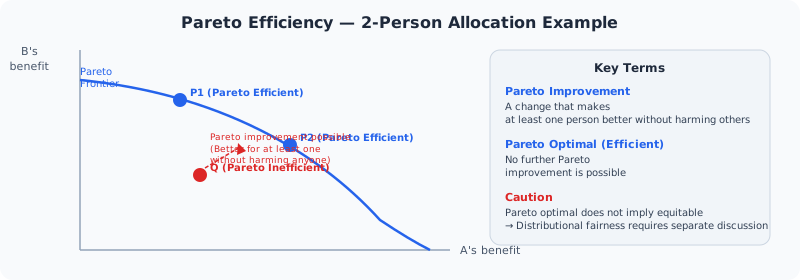
Plotting two individuals’ payoffs on the x- and y-axes, the set of Pareto-optimal allocations traces out a curve called the Pareto Frontier (Efficient Frontier).
Properties of the frontier:
Every point on the frontier has “no room for Pareto improvement.” Moving from one frontier point to another necessarily reduces one person’s payoff.
Points inside the frontier are “Pareto inefficient” — there is still room for both to improve.
Points outside the frontier (beyond the curve) are unachievable — given resource constraints, everyone cannot simultaneously reach that level.
Concave frontier:
Resource allocation Pareto frontiers are typically concave (bow-shaped outward). This reflects the fact that the “exchange rate” between A’s gain and B’s loss is not constant — the more resources are allocated to A, the worse the per-unit trade-off becomes (diminishing marginal utility).
Being aware of the Pareto frontier in negotiations helps distinguish between “deals that benefit both parties” (moving toward the frontier) and “zero-sum negotiation” (moving along the frontier).
The Prisoner’s Dilemma and Pareto Efficiency
The Prisoner’s Dilemma is the classic example of the divergence between game-theoretic equilibrium and Pareto efficiency.
Payoff table for the Prisoner’s Dilemma:
| Opponent: Cooperate | Opponent: Defect | |
|---|---|---|
| You: Cooperate | (3, 3) — light punishment for both | (0, 5) — only you get heavy punishment |
| You: Defect | (5, 0) — only opponent gets heavy punishment | (1, 1) — moderate punishment for both |
The Nash equilibrium is (Defect, Defect), giving both a payoff of (1, 1).
But (Cooperate, Cooperate) at (3, 3) is a better outcome for both. The change from (Defect, Defect) to (Cooperate, Cooperate) is a Pareto improvement — no one is harmed and both gain.
In other words, the Nash equilibrium (mutual defection) is Pareto-inefficient.

Individual rational choice (Nash equilibrium) does not necessarily achieve overall efficiency (Pareto optimality).
This principle extends beyond the Prisoner’s Dilemma to many “social dilemmas”: arms races (mutual disarmament would lower costs for both sides), price wars (intensifying price competition lowers industry-wide profits), and traffic congestion (if everyone used public transit, everyone’s travel time would fall).
The Fundamental Theorems of Welfare Economics
Pareto efficiency is closely tied to the Fundamental Theorems of Welfare Economics.
First Theorem (Invisible Hand Theorem): Under conditions of perfect competition (no information asymmetry, no externalities, no public goods), the competitive market equilibrium is Pareto efficient.
This is the mathematical expression of Adam Smith’s “invisible hand.” The proposition that each person pursuing their own interests in the market leads to an efficient allocation of resources across the whole economy.
Second Theorem: Under perfect competition, any Pareto-efficient resource allocation can be achieved through a redistribution of initial endowments (lump-sum taxes or subsidies) combined with market operation.
This shows that “efficiency” and “fairness” problems can be separated. The policy implication is: adjust “which efficient allocation to choose” (a fairness question) through redistribution, and leave “achieving efficiency” to the market.
However, the conditions for both theorems (perfect competition, symmetric information, no externalities) often fail in reality, and market failures (monopoly, externalities, public goods, information asymmetry) generate inefficient resource allocations.
The Kaldor-Hicks Criterion
The requirement of pure Pareto improvement (no one made worse off) is too strict for real-world policy evaluation. Most policies benefit some people while imposing costs on others.
To address this, economics uses the Kaldor-Hicks Criterion.
Content: If, after a policy change, the winners could compensate the losers and still retain net gains (a “potential Pareto improvement”), the policy is considered desirable (Kaldor-Hicks efficient).
The key point is that “compensation need not actually be paid.” Unlike pure Pareto improvement, if “winners’ gains > losers’ losses,” the Kaldor-Hicks criterion counts it as an improvement.
Use cases:
- Infrastructure (dams, highways): benefits to many vs. costs to those displaced
- Trade liberalization: benefits to export industries vs. losses to competing domestic industries
- Environmental regulation: benefits to future generations and the environment vs. costs to current industry
Under the Kaldor-Hicks criterion, cost-benefit analysis (CBA) is the main tool — converting both gains and losses to monetary terms for comparison.
Limitation: It ignores distributional questions — who gains and who bears the costs. Since it is not a pure Pareto improvement, it may classify unfair outcomes as “efficient” when compensation is not actually paid.
Efficiency vs. Fairness
Pareto efficiency is a criterion for “efficiency,” and it is distinct from “fairness.”
The simplest example: allocating all ¥10 million to person A while person B receives nothing is also Pareto efficient (there is no way to improve B’s situation without worsening A’s). Yet this is intuitively unfair.
Pareto efficiency is useful for “eliminating waste” but does not answer “how to distribute.” Distributional questions require separate value judgments.
Major fairness criteria:
Utilitarianism: Maximizes the total sum of all individuals’ utility (satisfaction). Proposed by Bentham and Mill. Every individual’s utility is weighted equally; the goal is the greatest happiness for the greatest number. Income redistribution from high-income to low-income individuals can be justified utilitarian-wise by diminishing marginal utility (an extra ¥10,000 adds less utility to a high-income person than to a low-income person).
Rawls’ theory of justice: John Rawls argued that a just social institution is one that rational people behind a “veil of ignorance” (not knowing their social position) would choose. This leads to the “maximin principle” (maximize the welfare of the worst-off). The difference principle (social and economic inequalities are permissible only if they benefit the least advantaged) also follows.
Egalitarianism: Emphasizes equality of outcomes or equality of opportunity. Strong forms aim for identical outcomes for all; weak forms require only equal opportunity.
“Which Pareto-efficient allocation to choose” is a fairness question — efficiency and fairness are independent value judgments.
Real-World Applications
Negotiation and transactions:
When negotiations stall, asking “is there any change that improves my position without harming the other party?” is Pareto improvement thinking. Value-creating negotiation — beneficial to both parties — means moving a Pareto-inefficient negotiation toward the frontier.
Example: In salary negotiations, a change of “increase monthly salary by ¥50,000 and eliminate overtime pay” may be a Pareto improvement if it benefits the employee (similar total income but more predictable compensation) and the employer (reduced overtime management costs).
Resource allocation and policy evaluation:
When evaluating regulatory changes, tax reforms, or public works, “is it a Pareto improvement?” is a minimum justification standard for policies. Pure Pareto improvements (no one worse off) cannot be opposed by anyone, but real policies almost always make someone worse off, so the Kaldor-Hicks criterion (is it a Pareto improvement after compensation?) is applied.
Investment portfolios:
In investment, a portfolio with higher expected return for the same risk, or lower risk for the same return, is considered “Pareto dominant.” Markowitz’s mean-variance frontier (efficient frontier) is the Pareto frontier in two dimensions of investment return and risk. Portfolios on the frontier are Pareto efficient; portfolios inside the frontier have room for improvement.
Organizational design:
In team task allocation, asking “is there a reassignment that makes at least one person better off without making anyone worse off?” applies Pareto improvement thinking to organizations. Job specialization and skill-fit optimization are searches for Pareto improvements.
Five-Step Framework for Pareto Improvement
A practical procedure for applying Pareto improvement thinking to decisions:
Step 1 — List stakeholders: Identify all parties affected by the transaction, policy, or allocation change.
Step 2 — Assess the current state: Clarify what each stakeholder gains and loses from the current situation.
Step 3 — Analyze the impact of proposed changes: Estimate how the proposed change affects each stakeholder. Clarify who gains and who loses.
Step 4 — Explore Pareto improvements: Consider whether there is room for a change where everyone gains (or at least no one loses). Bundling conditions, trading complementary interests, and temporal trade-offs (current costs vs. future benefits) are potential tools.
Step 5 — Apply the Kaldor-Hicks evaluation: When pure Pareto improvement is not available, assess whether “total gains > total losses.” Also evaluate the feasibility of compensation.
Summary
This article explained Pareto Efficiency. We hope it was useful.
“Is there still room for a change that benefits everyone?” — the Pareto improvement question is an often-overlooked perspective in negotiation, policy, and resource allocation.
However, applying efficiency (Pareto efficiency) together with fairness criteria enables more realistic judgments. As the Prisoner’s Dilemma illustrates, the divergence between Nash equilibrium and Pareto optimality is a universal structure of social dilemmas — and mechanism design, institutional design, and coordination mechanisms aim to resolve it.


To return to the framework list and game theory overview, see the links below.
Thank you for reading. We hope to see you in the next article.


Also popular with readers
📚 Series: Strategic Thinking Frameworks (8/16)