Thank you for visiting this site. This article explains the Nash Equilibrium.
The central concept of game theory, Nash equilibrium is the stable state that multiple players naturally reach when each is maximizing their own payoff. It is a structure that lurks in every competitive, negotiated, and cooperative situation — widely applied to economics, political science, biology, and military strategy.
The Birth of Game Theory and the Arrival of Nash
Game theory was systematized by twentieth-century mathematicians John von Neumann and Oskar Morgenstern in their 1944 book Theory of Games and Economic Behavior. But their original framework was confined to zero-sum games — situations where one player’s gain is exactly another’s loss, representing purely competitive interaction.
The breakthrough came from John Forbes Nash, born in 1928. As a Princeton graduate student, Nash published a twenty-seven-page paper in 1950 formulating a general equilibrium concept that applied to non-zero-sum games as well.
Nash later developed schizophrenia and fought the illness for more than thirty years. He received the Nobel Prize in Economics in 1994, having already recovered, and his turbulent life was depicted in the 2001 film A Beautiful Mind. His work showed that simplified mathematical models could serve as tools for analyzing the complex strategic realities of the real world — one of the most influential contributions to twentieth-century social science.
Definition of Nash Equilibrium
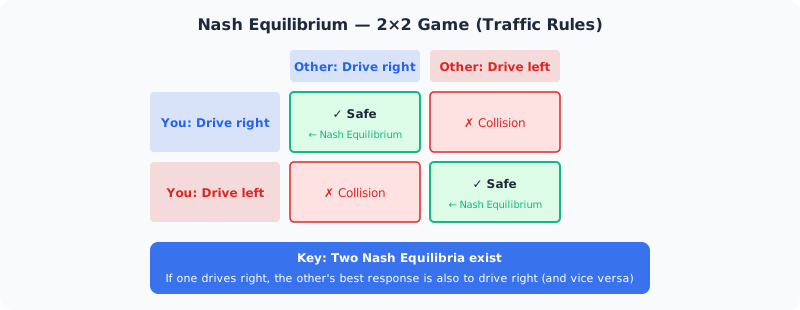
The definition is simple. A Nash equilibrium is a state in which every player is maximizing their own payoff given the strategies of all other players, such that no player can improve by unilaterally deviating.
In other words, once at a Nash equilibrium, no player gains from changing strategy alone — so everyone stays put and the state persists.
An important caveat: Nash equilibrium does not mean “a good outcome for everyone.” It simply means “a stable state from which no one has a unilateral incentive to deviate.” This becomes a critical problem in relation to the Prisoner’s Dilemma discussed below.
Difference from Dominant Strategy
A dominant strategy is a strategy that is always best for a player regardless of what others do. In the Prisoner’s Dilemma, “confess (defect)” is a dominant strategy: whether the opponent cooperates or defects, confessing yields a shorter sentence.
Most games, however, have no dominant strategy. In such cases, the best response depends on what the opponent does. Nash equilibrium is defined as “the state where everyone is playing a best response to everyone else’s strategy.” A dominant-strategy equilibrium is simply a special case of Nash equilibrium.
Finding Nash Equilibria in a Payoff Matrix
Battle of the Sexes
Suppose a couple must independently choose where to spend the holiday.
- Person A prefers a concert (concert → 3 points, football → 1 point)
- Person B prefers football (football → 3 points, concert → 1 point)
- If they go to different places: 0 points each
| B: Concert | B: Football | |
|---|---|---|
| A: Concert | A: 3 / B: 1 | A: 0 / B: 0 |
| A: Football | A: 0 / B: 0 | A: 1 / B: 3 |
There are two Nash equilibria: “both concert” and “both football.” In either equilibrium, the player who deviates unilaterally ends up at 0, so no one has an incentive to deviate.
The equilibrium selection problem — which equilibrium will actually be reached — is not resolved by the theory alone. If the couple can talk in advance, fine; if not, a Schelling point (focal point) may influence which equilibrium emerges.

Chicken Game
Two drivers face each other head-on; whoever swerves first is called a “chicken.”
- Both go straight: mutual crash (worst outcome)
- One swerves, one goes straight: the one who swerved is “chicken” (loss); the other “brave” (gain)
- Both swerve: draw (acceptable)
| Opponent: straight | Opponent: swerve | |
|---|---|---|
| You: straight | −10 / −10 | +3 / −1 |
| You: swerve | −1 / +3 | 0 / 0 |
Nash equilibria: “you go straight, opponent swerves” and “you swerve, opponent goes straight.” This game models nuclear deterrence, labor–management standoffs, and international diplomacy.
Mixed-Strategy Equilibrium
Mixed strategies — probabilistically choosing among actions — can also constitute a Nash equilibrium.
Rock-Paper-Scissors
The mixed-strategy Nash equilibrium is to play each option with probability 1/3.
Why? If the opponent puts more weight on rock, you should play scissors more — but once you do, the opponent should play rock less and paper more. This cycle means no pure strategy is stable. Equilibrium is reached by randomizing 1/3 each.
Formally, the defining condition is: “when the opponent plays the equilibrium mix, I am indifferent among all pure strategies.”
Nash’s existence theorem guarantees that every finite game has at least one Nash equilibrium (in mixed strategies). The proof used Brouwer’s fixed-point theorem.
Application to Tennis Serves
In tennis, the server chooses left or right and the receiver decides which side to cover. If the server concentrates on the right, the receiver shuts it down and the server should go left — creating a cycle. Studies in sports economics find that professional players’ serve directions are distributed close to the mixed-strategy equilibrium probabilities.
Subgame-Perfect Equilibrium
Nash equilibrium is defined for simultaneous-move games, but many real situations involve sequential moves. The refinement concept for such settings is the subgame-perfect equilibrium.
Backward Induction
The technique is to reason from the last move backward.
Example: A seller and buyer interact twice. At the final interaction, the seller has a short-run incentive not to deliver quality. The buyer anticipates this and refuses to transact in round two. If round two will not happen, round one may not either.
This backward reasoning — time consistency — applies to monetary policy, political promises, and treaty credibility. Whether a player can commit not to take the “convenient” action later determines whether the equilibrium can be realized.
Price Competition and Equilibrium: Bertrand and Cournot
Bertrand Price Competition
When two firms sell identical goods and compete on price, the Nash equilibrium has both firms pricing at marginal cost — the same outcome as perfect competition despite having only two firms. This is the “Bertrand paradox.”
Cournot Quantity Competition
When firms choose production quantities simultaneously, the Cournot equilibrium yields prices above marginal cost (positive profits for each firm) but below the monopoly price — a middle ground. Cournot equilibrium is a standard Nash equilibrium where each firm optimizes output treating the rival’s output as given. It models real oligopoly markets well.
Arms Race: Nash Equilibrium as Tragedy
The Cold War nuclear arms race is a tragic application of Nash equilibrium.
Both the US and USSR would be better off with mutual disarmament. Yet if the opponent disarms, you gain by remaining armed. If the opponent arms, disarming puts you at a severe disadvantage. In both cases, arming is the rational choice.
Both countries thus reached the Nash equilibrium of mutual arming — worse for both than mutual disarmament. In practice, arms control treaties (SALT, START) were institutional attempts to escape this equilibrium. Repeated-game logic and credible commitment changed the equilibrium.
Multiple Equilibria and the Equilibrium Selection Problem
Many games have multiple Nash equilibria. The theory alone cannot predict which will be realized — the equilibrium selection problem.
Factors that influence which equilibrium emerges:
Schelling points: Culturally or contextually salient options that people naturally converge on (covered in a separate article).
Fairness norms: Experimental economics consistently shows people prefer fair distributions over theoretical equilibria.
Communication: Pre-play communication makes convergence on a specific equilibrium easier, but “cheap talk” (non-binding communication) only helps when interests are sufficiently aligned.
Evolutionary dynamics: Which equilibrium emerges from repeated interactions is analyzed by evolutionary game theory (see separate article).

Experimental Evidence on Limitations
Nash equilibrium assumes rational players, but experimental economics shows people do not always follow it.
Ultimatum Game: Two people split ¥100. The proposer decides the split; if the receiver rejects, both get nothing. The Nash equilibrium is “proposer takes ¥99.” In practice, “unfair” offers (below 20%) are routinely rejected. People pay a cost to punish unfairness.
Public goods game: In experiments where a group can contribute to a shared resource, people initially cooperate more than the Nash equilibrium (“everyone free-rides”) predicts, though cooperation tends to erode over repetitions.
These findings indicate that Nash equilibrium is a better approximation when social norms, emotions, and reciprocity are weak — and requires modification when they are strong.
How to Apply Nash Equilibrium to Real Analysis
A practical procedure for using Nash equilibrium in analysis:
① Identify the players: Who are the decision-makers?
② Define the strategy space: What options does each player have?
③ Set payoffs: Quantify what each player gets from each combination of strategies.
④ Find equilibria: Compute best-response functions for each player and find where they intersect.
⑤ Assess the equilibrium: Is it Pareto-efficient? Are there multiple equilibria? Is the equilibrium stable (does it attract perturbations)?
Running through this analysis makes structurally transparent questions that superficially seem emotional or political — like “why do firms keep cutting prices?” or “why don’t countries reduce their arsenals?”
Summary
This article explained the Nash Equilibrium. We hope it was useful.
“The state where no player gains by unilaterally changing strategy” sounds simple, but the concept has deep structure: multiple equilibria, mixed strategies, dynamic refinements, and experimental challenges.
Two insights are especially important. First, Nash equilibrium is stable but need not be good. Second, institutions, repetition, and communication can change equilibria themselves. Many social problems are fundamentally design problems: how to escape a bad Nash equilibrium.
For related frameworks, Minimax strategy and evolutionary game theory deepen the picture.

To return to the framework list and game theory overview, see the links below.
Thank you for reading. We hope to see you in the next article.

Also popular with readers
📚 Series: Strategic Thinking Frameworks (3/16)