Thank you for visiting this site. This article explains Minimax Strategy.
Choose the option that minimizes potential damage even if the opponent plays the worst possible move against you. A concept spanning game theory, statistical decision theory, and artificial intelligence, it is widely applied to decision-making under high uncertainty or adversarial risk.
Origins of Minimax Strategy
“Minimax” is a portmanteau of “minimize the maximum.” The concept was mathematically established by John von Neumann, the founder of game theory.
In 1928, von Neumann proved the Minimax Theorem in his paper “On the Theory of Parlor Games” — the theorem that became the cornerstone of game theory and shaped economics, computer science, and military strategy for decades.
In 1944, the jointly authored book Theory of Games and Economic Behavior (von Neumann and Morgenstern) established game theory as a discipline. Minimax strategy was positioned as the mathematical foundation of economic decision-making.
In the 1940s–50s, statistician Abraham Wald applied the Minimax idea to statistical decision theory. Wald’s Minimax criterion provides a general decision-making framework that works even without probability information.
Zero-Sum Games and the Minimax Theorem
The Minimax Theorem guarantees that in a two-player zero-sum game, when one player uses a Minimax strategy and the other uses a Maximin strategy, an equilibrium always exists where both strategies coincide.
A zero-sum game is one in which one player’s gain equals the other’s loss — chess, poker, and zero-sum distribution negotiations are classic examples.
Suppose Player A picks a row and Player B picks a column; each cell shows A’s payoff (= B’s loss):
- A’s Minimax strategy: for each row, find the minimum payoff (worst case for A), then pick the row with the highest such minimum.
- B’s Maximin strategy: for each column, find the maximum payoff (maximum damage to A), then pick the column with the smallest such maximum.
Pure strategies often yield no equilibrium, but once mixed strategies (randomizing over options) are allowed, a Minimax equilibrium always exists. This is the heart of von Neumann’s theorem.
The Minimax equilibrium of a zero-sum game coincides with the Nash equilibrium — an important property of zero-sum structures.
Decision Trees and Backward Induction
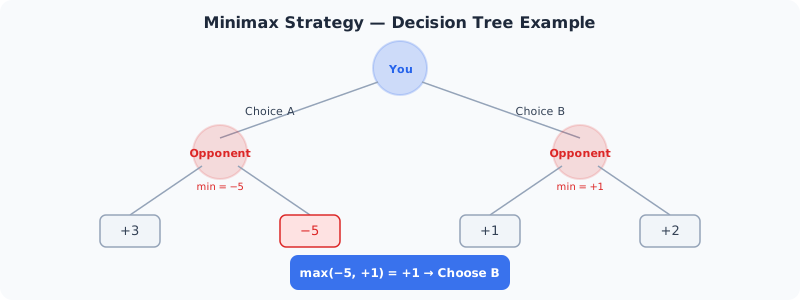
A game represented over time is called a game tree (decision tree). Each node is a decision point; each branch is a possible action; terminal nodes are final outcomes.
The Minimax algorithm evaluates the tree from the terminal nodes backward:
- Evaluate terminal nodes: Compute the evaluation score of each endpoint.
- Your turn (maximizing player): Adopt the maximum of the children’s values.
- Opponent’s turn (minimizing player): Adopt the minimum of the children’s values.
- Propagate to the root: When the root node is reached, the best move is determined.
This backward induction is used throughout game theory: deciding the current best move by working backward from the game’s eventual outcome is also applicable to negotiation, competitive strategy, and policy design.
Alpha-Beta Pruning
In complex games like chess or shogi, exhaustively searching the entire game tree is computationally infeasible. Chess has an average branching factor of about 35, making the search space astronomically large.
Alpha-beta pruning solves this. The principle is simple: when searching reveals that a branch “cannot possibly beat the best option already found,” that branch is cut off.
- Alpha (α): The best value the maximizing player can guarantee so far.
- Beta (β): The best value the minimizing player can guarantee so far.
When β ≤ α, the subtree is pruned — neither player would ever choose that path.
In the best case, alpha-beta pruning reduces search complexity from O(b^d) to O(b^(d/2)), effectively doubling the search depth for the same computational budget.
IBM’s Deep Blue, which defeated world chess champion Garry Kasparov in 1997, used alpha-beta pruning as its core algorithm on custom hardware, evaluating 200 million positions per second. Modern engines like Stockfish use the same foundations and far surpass the best human players.
Note: modern Go AI (AlphaGo and successors) uses Monte Carlo Tree Search combined with deep reinforcement learning — Minimax search is impractical for Go given the enormous branching factor and difficulty of position evaluation.
Wald’s Minimax Criterion
Statistician Abraham Wald proposed the Wald Minimax Criterion, a decision rule for situations with no probability information whatsoever (“under uncertainty”).
The criterion: for each option, identify the worst-case outcome; then choose the option with the best worst-case result.
Umbrella example:
| Option | Sunny | Rainy |
|---|---|---|
| No umbrella | Comfortable (+10) | Soaked (−20) |
| Folding umbrella | Slightly inconvenient (+5) | Slightly wet (−5) |
| Full umbrella | Bulky (+2) | Comfortable (+8) |
Wald’s criterion compares worst-case values: −20, −5, and +2. The full umbrella’s worst case (+2) is the best, so it is the Minimax choice.
This criterion is useful as a decision tool when probability information is completely absent, but it tends to overweight rare catastrophic scenarios since it ignores frequency.
Minimax Regret
A variant called Minimax Regret measures how much worse you are compared to the best possible choice in each scenario, then minimizes the maximum “regret.”
Using the same umbrella example:
Best outcomes: sunny → +10 (no umbrella); rainy → +8 (full umbrella).
| Option | Regret: Sunny | Regret: Rainy | Max Regret |
|---|---|---|---|
| No umbrella | 10 − 10 = 0 | 8 − (−20) = 28 | 28 |
| Folding umbrella | 10 − 5 = 5 | 8 − (−5) = 13 | 13 |
| Full umbrella | 10 − 2 = 8 | 8 − 8 = 0 | 8 |
Minimax regret selects the full umbrella (max regret = 8).
Amazon founder Jeff Bezos reportedly used a “regret minimization framework” when deciding whether to start Amazon — asking what his eighty-year-old self would regret most. This “regret minimization framework” is an intuitive application of Minimax regret.
Minimax regret is often more practical than Wald’s pure Minimax because it accounts for the relative position across scenarios, not just the worst absolute value.
Connection to Robust Optimization
The Minimax idea connects directly to modern engineering and operations research through robust optimization.
Robust optimization seeks solutions — designs or plans — that satisfy constraints and achieve objectives even when parameters vary within an “uncertainty set.”
This is exactly the Minimax structure: “find the solution that performs best in the worst realization of uncertain parameters.”
Real-world applications:
Supply chain management: Determining order quantities that avoid both stockouts and excess inventory across demand fluctuations.
Power grid design: Designing infrastructure that avoids blackouts under the worst demand patterns or generator failure scenarios.
Financial risk management: VaR (Value at Risk) and CVaR (Conditional VaR) minimize worst-percentile losses — a Minimax-inspired approach.
Machine learning robustness: Training models that resist adversarial examples is formulated as a Minimax problem: the adversary adds the worst noise; the model minimizes loss against it. GANs (Generative Adversarial Networks) share this structure.
Everyday Applications
Insurance decisions: Insurance is a quintessential Minimax choice. You pay a premium to minimize the worst-case loss (accident, illness, fire). Purely by expected value, insurance premiums are often negative, but when the worst-case damage is life-disrupting (bankruptcy, business failure, serious illness), paying a negative-expected-value premium is rational. Conversely, insurance may be unnecessary for risks whose worst case is tolerable.
Negotiation and BATNA: In negotiation theory, the BATNA (Best Alternative to a Negotiated Agreement) is the best outcome if talks fail. Having a clear BATNA is Minimax thinking in practice — “even in the worst case, I can fall back on this alternative.” A stronger BATNA raises bargaining power by ensuring that the worst-case outcome is already acceptable.
Project contingency planning: Identifying worst-case scenarios (schedule overruns, cost overruns, technical failures) and preparing contingency resources or alternatives is Minimax thinking applied to project management.
Security and defense: National defense is a classic Minimax problem — ensuring a minimum deterrence capability against the opponent’s worst-case attack scenario.
Minimax vs. Expected Utility: When to Use Each
Alongside Minimax, expected utility maximization is a key decision criterion. The two are fundamentally suited to different situations.
Expected utility maximization: When probabilities and outcomes are known, choose the option with the highest expected value. Optimizes the long-run cumulative outcome of frequently repeated decisions.
Minimax: When probabilities are unknown or when worst-case outcomes are unacceptable. Appropriate for one-shot, irreversible decisions.
Minimax’s main weakness: ignoring probability information can lead to overweighting low-probability catastrophic scenarios.
For instance, “0.1% probability of −10,000 loss” versus “50% probability of −100 loss”: the worst case strongly favors the first, yet the expected loss is 10 vs. 50 — the second is actually much worse. Minimax misses this distinction.
Practical guidelines:
| Situation | Appropriate criterion |
|---|---|
| Known probabilities, repeated decisions | Expected utility maximization |
| Unknown probability, one-shot high-stakes decision | Minimax |
| Worst case is unacceptable (bankruptcy, health ruin) | Minimax |
| Worst case is tolerable and events recur | Expected utility maximization |
| Opponent is clearly adversarial | Minimax |
Summary
This article explained Minimax Strategy. We hope it was useful.
Minimax spans von Neumann’s zero-sum game theory, decision trees, alpha-beta pruning, Wald’s statistical decision theory, and robust optimization — a foundational concept with a broad reach.
“Make the choice you can survive even in the worst case” is especially effective for irreversible decisions, adversarial situations, and environments where probabilities are unknown. When probability information is available, combining Minimax with expected utility maximization is more realistic.
To return to the framework list and game theory overview, see the links below.
Thank you for reading. We hope to see you in the next article.
Also popular with readers
📚 Series: Strategic Thinking Frameworks (4/16)