Thank you for visiting this site. This article explains Game Theory.
Game theory is the mathematical study of decision-making in situations where multiple players act while taking each other’s choices into account. Spanning economics, political science, biology, and computer science, it became one of the most influential intellectual frameworks of the twentieth century.
This article is an overview of the entire field. Links to specialized articles on individual concepts are provided throughout. If game theory is new to you, the section on “Normal-Form Games and Dominant Strategies” (Prisoner’s Dilemma and Nash equilibrium) is the best starting point for grasping the big picture.
The Birth and History of Game Theory
Von Neumann and “Theory of Games and Economic Behavior”
The mathematical foundations of game theory trace back to a 1928 paper by the Hungarian-born mathematician John von Neumann, “On the Theory of Parlor Games.” He proved the Minimax Theorem for two-player zero-sum games such as chess and poker, showing that even when no pure-strategy equilibrium exists, a mixed-strategy equilibrium always does.
In 1944, von Neumann co-authored with economist Oskar Morgenstern the landmark volume Theory of Games and Economic Behavior, running more than six hundred pages. The book established game theory as an analytical tool for economics.
John Nash and the “Nash Equilibrium”
Von Neumann’s theory was limited to two-player zero-sum games. In 1950, Princeton graduate student John Nash proposed a general equilibrium concept applicable to non-zero-sum and multi-player games. His twenty-seven-page doctoral dissertation introduced the Nash equilibrium, dramatically expanding the scope of game theory.
Nash later developed schizophrenia and endured years of mental illness before receiving the Nobel Prize in Economics in 1994, shared with John Harsanyi and Reinhard Selten. His turbulent life was depicted in the 2001 film A Beautiful Mind.
Subsequent Developments and Nobel Prizes
Game theory advanced rapidly through the 1960s–80s.
Selten (Nobel 1994): Introduced subgame-perfect equilibrium and backward induction, creating a “refinement” framework that eliminates non-credible threats from equilibria.
Harsanyi (Nobel 1994): Established the Bayesian game framework for analyzing incomplete information games where players do not know each other’s payoffs or characteristics.
Aumann (Nobel 2005): Provided mathematical rigor to the Folk Theorem and formalized the concept of common knowledge.
Schelling (Nobel 2005): Applied game theory to nuclear deterrence, negotiation, and international security; introduced the focal point (Schelling point).
Maskin, Myerson, Hurwicz (Nobel 2007): Founded mechanism design — “reverse game theory” that designs institutions to produce desired outcomes.
Shapley, Roth (Nobel 2012): Stable matching theory and its applications to market design.
The large number of game-theory Nobel laureates shows how deeply this framework has embedded itself at the core of modern economics and social science.
The Basic Elements of a Game
Game theory analyzes situations in which “multiple decision-makers choose actions while accounting for each other’s outcomes.” Such a situation is called a game and has three basic components.
Players: The decision-making agents. Humans, firms, nations, biological species — anything capable of intentionally choosing actions can be a player. Game theory typically assumes players are “rational agents” who maximize their own payoffs.
Strategies: The set of action plans available to each player.
- Pure strategy: A deterministic plan that selects a specific action with certainty (“always go right”).
- Mixed strategy: A probabilistic plan that selects actions randomly (“go right with 50% probability”).
Payoffs: The value each player receives from each combination of strategies (outcome). Usually expressed as utility (subjective satisfaction). “Rationality” in game theory means acting so as to maximize this payoff.
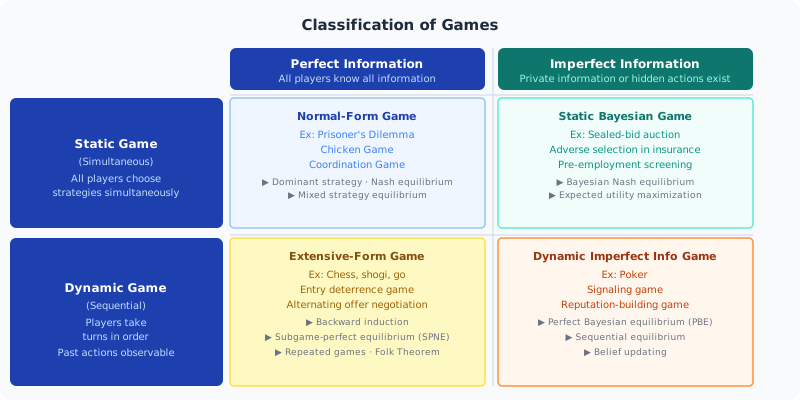
Classification of Games
Games are categorized along several dimensions.
By cooperation structure:
- Non-cooperative game: Players make independent decisions without binding agreements. The centerpiece of modern game theory; Nash equilibrium is defined here.
- Cooperative game: Players form coalitions with binding agreements inside each coalition. Analysis focuses on which coalitions form and how payoffs are distributed. Key solution concepts: Shapley value and the core.
By information structure:
- Perfect information game: All players know all information (every past action, every player’s payoff function). Chess and shogi are canonical examples.
- Imperfect information game: Some information (payoffs, types, past actions) is hidden from at least one player. Auctions, poker, and insurance markets are canonical examples.
By time structure:
- Static game (simultaneous): All players choose strategies simultaneously (or without observing each other’s choices).
- Dynamic game (sequential): Players act in turn; later players can observe earlier players’ actions.
By zero-sum property:
- Zero-sum game: The sum of all players’ payoffs is always constant; one player’s gain is another’s loss. Chess, poker, Minimax strategy.
- Non-zero-sum game: All players can gain (or all can lose) simultaneously. Most real-world business, diplomacy, and environmental problems are non-zero-sum.
Normal-Form Games and Dominant Strategies
Reading a Payoff Matrix
Static games are represented by a payoff matrix.
In a two-player game, the row player picks a row and the column player picks a column. Each cell shows payoffs in the form (row player’s payoff, column player’s payoff).
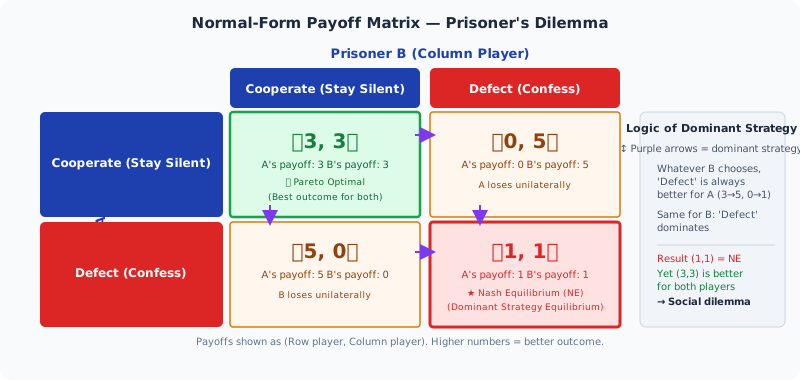
The figure above shows the payoff matrix for the Prisoner’s Dilemma. Two suspects (A and B) are interrogated separately and must choose between staying silent (cooperate) and confessing (defect).
- Both cooperate: payoff 3 each (light punishment)
- Only A defects: A gets 5 (goes free), B gets 0 (heavy punishment)
- Only B defects: B gets 5, A gets 0
- Both defect: payoff 1 each (moderate punishment)
Dominant Strategy
A dominant strategy yields a payoff at least as high as any other strategy, regardless of what the opponent does.
From A’s perspective:
- If B cooperates: cooperate → 3, defect → 5 (defect is better)
- If B defects: cooperate → 0, defect → 1 (defect is better)
“Defect” is A’s dominant strategy in both cases. B’s dominant strategy is also “defect.”
When a dominant strategy exists, a rational player will always choose it — no need to think about what the opponent will do.
Nash Equilibrium
Not every game has a dominant strategy. In many games the best response depends on what the opponent does.
This is where Nash equilibrium comes in.
Definition: A combination of strategies in which every player is maximizing their own payoff (playing a best response) given the strategies of all other players.
At a Nash equilibrium, no player can improve their payoff by unilaterally changing strategy (no incentive to deviate).
In the Prisoner’s Dilemma, (defect, defect) is the Nash equilibrium:
- If A switches from “defect” to “cooperate” while B defects: A’s payoff falls from 1 to 0. A won’t deviate.
- The same logic applies to B.
Note, however, that Nash equilibria are not necessarily Pareto-optimal. In the Prisoner’s Dilemma, (cooperate, cooperate) at (3, 3) would be better for both, yet the equilibrium is (defect, defect) at (1, 1). This is the structure of “social dilemmas.”
Nash’s existence theorem: Nash proved that every finite game has at least one Nash equilibrium (in mixed strategies). This was the central result of his doctoral dissertation.
Canonical Game Examples
Prisoner’s Dilemma
As described above. Individual rational behavior undermines collective welfare — the quintessential social dilemma. Arms races, price wars, and the free-rider problem in public goods all share this structure.
Chicken Game (Hawk-Dove Game)
Two cars race head-on; whoever swerves first loses. There are two Nash equilibria: (straight, swerve) and (swerve, straight). The structure models nuclear deterrence, labor-management standoffs, and international negotiations.
Coordination Game
Both players gain more by matching their choices.
| Opponent: Standard A | Opponent: Standard B | |
|---|---|---|
| You: Standard A | (10, 10) | (0, 0) |
| You: Standard B | (0, 0) | (10, 10) |
Two Nash equilibria: (A, A) and (B, B). Which equilibrium is reached often depends on a Schelling point — the option that “seems natural to everyone.”
Battle of the Sexes
A coordination game where players’ preferences differ. Two Nash equilibria exist and each player prefers a different one. Social norms, conventions, and communication determine which equilibrium prevails.
Mixed-Strategy Equilibrium
Some games have no pure-strategy Nash equilibrium. The canonical example is rock-paper-scissors.
No pure strategy is optimal here; the solution is the mixed-strategy Nash equilibrium of choosing each option with probability 1/3. When the opponent randomizes equally, the expected payoff from any pure strategy is the same (zero), so randomizing 1/3 each is also optimal.
Intuition: In adversarial situations, randomizing to prevent the opponent from predicting your action can be strategically optimal. Soccer penalty kicks, baseball pitch selection, and tennis serves all exhibit near-equilibrium mixed strategies in empirical data.
Nash’s existence theorem guarantees that every finite game has at least one Nash equilibrium when mixed strategies are allowed.
Extensive-Form Games and Backward Induction
Dynamic games are represented not by a payoff matrix but by a game tree (extensive form).
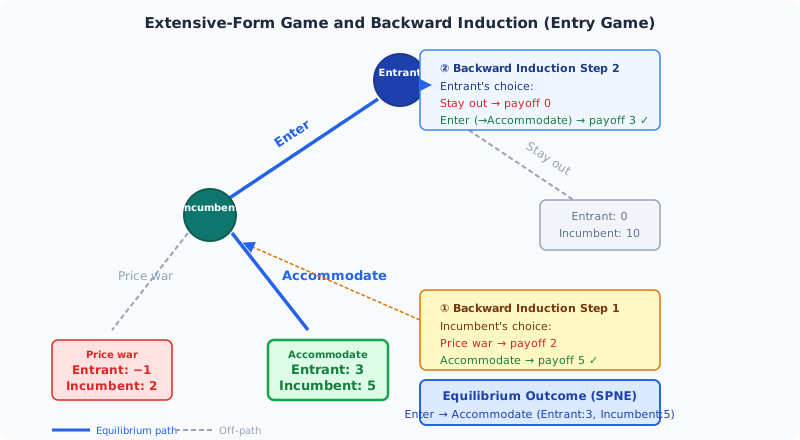
The figure above shows the Entry Deterrence Game.
Setup:
- An entrant considers entering a market.
- The incumbent can respond to entry with “price war” or “accommodate.”
Payoffs:
- Enter → price war: (entrant: −1, incumbent: 2)
- Enter → accommodate: (entrant: 3, incumbent: 5)
- Stay out: (entrant: 0, incumbent: 10)
Backward Induction Steps
Step 1 (last decision): If the entrant enters, the incumbent chooses between price war (payoff 2) and accommodate (payoff 5). Since 5 > 2, the incumbent accommodates.
Step 2 (first decision): Anticipating Step 1, the entrant compares entering (payoff 3) with staying out (payoff 0). Since 3 > 0, the entrant enters.
Subgame-perfect Nash equilibrium: (enter, accommodate) → payoffs (3, 5).
Eliminating Non-Credible Threats
The incumbent may threaten “price war if you enter,” but since accommodating (5) is better than fighting (2) after entry actually occurs, this threat is a non-credible threat. The entrant sees through it and enters anyway.
This is the key insight of backward induction. Selten’s subgame-perfect Nash equilibrium (SPNE) recognizes only strategy profiles that constitute a Nash equilibrium in every subgame, eliminating non-credible threats from equilibria.
Repeated Games and the Folk Theorem
In a one-shot Prisoner’s Dilemma, defection is the equilibrium. But when the same players interact repeatedly, things change.
Folk Theorem: In an infinitely repeated game, when the discount factor δ (the weight players place on future payoffs) is large enough, mutual cooperation can be sustained as a Nash equilibrium.
Intuition: “Defecting now gains 5 in the short run, but triggers eternal retaliation yielding only 1 thereafter. Sustaining cooperation yields 3 every period. If the future matters enough, the long-run value of cooperation exceeds the short-term gain from defection.”
The cooperation-sustaining condition: δ ≥ (5 − 3) / (5 − 1) = 0.5. If the discount factor is at least 50%, cooperation can be sustained.
Axelrod and Tit-for-Tat: In repeated-game computer tournaments, the “Tit-for-Tat” strategy (cooperate first, then mirror whatever the opponent did last round) won overall. Simple but powerful.
Incomplete Information Games and Bayesian Equilibrium
In many real-world strategic situations, players don’t know each other’s payoffs, capabilities, or intentions. These are incomplete information games.
Harsanyi proposed the Bayesian game framework: each player holds probabilistic beliefs (priors) about other players’ types.
Bayesian Nash Equilibrium: A strategy profile in which every player maximizes expected payoff given their beliefs about others’ types.
Signaling games: A dynamic incomplete-information game. The informed player (worker) sends a signal to the uninformed player (employer), who updates beliefs on observing the signal. Spence’s education signaling model is the canonical example.
Perfect Bayesian Equilibrium (PBE): Applied to dynamic incomplete-information games; requires players to update beliefs using Bayes’ rule and maximize expected payoff at every information set.
Cooperative Game Theory
In contrast to non-cooperative game theory, cooperative game theory analyzes situations where players form coalitions with binding agreements.
Core: The set of payoff allocations such that no coalition can do better by acting independently. Core allocations are stable in the sense that no coalition has an incentive to deviate.
Shapley Value: Lloyd Shapley’s formula for a “fair” payoff distribution in n-player cooperative games. Defined as each player’s expected marginal contribution across all possible coalition formation orders. The only allocation rule satisfying efficiency, symmetry, linearity, and the dummy-player axiom.
The Shapley value is also prominent in AI/ML through SHAP (SHapley Additive exPlanations), which quantifies how much each feature contributes to a model’s prediction.
Applications of Game Theory
Game theory’s reach extends far beyond economics.
Industrial organization: Price-setting, capacity investment, R&D, and advertising by competing firms. Bertrand competition (price), Cournot competition (quantity), Stackelberg competition (leader-follower).
Auction and market design: Designing auctions with desirable properties (efficiency, revenue maximization, incentive compatibility). Applications to spectrum auctions, internet advertising, and electricity markets.
International politics and security: Nuclear deterrence, arms control negotiations, trade wars, and treaty compliance.
Biology and evolution: Evolutionary game theory analyzes animal behavior (territory disputes, cooperative behavior, signaling) using fitness as the payoff.
Computer science and AI: Multi-agent systems, online auction algorithm design, and reinforcement learning. AlphaGo and autonomous vehicle decision-making rely heavily on game-theoretic frameworks.
Political science: Strategic voting, electoral system design, coalition formation, and lobbying.
Limitations and Criticisms
Rationality assumption: Game theory assumes rational payoff-maximizing agents, but experimental economics has repeatedly shown that humans make systematically irrational choices. The Ultimatum Game — where “unfair” offers are frequently rejected even at cost to the rejector — is a classic demonstration.
Multiple equilibria: Many games have multiple Nash equilibria with no theoretical way to predict which will be realized.
Common knowledge assumption: The assumption that the game’s structure and all players’ rationality are “common knowledge” (each knows, and knows that each knows, …) is unrealistic in practice.
Computational complexity: Computing Nash equilibria in large games can be NP-hard, making theoretically optimal equilibria practically intractable.
Summary
This article introduced Game Theory. We hope it was useful.
Game theory has grown from von Neumann and Nash’s mathematical foundations into a unified framework for analyzing diverse games — static and dynamic, perfect and imperfect information.
“Analyzing situations where my choices affect others, and others’ choices affect me” — this core question of game theory runs through economics, political science, biology, and computer science alike.
For deeper dives into individual concepts, see the articles below.
To return to the framework list, see the link below.
Thank you for reading. We hope to see you in the next article.
Also popular with readers
📚 Series: Strategic Thinking Frameworks (2/16)