Thank you for visiting this site. This article covers the monument of deduction puzzles: “the zebra puzzle.”
Five houses in a row; the residents’ nationalities, house colors, drinks, cigarette brands, and pets all differ. All you get are 15 fragmentary clues like “the Englishman lives in the red house.” From them you must determine who drinks water, and who keeps the zebra. It spread worldwide under the billing “composed by Einstein as a boy — 98% of the world cannot solve it” — though that legend, as it happens, is one more riddle planted inside the puzzle.
What Is the Zebra Puzzle?
The zebra puzzle is the flagship of deduction puzzles where you pin down a unique assignment of multiple attributes purely by elimination from given conditions. The original rules, from the 1962 magazine printing:
- Five houses stand in a row, each a different color
- The residents differ in nationality, drink, cigarette brand, and pet
- All fifteen of the following clues hold
- The Englishman lives in the red house
- The Spaniard owns the dog
- Coffee is drunk in the green house
- The Ukrainian drinks tea
- The green house is immediately to the right of the ivory house
- The Old Gold smoker owns snails
- Kools are smoked in the yellow house
- Milk is drunk in the middle house
- The Norwegian lives in the first house on the left
- The Chesterfields smoker lives next to the man with the fox
- Kools are smoked in the house next to the house where the horse is kept
- The Lucky Strike smoker drinks orange juice
- The Japanese smokes Parliaments
- The Norwegian lives next to the blue house
- And the question: Who drinks water? Who owns the zebra?
Notice the sly part? Water and zebra never appear in the clues at all. Pin down every other item from the 14 conditions, and the blanks left over are the answer’s reserved seats.
The 1962 Life Original and the Author Legend
The puzzle’s debut is well documented: the December 17, 1962 issue of Life International. Reader solutions poured in, and the March 1963 issue published the answer and a list of correct solvers. The 15 clues above are essentially that Life version.
As for the internet-famous billing — “devised by Einstein in boyhood,” “98% of the world cannot solve it” — no supporting evidence has ever been found. The Lewis Carroll attribution fares no better. The cigarette brands in the Life version were 1960s American products, chronologically impossible for the boyhood of Einstein, who died in 1955.
The “98% can’t solve it” tagline, in other words, was retrofitted showmanship. And yet the puzzle itself is unmistakably first-class — subtract the false billboard and it still gets solved, joyfully, worldwide.
Build a Grid and Fill In from What’s Certain
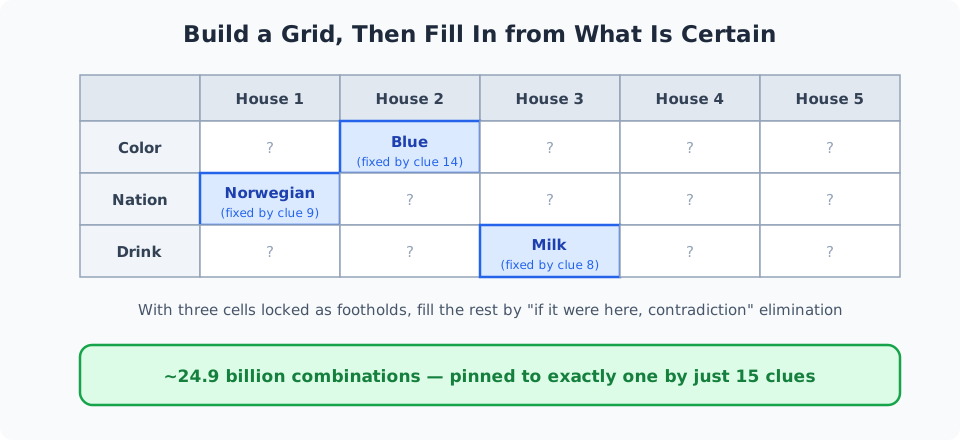
The method is essentially settled: build a grid with house positions 1–5 as columns and the attributes (color, nationality, drink, cigarettes, pet) as rows, and fill in from certainties. Here is the opening sequence.
Two cells lock immediately: from clue 8, house 3 drinks milk; from clue 9, house 1 is the Norwegian’s. Then by clue 14, the blue house next to the Norwegian must be house 2.
Next, clue 5: green sits immediately right of ivory, an (ivory, green) pair. House 2 is blue, so the candidates are houses 3–4 or 4–5. If green were house 3, clue 3 would make it drink coffee — but house 3 drinks milk. Contradiction. So ivory is house 4 and green is house 5. Then clue 1 puts the Englishman in the red house; house 1 is the Norwegian’s, so red isn’t house 1 — leaving house 3 red, house 1 yellow. By clue 7 the resident of house 1 smokes Kools; by clue 11 the horse lives next door in house 2 — and the chain keeps pulling.
Repeating this loop of “lock in → use it to lock in the next” plus the elimination move “if it were here, contradiction — strike it,” the grid fills in exactly one way. The answer: the Norwegian in house 1 drinks the water, and the Japanese in house 5 owns the zebra.
| House | Color | Nationality | Drink | Cigarettes | Pet |
|---|---|---|---|---|---|
| 1 | Yellow | Norwegian | Water | Kools | Fox |
| 2 | Blue | Ukrainian | Tea | Chesterfields | Horse |
| 3 | Red | English | Milk | Old Gold | Snails |
| 4 | Ivory | Spanish | Orange juice | Lucky Strike | Dog |
| 5 | Green | Japanese | Coffee | Parliaments | Zebra |
24.9 Billion Possibilities, Squeezed to One by 15 Conditions
The puzzle’s power shows when you count. Each of the five attributes can be arranged 5! = 120 ways; the total combinations run 120^5 — about 24.9 billion. A mere 15 conditions squeeze that to exactly one, with nothing missing and nothing wasted. Remove one clue and multiple answers appear; add a redundant one and there’s slack. Tuned so that a bare minimum of information pins the solution uniquely — that calibration is why this puzzle is called a masterpiece.
And this structure is precisely what computer science calls a constraint satisfaction problem — a major research subject. Assign values to variables (each house’s attributes) and search for assignments satisfying every constraint. The zebra puzzle is a standard benchmark for constraint-solving programs, recurring in AI textbooks and in tutorials for software called constraint solvers.
The grid operation of “pruning candidates from established facts” is called constraint propagation; the move of “tentatively assume, and back out on contradiction” is backtracking search — and these two are the actual core techniques of modern solvers. Sudoku and nonograms belong to the same constraint-satisfaction family. There is something pleasing in learning that the elimination you were doing in your head has a proper name.
Real Work Is Made of Elimination Puzzles
The skills the zebra puzzle sharpens transfer directly into working life.
First, incident investigation and debugging. “This log line means the network is alive”; “it doesn’t reproduce with this operation, so it isn’t data-driven” — fault isolation is exactly the game of striking candidates using clues, and doing it purely in your head guarantees dropped cases. As with the puzzle’s grid, the reliable way is to draw the table of candidates × established facts and crush them one by one.
Second, scheduling and assignment. Shift rosters, meeting-room allocation, timetables — these are the industrial edition of constraint satisfaction, and they really are solved with constraint solvers. Searching for a solution among conditions like “A can’t do Tuesdays” and “these two can’t share a team” is structurally identical to the five houses.
One more thing worth internalizing: pile on too many conditions and the solution vanishes. The zebra puzzle’s 15 conditions coexist exquisitely, but in real-world requirements gathering, accumulated conditions regularly contradict one another into “no solution.” Finding which constraint to relax so that a solution exists — that too is part of the elimination puzzle called work.
The Einstein Legend, and Solving Questions
Did Einstein Really Write It?
As noted, no evidence supports the attribution, and the verifiable first appearance is Life, 1962. The cigarette brands being 1960s products also marks it as later work. The “98%” figure has no source either. Still, this genre of borrowed-authority legend is a fine live specimen of the psychology this site covers under the halo effect — attach a genius’s name and the problem gleams.
Can It Be Solved by Pure Elimination, Without Guessing?
Early and middle stages proceed on chains of certainty as shown above, but the endgame includes spots where you posit “suppose this house were X” and hunt the contradiction. This is not guessing: it is case analysis with rejection by contradiction — the same operation as proof by contradiction in mathematics. Not fearing the tentative assumption and the rollback is, if anything, the key to getting good at this genre.
How Does It Differ from Sudoku?
Both are constraint satisfaction, but the constraint vocabulary differs. Sudoku has a single constraint type — “no repeated digit in a row, column, or block” — a purebred. The zebra puzzle’s constraints come in many flavors — “if A then B,” “A is next to B,” “A is immediately right of B” — and demand reading comprehension and translation into logic. If sudoku is arithmetic drill, the zebra puzzle is a word problem.
Related Logic Puzzles
See identities exposed by case analysis and contradiction in “the guards of heaven and hell”; elimination through others’ viewpoints perfected in “the blue-eyed islanders”; and the psychology of collecting only convenient clues in “confirmation bias.”
Summary
This article covered “the zebra puzzle.”
Twenty-four-point-nine billion possibilities folded down to one by fifteen unassuming sentences. The satisfaction of finishing it stands apart even among deduction puzzles. And the method — draw the grid, fill from certainties, prune branches by contradiction — is the prototype of techniques used daily in real problem-solving, from fault isolation to shift rosters.
The Einstein legend was false. But this puzzle has the substance to shine without the counterfeit signboard. If you have never solved it yourself, take paper and pencil, draw the grid, and give it one honest attempt.
To return to the full list of logic and probability puzzles, follow the link below.
Thank you for reading. We hope to see you in the next article.

Also popular with readers
📚 Series: Logic & Probability Puzzles (5/11)