Thank you for visiting this site. This article covers the classic logic puzzle “the guards of heaven and hell.”
Two doors stand before you. One leads to heaven, the other to hell. Two guards stand at the doors: one always tells the truth, the other always lies. You cannot tell which is which by looking. You are allowed one question, to one guard only. Under these conditions, a question exists that finds the door to heaven with certainty. A masterpiece of question design: extracting a correct answer from an untrustworthy source.
What Is the Guards Puzzle?
The guards of heaven and hell belongs to the family of logic puzzles about extracting correct information, through clever questioning alone, from a mix of truth-tellers and liars. In the English-speaking tradition the truth-teller is a knight and the liar a knave, and the whole genre goes by “knights and knaves.”
The rules:
- Two doors; one leads to heaven, the other to hell
- Two guards; one always tells the truth, one always lies
- The guards know which door is heaven, and each knows whether the other is honest or a liar
- You may ask exactly one question, to exactly one guard
First consider asking straight out: “Which door leads to heaven?” Hit the truth-teller and you get heaven’s door; hit the liar and you get hell’s. Since you don’t know whom you asked, the answer is right with fifty-fifty odds — your one precious question, effectively thrown away.
The Answer: Route the Question Through the Other Guard
The famous solution: ask either guard —
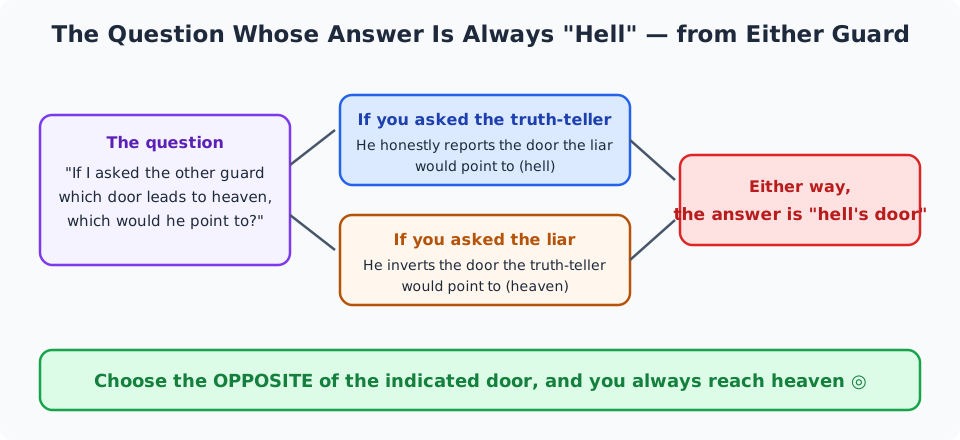
“If I asked the other guard which door leads to heaven, which door would he point to?”
Then choose the opposite of the door indicated. You reach heaven with certainty.
Why does it always work? Check the cases.
If you asked the truth-teller: He knows the liar would point to hell’s door, and he reports that honestly — so he points to hell’s door.
If you asked the liar: The truth-teller would point to heaven’s door. The liar falsifies that fact — and points to hell’s door.
Whichever guard you ask, the answer that comes back is always the same: “hell’s door.” You never learn who is who — but the direction of the answer’s bias is perfectly predictable. Choose the opposite. That is the puzzle’s beauty.
Smullyan and the Island of Knights and Knaves
The man who systematized this genre and spread it worldwide was the mathematician-and-magician Raymond Smullyan. His 1978 book “What Is the Name of This Book?” unleashed a torrent of puzzles set on “an island inhabited only by knights who always tell the truth and knaves who always lie,” making him the very name of the liar-puzzle genre.
Here is one island puzzle. You meet islanders A and B, and A says: “We are both knaves.” What are they?
The answer: A is a knave and B is a knight. If A were a knight, we’d have the contradiction of a knight truthfully declaring himself a knave — so A is a knave. But then the knave A’s statement must be false, so “both knaves” fails, and B must be a knight. Deducing the speaker’s own identity from the content of the speech — that is this genre’s finest pleasure.
Note that a knave can never say, on its own, “I am a knave.” From a knave it would be true; from a knight, false. This structure runs continuous with the ancient “liar paradox” (the Cretan’s paradox).
The two-guards puzzle itself is also widely known from its appearance in the film “Labyrinth” (1986), and lives on in pop culture abroad as “the two doors problem.”
The Design: Force the Answer Through the Lie-Filter Exactly Once
Why is the question so powerful? Let’s dig one level deeper.
Think of the truth-teller as “a filter that returns its input unchanged” and the liar as “a filter that inverts its input.” The routed question is engineered so that, before the answer reaches you, it passes through both filters — one pass-through and one inversion — no matter what. Whichever order it traverses them, the total inversions equal one. So the output stabilizes at “the opposite of the truth,” always.
The crucial mental flip: an error that is always in the same direction is not noise — it is information. An answer is useless when you can’t tell right from wrong; an answer guaranteed to be wrong becomes correct the moment you flip it.
There is a famous alternative solution on the same principle — a self-referential question that makes the guard predict his own answer:
“If you were asked which door leads to heaven, which door would you point to?”
The truth-teller plainly points to heaven. The liar — who would actually point to hell — lies about himself, and so answers “I would point to heaven’s door.” The lie applies to itself twice and cancels out. In this version, take the indicated door as-is.
The routed version arranges an odd number of inversions; the self-referential version, an even number. Two implementations of one principle: control the inversion count.
Three Gods, and the Hardest Logic Puzzle Ever
The puzzle has a terrifyingly difficult descendant. In 1996, the philosopher George Boolos published a problem under the name “the Hardest Logic Puzzle Ever.” By Boolos’s account, the original was Smullyan’s, with the final twist added by John McCarthy, one of the founders of artificial intelligence research.
- There are three gods: one always tells the truth, one always lies, and one answers completely at random
- You may ask up to three yes-or-no questions, each to any single god you choose
- The gods understand your questions but answer in the words “da” and “ja” — and you do not know which means “yes”
- Identify all three gods
Despite the double noise — a whimsical random god, plus meaningless replies — it is proven solvable in three questions. The key is again the nested question: with the format “If I asked you ~, would you answer ‘da’?”, both the unknown meanings of the words and the inversion of lies cancel out. The tool you sharpened at the gates of heaven and hell turns out to be the key to the hardest problem in the genre — that is the depth of this territory.
The Craft of Extracting Answers from Unreliable Sources
The puzzle’s insight transfers directly to life outside puzzles.
First, the perspective that systematic error is easier to handle than random error. A thermometer that always reads two degrees high becomes an accurate instrument once calibrated. A team member whose estimates always run 30% optimistic can be corrected — as long as the bias is consistent. The truly frightening god is not the liar but the random one whose answers change with mood — exactly the relationship between systematic and random error in data analysis.
Second, the routed question exists in the wild as a technique for asking the unaskable. Where “Are you dissatisfied with this workplace?” invites diplomatic non-answers, asking “What do you think your colleagues would say?” is the projection-question staple of marketing research and interviews. What is hard to say as one’s own opinion becomes sayable as a prediction about others.
Third, the idea of mixing in questions whose answers you already know, to measure a source’s reliability. Slipping known-answer control samples into quality inspection, or holding out labeled test data in machine learning — these are, in effect, questions asked to unmask the guard first.
How to Fight When the Premises Crumble
What If the Guards Don’t Know Each Other’s Identities?
Sharp — the routed question depends on the guard knowing how the other would answer. Break that premise and routing fails. Even then, however, the self-referential form — “If you were asked which door is heaven, which would you point to?” — still works, because its inversion completes entirely within the guard himself. Standing on weaker premises, the self-referential version is the more robust solution.
What If the Guards Answer Only “Yes” or “No”?
Instead of asking for a pointed finger, ask: “If you were asked ‘Is the left door heaven?’, would you answer ‘yes’?” If the answer is “yes,” the left door is heaven; if “no,” the right. The self-cancellation principle is untouched — only the response format changes. This is precisely the question format used in Boolos’s hardest puzzle.
What Happens If a Random-Answering Guard Joins?
From a random answerer, no question extracts information. That is why Boolos’s problem is attacked with the strategy of using the first question to identify one god who is at least not random, then concentrating the remaining questions on that god. Not silencing the noise source — routing around it. As a way of operating in unreliable information environments, it is rich with suggestion.
Related Logic Puzzles and Paradoxes
See “the liar paradox,” on what happens when a liar speaks about himself; “the crocodile paradox,” where fate turns on a prediction instead of a question; and “the blue-eyed islanders,” where chains of reasoning about other minds are stacked to the limit.
Summary
This article covered the classic logic puzzle “the guards of heaven and hell.”
What makes the winning question excellent is that it never tries to spot the liar. It abandons identifying the guard from the outset and instead builds into the question a structure that returns the same answer no matter whom you ask — erasing the uncertainty itself. Attending not to the truth of individual answers but to the mechanism that produces them: in an age drowning in information faster than we can verify it, that shift matters more than ever.
A source that is always wrong becomes, flipped over, a source that is always right. I love the pleasure of that inversion — this is the first puzzle I reach for when I want to tell someone a good one.
To return to the full list of logic and probability puzzles, follow the link below.
Thank you for reading. We hope to see you in the next article.

Also popular with readers
📚 Series: Logic & Probability Puzzles (2/11)