Thank you for visiting this site. This article covers the logic puzzle classic “the 12 coins and the balance scale.”
Among 12 identical-looking coins hides one counterfeit of a different weight. Whether the fake is heavier or lighter than the genuine coins is unknown. Your only tool is a balance scale with no weights. Can you, in just three weighings, identify the fake — and determine whether it is heavy or light? At first glance the budget looks hopelessly short. In fact, it fits exactly.
What Is the 12-Coin Problem?
The 12-coin problem (the genre at large is the counterfeit coin problem) is the flagship of puzzles about identifying a fake within a limited number of balance weighings. The rules:
- 12 coins; exactly one is a counterfeit of different weight, the other 11 weigh the same
- Whether the fake is heavier or lighter is unknown
- The balance only compares pans; there are no reference weights
- Three weighings maximum. Identify the fake, and whether it is heavy or light
The puzzle’s spice is that single clause: “heavy or light unknown.” If you knew the fake was heavy, the problem would be far easier. Not knowing, a tilt of the balance cannot distinguish “a heavy fake on the left pan” from “a light fake on the right pan,” and naive approaches dead-end fast.
Published in 1945 — and a Wartime Craze
The puzzle’s history is surprisingly recent: the first documented appearance is held to be January 1945, in the American Mathematical Monthly. E. D. Schell posed a version with 8 coins and a known-light fake in 2 weighings; soon after, today’s form — unknown weight, 12 coins, 3 weighings — took over.
In the middle of World War II, the puzzle reportedly spread explosively among Allied scientists and military personnel. So many people brooded over it instead of working that a joke survives: “perhaps we should drop this puzzle over Germany to sabotage their research.” True or not, the problem’s grip on human attention is beyond dispute.
After the war it entered puzzle books worldwide as a standard, and today serves as an introductory teaching example for information theory and algorithms.
Why Weighing 6 Against 6 Is a Blunder
Most people’s first instinct is “split the 12 into two sixes and weigh them” — the halving instinct of binary search. It is the textbook blunder.
Two reasons. First, the fake is necessarily on one pan or the other, so the balance tilts with 100% certainty. An experiment whose outcome is predetermined yields less information. Second, even seeing the tilt, you cannot tell “heavy fake among the left six” from “light fake among the right six” — the suspect pool shrinks only to 12 possibilities.
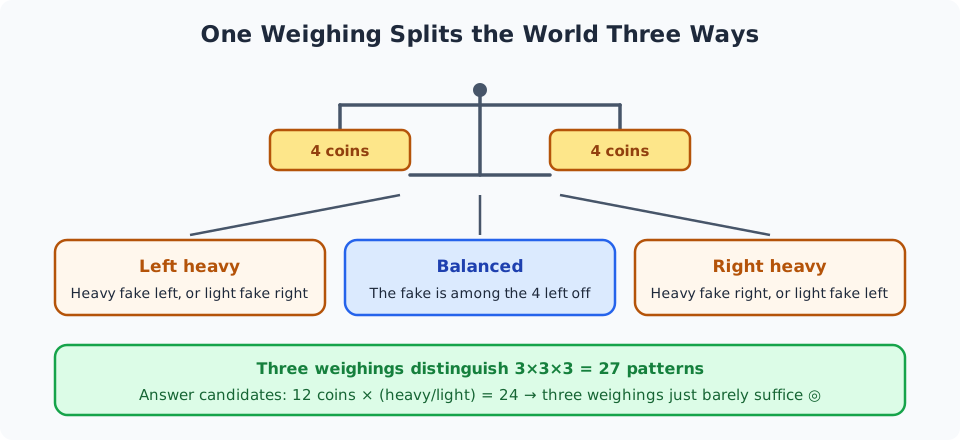
Now for the counting idea at the puzzle’s heart. One weighing has three possible outcomes: left heavy, balanced, right heavy. So three weighings can distinguish at most 3×3×3 = 27 patterns.
Meanwhile, the answer candidates number 12 coins × 2 (heavy or light) = 24. Twenty-seven versus twenty-four: it fits, with a margin of just three. Which means a single move that wastes the three-way split — like a weighing guaranteed to tilt — instantly makes three weighings insufficient. Balance, too, is precious information: the puzzle’s greatest lesson.
The Procedure: Weigh 4 Against 4, Then Swap
Now the actual solution. The opening move is 4 versus 4. Number the coins 1–12 and put 1, 2, 3, 4 on the left pan, 5, 6, 7, 8 on the right.
If it balances, life is easy: the fake is among the remaining 9–12, and coins 1–8 are now certified genuine — free to use as references. For the second weighing, compare 9, 10, 11 against three genuine coins; the tilt narrows the suspects and their weight direction, and the third weighing finishes the job.
The fun case is a tilt. Say the left pan drops. The suspects now appear to number eight: “possibly-heavy 1–4” and “possibly-light 5–8.” Here comes the masterstroke: swapping coins.
For the second weighing, recompose: left pan 1, 2, 5; right pan 3, 4, 6; and set 7, 8 aside. Heavy-suspects 3 and 4 move to the right; light-suspect 5 moves to the left. This weighing splits three ways:
- Balanced: the fake is 7 or 8, both light-suspects. Third weighing: 7 vs 8; the lighter one is the fake
- Same tilt as before (left down): the cause is a coin that didn’t move — heavy-suspects 1, 2 still on the left, or light-suspect 6 still on the right. Third weighing: 1 vs 2; the heavier is the fake, and if balanced, 6 is the light fake
- Tilt reversed: the cause is a coin that switched pans — heavy-suspects 3, 4 now on the right, or light-suspect 5 now on the left. Third weighing: 3 vs 4; the heavier is the fake, and if balanced, 5 is the light fake
In short: divide the coins into “stay,” “swap,” and “remove” groups, and the change in tilt (same / reversed / balanced) names the culprit’s group directly. Detail allocations vary by school, but every version shares the same spine: compose each weighing so its three outcomes map one-to-one onto three suspect groups.
Not Binary Search — Ternary Search
What this puzzle teaches is the habit of first counting how many ways a single trial can come out.
A yes/no question splits the world in 2; n questions distinguish 2^n cases. The game of “Twenty Questions” resolving about a million possibilities, and git bisect halving a change history to find the bad commit, live in that binary world. The balance splits 3 ways per use — a base-3 instrument that processes more candidates in the same number of trials.
The lens applies directly to practical troubleshooting. Rather than stacking binary checks — “is server A the cause, or not?” — design a single test whose outcome fans out multiple ways: “network layer, application layer, or data layer?” — and you reach the cause in fewer moves. Repeating confirmations whose outcome is all but predetermined is exactly the 6-versus-6 weighing, over and over.
Also crucial: “no anomaly” carries information too. Just as a balanced scale certified coins 9–12 as the suspect pool, confirming the healthy parts lights up the fault’s location by elimination.
What If You Change the Counts or Conditions?
With One Borrowed Genuine Coin as a Reference
You can handle 13 coins. Under the identify-and-determine-weight requirement, n weighings handle at most (3^n − 3)/2 coins — 12 for three weighings. But with one extra certified-genuine coin available, the freedom to balance pan counts grows, giving (3^n − 1)/2 — 13 coins in three weighings. One trusted reference expands your searching power — the same structure as inspection getting easier when you own one calibrated instrument.
The Non-Adaptive Solution with Weighings Fixed in Advance
Solvable. In contrast to the adaptive style — choosing each loading after seeing the last result — there exist non-adaptive solutions fixing all three loadings beforehand. Assign each coin a base-3 duty roster like “first weighing: left pan; second: off; third: right pan,” and the sequence of three tilts becomes a code that directly spells the fake’s number and weight direction. A design with clear kinship to error-correcting codes — magnificent.
If the Fake’s Weight Direction Is Known from the Start
The problem simplifies drastically: n weighings handle 3^n coins — 27 with three. Each round, split the coins into thirds and weigh two groups: a tilt names the group on the heavy (or light) side, balance names the unweighed group, and the candidates shrink threefold each time. The comparison shows just how exquisitely tuned the unknown-direction 12-coin version is.
Related Logic Puzzles and Paradoxes
See information compressed to one bit to save 99 friends in “the hat puzzle”; optimal procedure design questioned for 1,200 years in “the river crossing puzzle”; and a dollar vanishing to a numbers trick in “the missing dollar riddle.”

Summary
This article covered the logic puzzle classic “the 12 coins and the balance scale.”
The puzzle’s essence is not balance-handling technique but the move of counting first: “24 candidate answers, 27 distinguishable outcomes.” The moment you count, two things become visible at once — that not a single wasted weighing is affordable, and that three weighings nevertheless suffice. Estimate the information budget before flailing. That habit pays off in debugging, in experimental design, in everyday research.
Balance is information. “No anomaly” is a clue. When I hit a wall isolating a system fault, I make a point of remembering this scale.
To return to the full list of logic and probability puzzles, follow the link below.
Thank you for reading. We hope to see you in the next article.
Also popular with readers
📚 Series: Logic & Probability Puzzles (7/11)