Thank you for visiting this site. This article covers “confirmation bias.”
Have you ever felt a horoscope or personality test was “surprisingly accurate”? Or caught yourself searching only for good news about a stock you just bought? That is confirmation bias at work. Among all the cognitive biases, it is considered the most pervasive and the most powerful.
What Is Confirmation Bias?
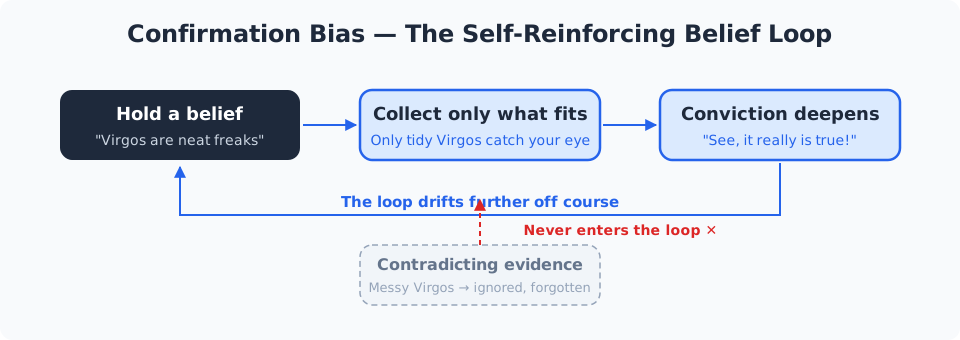
Confirmation bias is the tendency to gather only information that supports the beliefs and hypotheses you already hold, while ignoring or downplaying information that contradicts them.
The crucial point is that this is not deliberate behavior. You may fully intend to gather information fairly, but your brain quietly filters it before you notice.
- You read articles that agree with you to the end, but close opposing articles after the headline
- You remember the parts of a personality reading that fit you and forget the parts that miss
- You readily notice the failures of someone you dislike, but dismiss their successes as “luck”
Most of us recognize ourselves in at least one of these. All of them are confirmation bias in action.
Wason’s 2-4-6 Task
The classic experimental demonstration is the “2-4-6 task” run by psychologist Peter Wason in 1960.
Participants were shown the sequence “2, 4, 6” and asked to figure out the rule it follows. They could propose any sequences they liked, and the experimenter would only say whether each one fit the rule.
Most participants formed the hypothesis “numbers increasing by 2” and proposed only sequences that fit it — “8, 10, 12,” “20, 22, 24,” and so on. Each “yes, that fits” deepened their confidence, until they confidently announced the rule — and got it wrong.
The actual rule was far looser: “any increasing sequence.” “1, 2, 3” would have fit. So would “10, 100, 1000.”
The point of the experiment is that participants kept testing sequences that confirmed their hypothesis and almost never tried sequences that could break it (such as “3, 2, 1”). If you genuinely want to test a hypothesis, hunting for counterexamples is the shortest route — and humans do not do it naturally.
Why Does the Brain Hate Disconfirmation?
Why would such an inconvenient habit be built into the human brain at all? Psychology offers several explanations.
The first is “saving cognitive cost.” Rebuilding a hypothesis is expensive work for the brain. If your existing beliefs can still explain things, keeping them is the energy-efficient choice. On this view, confirmation bias is the brain cutting corners to save fuel.
The second is “avoiding cognitive dissonance.” Encountering information that contradicts your beliefs is genuinely unpleasant. The easiest way to resolve that discomfort (cognitive dissonance) is to label the contradicting information “wrong” or “an exception.”
The third, which has drawn attention in recent years, is the “argumentative theory of reasoning” proposed by cognitive scientists Mercier and Sperber. On this hypothesis, human reasoning did not evolve to find truth in the first place — it evolved to persuade others and win arguments. If winning arguments is the goal, then stockpiling evidence for your own side is not a bug but a feature.
Whichever explanation you prefer, they agree on one thing: confirmation bias is not “a defect of unintelligent people” but a specification rooted in the brain’s basic design. Willpower alone cannot switch it off.
Confirmation Bias in Daily Life and Business
Confirmation bias shows up everywhere.
Social media echo chambers are the textbook case. We follow accounts that share our views, and the algorithm prioritizes posts we will like. The result is a room where our own opinion echoes back at us from every wall, producing the illusion that “most people agree with me.”
Investment decisions suffer badly too. An investor who buys a stock tends to search for its good news and wave off bad news as “temporary.” This is one reason people are slow to cut their losses.
Job interviews are well documented: once an interviewer forms the hypothesis “this candidate seems strong” in the first few minutes, their later questions unconsciously drift toward confirming it.
Medical misdiagnosis is also linked to confirmation bias — attending to the symptoms that fit the initial diagnosis while treating the ones that do not as exceptions. Experienced doctors form better initial hypotheses, but some research notes they can also fixate on those hypotheses more strongly.
Confirmation Bias in the Age of AI
Confirmation bias is ancient, but I would argue no era in history has reinforced it as efficiently as ours.
One reason is recommendation algorithms. Video sites, social media, and news apps all learn “what you like” and show more of it. Without lifting a finger, you get an environment that auto-assembles itself out of agreeable information — the so-called “filter bubble.”
The other is conversation with generative AI. Ask a model like ChatGPT “I think X — that’s right, isn’t it?” and it will tend to answer within your premise. Depending on how you phrase your questions, AI becomes the most capable “yes-man” ever built.
Used differently, though, AI becomes a powerful tool against confirmation bias. Ask it “list the weaknesses of this idea” or “what is the strongest argument on the other side?” and it will do the counterevidence-gathering you would hesitate to ask of a friend, without complaint. Whether AI plays the yes-man or the devil’s advocate depends entirely on how you design the question.
Showing People Opposing Evidence Doesn’t Change Their Minds
At this point you might think, “then the fix is simple — just show people the other side’s information.” Unfortunately, it is not that easy.
In a famous experiment, supporters and opponents of the death penalty were both given two studies to read — one favoring each side. Since everyone read the same materials, you would expect opinions to converge toward the middle. The opposite happened. Supporters became more supportive, opponents more opposed, and the gap between them widened.
Why? Because people accept congenial studies as “well-designed research” while nitpicking uncongenial ones — “small sample,” “different conditions.” If both studies were judged with equal rigor, this would not happen. In other words, confirmation bias operates not only when we gather information but also when we evaluate the information we have gathered.
This phenomenon — digging in harder when shown counterevidence — is sometimes called the “backfire effect” (recent replications suggest it occurs only under limited conditions, but at minimum, “show them the facts and they’ll come around” is clearly too simple).
That is why the countermeasures below center not on “confronting others with counterevidence” but on going out to find counterevidence against yourself. Counterevidence you discover on your own is far easier to accept than counterevidence thrust at you.
The Countermeasure: Go Hunting for Counterevidence
The defense against confirmation bias is the mirror image of the weakness Wason exposed: deliberately go looking for disconfirming evidence.
- Read articles and books from the opposing side — all the way to the end
- Before an important decision, write down: “if this decision is wrong, why would it be wrong?”
- When everyone in a meeting agrees, assign someone to argue the opposite (a devil’s advocate)
The second technique is known in psychology as “consider the opposite,” and multiple experiments confirm it reduces bias.
That said, remember that confirmation bias can never be fully eliminated. Even psychologists who study it fall for it, and believing “I’m immune” is precisely the most dangerous state of mind.
Common Objections and a Self-Check
Let me address the remaining questions.
Isn’t Collecting Information You’re Interested in Just Normal?
Absolutely — following your interests is fine in itself. The problem arises when you mistake that collection for verification. Collecting news about your favorite team is harmless; but in domains where “being wrong costs you” — investing, health — a pile of supporting evidence is not a test of anything. The key is to distinguish “collecting for enjoyment” from “verifying for a decision.”
Doesn’t This Only Affect Stubborn People?
No — personality has almost nothing to do with it. Wason’s participants were ordinary university students, and later research found the same pattern in scientists and physicians. Ironically, some studies report that the more knowledgeable you are, the better you are at rebutting inconvenient evidence — and thus the better you are at protecting your beliefs. Intelligence is not armor against this bias; sometimes it is a weapon in its service.
How Do I Check Whether I’m Caught in It?
There is a simple test. Ask yourself: “have I recently read even one good article or book that argues against my position?” If nothing comes to mind, your information diet has tilted to one side. A second test: can you state “what evidence, if it appeared, would prove my opinion wrong?” An opinion that cannot answer that question may have hardened into an unfalsifiable belief.
Related Cognitive Biases
Below are articles on biases closely tied to confirmation bias. The “availability heuristic,” which drags judgment toward easily recalled information, and “hindsight bias,” the feeling of “I knew it all along,” frequently operate hand in hand with confirmation bias.
There is also a paradox about the logical strangeness of collecting “confirmations” — “Hempel’s Ravens.” Reading it alongside this article deepens the picture.
Summary
This article covered “confirmation bias.”
Humans do not gather information to test their beliefs — we gather it to reinforce them. The polarization of opinion on social media and the psychology of refusing to cut investment losses both grow from this same root.
That is exactly why the small extra step of “going hunting for counterevidence” is so valuable. I believe the habit of deliberately reading information inconvenient to your own views raises the quality of your thinking by a full level on its own.
To return to the full list of cognitive biases, follow the link below.
Thank you for reading. We hope to see you in the next article.
Also popular with readers
📚 Series: Cognitive Bias Guide (2/26)