Thank you for visiting this site. This article covers “hindsight bias.”
The day after a market crash, people saying “I knew this was coming” suddenly multiply. After a lost game, voices insisting “I always thought that lineup was a mistake” flood in. If they truly knew in advance — why didn’t they short the market? Why didn’t they say so during the game?
What Is Hindsight Bias?
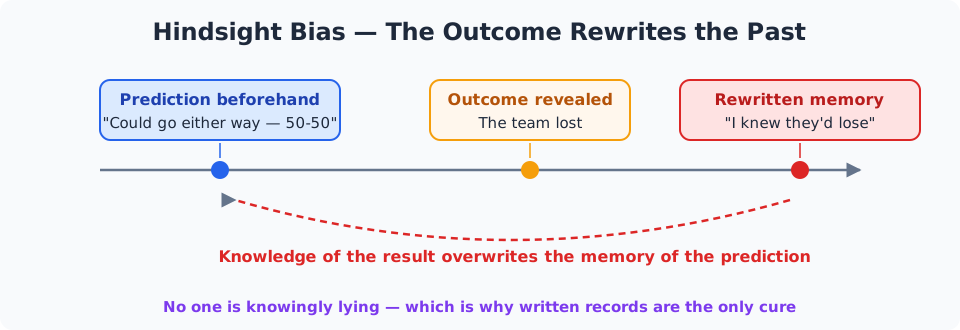
Hindsight bias is the tendency, once you know an outcome, to feel that the outcome was predictable all along. It is also known as the “knew-it-all-along effect.”
The frightening part is that nobody is lying. The moment you learn the outcome, your brain silently rewrites your memory of your own past predictions, so you genuinely feel you “called it.”
- A contest you thought was a coin flip → after seeing the result, you remember predicting it “70-30”
- A decision you agonized over → once it succeeds, you remember being “confident from the start”
Memory is not a recording — it is reconstructed each time you recall it. Hindsight bias is what happens when knowledge of the outcome leaks into that reconstruction.
Fischhoff’s Experiments
Hindsight bias was first demonstrated experimentally by psychologist Baruch Fischhoff. In a study published in 1975, he had participants read accounts of a historical event whose ending almost nobody knows — the 19th-century war between Britain and the Gurkhas of Nepal.
He split participants into groups, told only some of them “the actual outcome,” and then asked everyone to rate “how predictable each possible ending was, based on the background information alone.”
The results were unambiguous. Groups told the outcome rated that outcome as far more “predictable in advance” than groups who weren’t told. Even when explicitly instructed to “ignore your knowledge of the outcome,” the effect did not disappear.
An outcome, once known, cannot be pushed back out of your head by conscious effort — that is the experimental bottom line of hindsight bias.
The Three Levels of Hindsight Bias
Later research treats hindsight bias not as one phenomenon but as three overlapping levels. The framework organized by psychologists Roese and Vohs in 2012 is the best known.
Level 1 is “memory distortion” — misremembering your own past prediction as closer to correct than it was: “I’m sure I said so,” “I definitely expected this.”
Level 2 is “the illusion of inevitability” — feeling that “it was bound to happen,” as if the causal path to the outcome had been a single straight road. However many accidents were actually involved, a story reverse-engineered from the outcome always looks like a clean straight line.
Level 3 is “the illusion of foreseeability” — feeling that “it could have been known in advance” from the information available at the time. When we sit in judgment of others after a failure, this is mainly the level we are wielding.
Broken down this way, you can see that hindsight bias is not a mere “memory slip” — it is a phenomenon that retroactively remodels how the world itself appears.
Why Does Memory Get Rewritten?
“Your memory gets rewritten” may sound hard to believe, so let’s dig into the mechanism.
The key is that human memory is not “playback of a recording” but “reconstruction on demand.” The brain does not store past events whole; it stores fragments and rebuilds them at recall time, filling gaps with present knowledge. Normally this design is a triumph — it handles a vast past with minimal storage.
The problem is that “present knowledge” is part of the building material. Try to recall “my prediction before the game” after learning the result, and the brain assembles the answer from “fragments of the prediction” mixed with “knowledge of the result.” No sorting mechanism exists to keep the outcome out.
The second factor: knowing an outcome auto-generates a causal story. “The star player was injured.” “The other team was on a winning streak.” The instant you know the result, supporting material assembles itself from memory into a coherent narrative of “a loss that was always coming.” And once the story flows, feeling that “it was foreseeable” is the natural next step.
Hindsight bias, in other words, emerges from the combination of two normally useful functions — memory’s storage-efficient design and our storytelling ability. That is why it operates without awareness and cannot be blocked by willpower.
It Distorts Investing, Accident Inquiries, and Management Reviews
Investing is a treasure trove of hindsight bias. After every crash come the commentaries — “the warning signs were everywhere” — yet the people who actually sold on those signs beforehand are vanishingly few. Looking at an old chart and feeling “buying here was obviously the move” has the same structure: to eyes that know the outcome, the past looks simple.
Assigning blame after accidents is where the damage gets serious. Post-accident inquiries tend to ask the person in charge, “how could you miss this danger?” — but that is the perspective of someone who knows the ending. At the time, that danger may have been just one of countless possibilities. Blame that ignores hindsight bias risks condemning decisions that were entirely reasonable when they were made.
Evaluating management decisions works the same way. Strategies that succeed are called “visionary”; strategies that fail are called “reckless gambles.” But the quality of a decision should properly be judged not by its result, but by “whether it was rational given the information available at the time.”
Why History Looks Inevitable
One of the places hindsight bias hits hardest, I believe, is our understanding of history.
Read a history textbook and the rise and fall of empires, the outcomes of wars, all read as if causes accumulated toward an inevitable result. But that account is also a story woven by someone who knows the ending, collecting only the factors that led to it. The same era contained countless factors that led nowhere — and those are quietly deleted from the narrative.
This calls for care when drawing lessons from history. “That company succeeded because it did X.” “That nation declined because it neglected Y.” Such narratives may be causal chains edited in hindsight. Learning from history is worthwhile — but adding one question, “what could people at the time actually see, and what couldn’t they?” transforms the quality of the lesson.
News commentary is no different. The clarity of the “reasons this happened” offered right after an incident or a crash is often a product of hindsight. Reasons nobody voiced at the prediction stage bloom in the hundreds after the result. Once you notice this asymmetry, you never read punditry quite the same way.
The Fix: Write Your Predictions Down
Since hindsight bias works by rewriting memory, there is exactly one first-line defense: keep records that cannot be rewritten.
- Before any important decision, write down “my prediction, and my confidence level (%)”
- For investments, log the reason for each trade and your expected scenario, with the date
- At project kickoff, have the team record “what do we think the probability of success is?”
Reviewing these records later, you will be startled by how often your predictions missed. That “surprise” is the best teaching material there is for learning your true forecasting ability.
When judging others, deliberately return to “the viewpoint of someone who didn’t know the outcome.” In postmortems, list “what was known at the time” first, before debating the quality of the decision — it measurably reduces unfair hindsight condemnation.
Where Reflection Ends and Hindsight Begins
What’s the Difference Between Healthy Review and Hindsight?
A good question. The boundary is whether you separate “information available then” from “information gained since.” Asking “of the information obtainable at the time, what did we overlook?” is healthy review. Judging your past self or others with “it was obvious, seen with today’s eyes” is hindsight. In retrospectives, list “what we knew then” before the discussion starts, and the two stay separated.
Are ‘I Told You So’ Arguments Hindsight Bias Too?
Largely, yes. In household or workplace disputes of “I said this ages ago,” both sides usually believe their memories sincerely. After the outcome is known, a once-vague remark transforms into a memory of “a clear warning.” It is more constructive to assume this is simply how memory works than to assume someone is lying — and it is exactly why agreements worth keeping belong in writing or in chat logs.
Does Hindsight Bias Have Any Upside?
One, arguably: it preserves the feeling that “the world is understandable.” If every event looked like unforeseeable chance, we would lose the will to learn at all. The ability to organize the past into stories is also the foundation for extracting lessons and applying them. The harm begins only when the story is used to condemn others with “you should have seen it coming,” or to inflate faith in your own foresight. Use the story for learning; use the information of the time for judging. That division is enough.
Related Cognitive Biases
Hindsight bias teams up with other biases to make your judgment feel sharper than it is. See the “Dunning-Kruger effect,” where the least able are the most confident, and “confirmation bias,” the collection of only convenient evidence.
Summary
This article covered “hindsight bias.”
The moment you learn an outcome, your past memory rewrites itself and the world looks like it was “predictable.” This bias inflicts two harms at once: overconfidence in your own foresight, and unfairly harsh criticism of others.
The countermeasure is humble but powerful: don’t keep predictions in your head — put them on paper with a date. That alone lets you face the un-rewritable record of your actual forecasting ability.
To return to the full list of cognitive biases, follow the link below.
Thank you for reading. We hope to see you in the next article.
Also popular with readers
📚 Series: Cognitive Bias Guide (8/26)