Thank you for visiting this site. This article covers the “Dunning-Kruger effect.”
You have surely met both types: the person who lectures confidently on knowledge they acquired last week, and the genuine expert who says, “I’m still learning, really.” Competence and confidence not only fail to match — they often invert. The Dunning-Kruger effect is the name given to this phenomenon.
What Is the Dunning-Kruger Effect?
The Dunning-Kruger effect is the tendency of low performers to overestimate their own ability, and of high performers to underestimate theirs.
The core of this bias is not simple “arrogance.” The point is structural: accurately evaluating a skill requires that very skill.
A weak writer, for example, also lacks the ability to judge “what good writing looks like,” so the flaws in their own writing are invisible to them. If you cannot see your flaws, your self-assessment naturally floats upward. Low ability conceals low ability. Psychologists call this “ability to evaluate yourself” by the name “metacognition.”
The Bottom 25% Rated Themselves Above Average
The bias was demonstrated in a 1999 paper by Cornell psychologist David Dunning and his graduate student Justin Kruger.
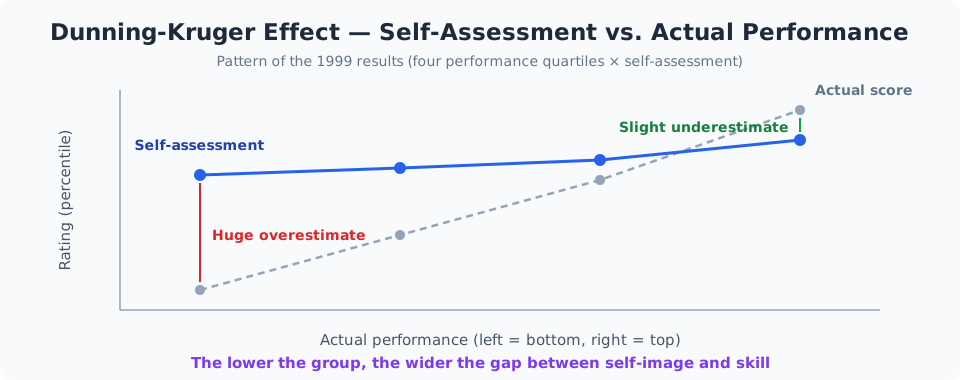
They gave university students tests of “humor,” “grammar,” and “logical reasoning,” then asked each student to estimate “what percentile do you think your score falls in?” The results were consistent:
| Actual score | Self-assessment |
|---|---|
| Bottom 25% group | Estimated themselves around the 62nd percentile on average (massive overestimate) |
| Top 25% group | Estimated slightly below their actual standing (underestimate) |
The students with the lowest scores were the ones most convinced they were above average. Even more interesting: when the bottom group received training in how to grade the tests, they noticed how poorly they had done and revised their self-assessments downward. As their ability rose, their own incompetence became visible to them.
One caveat: the famous curve labeled “Mount Stupid” and the “Valley of Despair” appears nowhere in the original paper — it is an internet-born embellishment. What the paper showed was simply “a gap between self-assessment and actual performance,” not any dramatic mountain-shaped curve. The diagram in this article follows the original study’s actual finding.
Dunning-Kruger in Daily Life and Business
Confident pronouncements on social media are the obvious example. Experts speak carefully, hedged with conditions, while someone who has read a single introductory book speaks in absolutes. The shallower the knowledge, the less visible the field’s complexity and exceptions — which is exactly what makes simple, strong conclusions possible.
Driver self-ratings are the classic survey finding. Across countries, 70–90% of drivers rate themselves “above average.” Since everyone cannot be above average, a large share are overestimating.
In the workplace, the phase when a new hire finds the job “easier than expected” is famously dangerous — usually they simply cannot yet see the job’s depth and pitfalls. Conversely, when a veteran calls a project “difficult,” they are likely seeing risks invisible to beginners.
Learning any skill follows the pattern too. In languages or programming, a little knowledge brings a moment of “I’ve basically got this,” and deeper study brings the realization “I understood nothing.” That near-universal arc is precisely metacognition developing.
Understanding It Through the Four Stages of Learning
To feel this bias intuitively, it helps to overlay the classic “four stages of competence” model from education. Mastery is said to pass through:
- “Unconscious incompetence” — you don’t even know what you can’t do. The difficulty itself is invisible, so everything looks easy
- “Conscious incompetence” — you now see what you can’t do. The depth of the subject appears, and confidence plummets
- “Conscious competence” — you can do it with deliberate effort. Skill and self-assessment begin to align
- “Unconscious competence” — you do it without thinking. But because so much has become “obvious to you,” it feels like anyone could do it, and self-assessment tends to turn modest
Overestimation lives in stage 1. Watching a craftsman’s video and thinking “I could probably do that” happens because the countless micro-decisions packed into the craftsman’s movements are invisible to the viewer. The moment you actually try it and enter stage 2, “looks doable” becomes “I had no idea.”
The practical lesson of this model: a crash in confidence is not a sign of failure — it is the sign of progressing from stage 1 to stage 2. When a new field starts feeling “harder than expected,” you have not gotten worse; your field of view has widened. Quitting at that exact point is the greatest waste.
The Critique: Is It Just a Statistical Illusion?
Having introduced the effect, fairness requires mentioning that in recent years it has faced a serious challenge from statisticians. The debate is now unavoidable when discussing this bias.
The critique runs as follows. In a task of “guessing your own percentile,” even if everyone answered randomly, low scorers would “appear” to overestimate and high scorers to underestimate — because those at the bottom have nowhere to miss but up, and those at the top nowhere to miss but down. This is the statistical phenomenon of “regression toward the mean,” and it alone reproduces much of the shape of the original graphs.
Add the general tendency to consider oneself above average (the “better-than-average effect”), and you can generate data resembling the original paper without assuming any special psychological mechanism.
Does that make the effect an illusion? Not quite. Evidence for a metacognitive component exists — such as the finding that grading training improved self-assessments — and researchers continue to argue. My own view is that the practical lesson, “beginners cannot see the pitfalls,” survives regardless of the statistical dispute — but presenting Dunning-Kruger as “a fully established scientific law” would be unfair, so it is best remembered together with this controversy.
The Mirror Image: Impostor Syndrome
The other half of Dunning-Kruger — “high performers underestimate themselves” — has a well-known extreme form: “impostor syndrome.”
Despite objectively solid accomplishments, a person feels persistently that “my success is luck, not ability” and “someday they’ll find me out.” The more capable you are, the more clearly you see how many people are above you, which makes it easy to place yourself too low.
The result is a structural pattern: the underqualified broadcast with total confidence, while the qualified stay silent, thinking “I’m not there yet.” I believe this is part of why volume and correctness so often fail to correlate on social media.
And whether you suffer from overestimation or underestimation, the prescription turns out to be the same — which brings us to the countermeasures.
The Fix: External Yardsticks for Your Ability
The countermeasure for the Dunning-Kruger effect comes down to one principle: don’t leave self-assessment to subjectivity — measure with external yardsticks. Whichever direction your subjective self-rating errs, an external yardstick reports your true position.
- Regularly put yourself in “objectively scored situations” — tests, certifications, competitions
- Deliberately study the work of people clearly better than you (visible superiors dissolve false omnipotence)
- Keep people around who give you feedback, and welcome the negative feedback most
- In any new field, operate on the assumption: “I cannot yet see the pitfalls”
It also works when evaluating others’ confident claims. Just knowing that “strength of assertion is not evidence of competence” makes you far harder to sway with volume alone.
Questions About Dealing with the Confident
Should I Distrust Every Confident Person?
No — that overcorrects. Plenty of experts hold confidence backed by real accomplishment, and plenty of people’s confidence matches their ability. What this bias teaches is only that confidence alone is weak evidence of competence. Judge by track record, reasoning, and verifiable explanations rather than by assertiveness. And the converse error is just as real: concluding someone is less capable because they speak modestly.
So the Goal Is to Be Humble?
Not quite. The goal is not to present yourself as lesser but to make your self-assessment match your actual ability. Say “I can” about what you can do and “I can’t” about what you cannot. Underestimation has real costs — missed opportunities, unclaimed compensation. The ideal is knowing your ability accurately and stating it exactly as it is.
How Do I Help a Colleague Who Is in Stage 1?
Telling them “you don’t understand” head-on tends to backfire — precisely because what they don’t understand is invisible to them. What works, as the original study itself showed, is teaching the evaluation criteria themselves. Show exemplary output, have them self-score against a checklist, give them a slightly stretching task to attempt for real. Handing someone “a yardstick they can use on themselves” works far faster than persuasion.
Related Cognitive Biases
Below are related biases around self-evaluation. “Hindsight bias” — feeling you “knew it all along” after the fact — pairs with Dunning-Kruger (in the worst way) by inflating trust in your own judgment.
Summary
This article covered the “Dunning-Kruger effect.”
The essence of this bias is not “a story for laughing at ignorant people.” It is the fact that every one of us falls into this state in any field where we are a beginner. I have stepped into the “I’ve basically got this” trap myself, repeatedly, every time I pick up something new.
That is why it matters to have systems that measure ability with objective yardsticks rather than strength of confidence. And when a strange sense of omnipotence washes over you in a new field — consider that it might be evidence your learning is still shallow.
To return to the full list of cognitive biases, follow the link below.
Thank you for reading. We hope to see you in the next article.
Also popular with readers
📚 Series: Cognitive Bias Guide (7/26)