Thank you for visiting this site. This article covers the “anchoring effect.”
Have you ever seen an ad that says “Regular price $298 — today only, $98!” and felt you were getting a bargain? If you think about it calmly, the only question that matters is “is this product worth $98?” And yet that first number — 298 — digs into your judgment like an anchor.
What Is the Anchoring Effect?
The anchoring effect is the phenomenon in which the first number or piece of information you encounter becomes an anchor, and every judgment that follows is pulled toward it.
When a ship drops anchor, it can only drift within a small circle around it. In the same way, once your mind has seen an initial number, your thinking can only wander in that number’s neighborhood.
The frightening part is that the anchor works even when it is completely irrelevant to the judgment at hand. The famous experiment below demonstrated this in spectacular fashion.
The Experiment Where a Roulette Wheel Changed the Answer
Daniel Kahneman and Amos Tversky, the founders of behavioral economics, ran the following experiment in 1974.
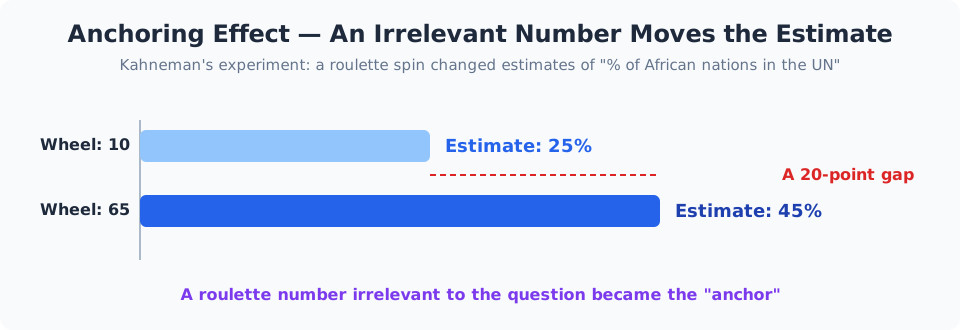
In front of the participants, they spun a roulette wheel numbered 1 to 100. The wheel was secretly rigged to land only on “10” or “65.”
After the wheel stopped, participants were asked whether the percentage of African nations in the United Nations was higher or lower than the number shown — and then asked to estimate the actual percentage.
The results were remarkable.
| Roulette number | Median estimate |
|---|---|
| Group that saw 10 | 25% |
| Group that saw 65 | 45% |
A meaningless roulette spin moved the estimates by 20 percentage points. This happened even though participants fully understood the wheel had nothing to do with the question.
Why Do Anchors Work?
Psychology offers two main explanations for why we get dragged along even by irrelevant numbers.
The first is “insufficient adjustment.” People start from the anchor and adjust — “that seems too high, let me lower it” or “too low, let me raise it.” But this adjustment tends to be cut off early, at the point of “this feels about right,” so the final answer stays close to the anchor.
The second is called “selective accessibility.” The moment you see the anchor number, your brain unconsciously starts retrieving information consistent with it. Someone who sees “65%” finds evidence that “Africa has many countries” coming to mind more easily, while someone who sees “10%” gathers evidence for “probably just a few.” In other words, the anchor gets planted as a seed of confirmation bias.
What both explanations share is that the anchor starts working before it ever reaches conscious awareness. By the time you think “I’ll just ignore it,” the foundation of your judgment is already contaminated.
It Happens on Supermarket Shelves Too
Anchoring is not limited to special situations like negotiations. Here is a clear experiment showing it operates at the level of everyday grocery shopping.
An American supermarket ran a discount on canned soup. The discount was identical; only the sign changed.
- Sign A: “No limit per customer”
- Sign B: “Limit 12 per customer”
With sign A, shoppers bought about 3 cans on average. With sign B, the average jumped to about 7 — more than double. The purchase limit of “12” became the anchor for how many to buy.
Rationally, “limit 12” does not mean “you should buy 12.” It is just a cap. Yet once “12” is placed in your head, the adjustment of “maybe I’ll stock up a little” starts from 12. If you have ever overbought after seeing a “limited stock” or “max N per person” sign, you were reenacting this experiment in the store aisle.
The key insight of this experiment is that the anchor does not have to be a price. A quantity, a number of days — any number that enters your field of view can become an anchor.
Anchors Hidden in Price Tags, Negotiations, and Menus
I would argue anchoring is the most frequently “exploited” bias in our daily lives.
Dual pricing is the most obvious example. A tag reading “Regular $298 → Sale $98” hammers in 298 as the anchor to make 98 feel cheap. This is why inflating a baseless “regular price” is regulated as deceptive pricing in many jurisdictions.
Price negotiations reward whoever states a number first, because that number becomes the anchor. Multiple experiments confirm that in used-car and real-estate negotiations, “the opening offer” heavily determines the final price.
Salary negotiations work the same way. One reason interviewers ask your “desired salary” first is to use your answer as the anchor. Conversely, stating a figure somewhat above market rate first is how the candidate plants their own anchor.
Restaurant menus apply it too. Put a $300 bottle at the top of the wine list, and the $80 bottle suddenly looks “reasonable.” The $300 wine is doing its job even if nobody ever orders it.
Using Anchoring at Work
Anchoring is not only something to “defend against” — it can also be “used well.” Here are some examples from actual business practice.
The order you present quotes is a classic. When proposing multiple plans, showing the most expensive plan first makes the later ones feel affordable. Combined with people’s tendency to pick the middle option, this good-better-best lineup is a staple of price design.
The opening move in a negotiation matters too. As noted above, the first number on the table defines the range of the negotiation that follows. Rather than waiting for the other side, presenting your own number with justification usually works in your favor.
One caution, though: an unrealistic anchor destroys trust. An opening figure wildly outside the market range risks ending the negotiation on the spot as “not worth discussing.” Anchoring only works within the range the other party still perceives as plausible.
Defending Against Anchors
The nasty thing about the anchoring effect is that experiments show even experts who know about it cannot fully avoid it. In a study where professional real-estate appraisers valued a property, the “listing price” they were shown beforehand shifted even their expert appraisals.
Still, there are ways to shrink the impact.
- Before looking at any price, form your own estimate of what it should cost (drop your own anchor first)
- Ignore “list price” and “reference price”; instead compare actual market prices of several similar products
- In negotiations, try to be “the side that names a number first” whenever possible
- Whenever a number is presented to you, always ask “what is this number based on?”
For any major purchase especially, I recommend pausing once to ask whether the first number you saw has become your anchor.
Does Knowing the Market Rate Protect You?
Why Market Knowledge Alone Is Not Enough
Knowledge is genuinely useful armor, but it does not protect you completely. As covered above, even professional appraisers were dragged by the listing price. What the experiments show is that market knowledge can “weaken” the anchor’s pull but cannot “erase” it. That is why the extra step of “forming your own estimate first” matters on top of knowledge.
What Kinds of Numbers Can Become Anchors?
The range is surprisingly wide. In experiments, even completely meaningless numbers like the last two digits of one’s Social Security number worked as anchors. Beyond numbers, first experiences — “the first apartment you viewed,” “the first restaurant you tried” — also act as anchors in the broad sense, becoming the baseline for every later comparison. A practical rule of thumb: “whatever you encounter first becomes the standard.”
When Should You Actually Be On Guard?
You do not need to interrogate every number you see. Getting anchored on small everyday purchases costs you very little. The situations worth real vigilance are the big, hard-to-reverse ones — housing, cars, insurance, salary. For major financial decisions only, stop once and ask “who placed this number here first?” That selective attention is the realistic way to live with this bias.
Related Cognitive Biases
Below are articles on the “availability heuristic,” which distorts judgment at the entry point just like anchoring, plus Kahneman’s “prospect theory” and “behavioral economics,” which systematized these findings. If you want to go deeper into the psychology of pricing — loss aversion, framing, and more — these are good next steps.
Summary
This article covered the “anchoring effect.”
If even a meaningless roulette number can move our judgment, there is no way deliberately engineered price displays and negotiation tactics would fail to. It is hardly an exaggeration to say we shop every day in a sea of anchors someone else has dropped.
That is exactly why the habits of “question the first number” and “build your own baseline first” are so valuable. Next time you see a sale price, try deciding what you would pay before you look at the “regular price.”
To return to the full list of cognitive biases, follow the link below.
Thank you for reading. We hope to see you in the next article.
Also popular with readers
📚 Series: Cognitive Bias Guide (3/26)