Thank you for visiting this site. This article covers the “Barnum effect.”
“You sometimes present as outgoing and sociable, but inside you have a careful, introspective side.” Ever read a line like that in a horoscope or personality test and thought, “that’s so me”? The thing is, that sentence applies to nearly the entire human race. Yet people still feel “it saw right through me.” That is the Barnum effect.
What Is the Barnum Effect?
The Barnum effect is the tendency to experience vague, general statements that fit almost anyone as accurate descriptions aimed specifically at you.
The name comes from the 19th-century American showman P.T. Barnum, credited with the line “we’ve got something for everyone” — psychologist Paul Meehl coined the term in his honor. It is also called the “Forer effect” after its discoverer.
Barnum statements come in recognizable patterns:
- “Double-siding”: outgoing, but with an introverted side (heads you win, tails you also win)
- “Voicing the wish”: you have talents you haven’t yet fully used (everyone wants this to be true)
- “Gentle self-criticism”: you tend to be too hard on yourself (the humbler the reader, the harder they nod)
Precisely because these sentences aim at nothing, they hit every target.
Forer’s Experiment
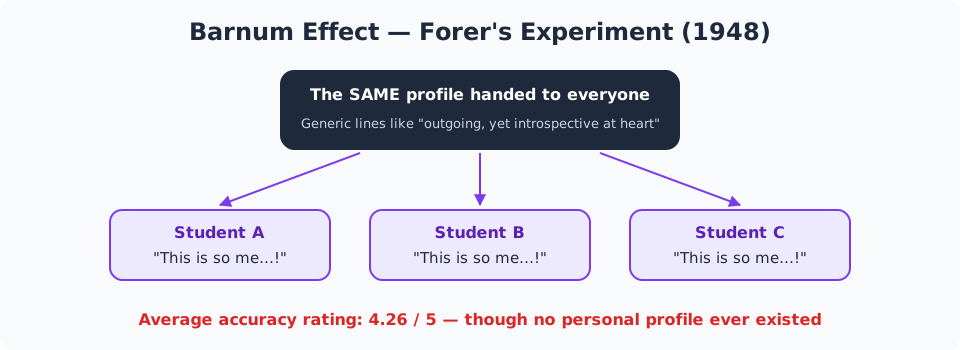
The classic demonstration is psychologist Bertram Forer’s 1948 experiment.
Forer gave his students a personality test, then later handed each one “your own personalized personality profile” and asked them to rate “how well does this describe you?” on a 5-point scale.
The average: 4.26 out of 5. The students judged the profile “remarkably accurate.”
The trick: every student had received exactly the same text — generic sentences Forer had assembled from astrology books, like “you have a strong need for others to like you” and “you tend to be critical of yourself.” No personalized profile ever existed, yet nearly everyone felt “it captured me.”
The experiment has been replicated over and over, across decades and countries, with the same result. The feeling of “being seen through” is that easy to manufacture.
Three Conditions That Strengthen the Effect
Follow-up research identified conditions that amplify the Barnum effect. The big three:
-
“Believing it’s just for you.” The same text rated as “a personalized reading” scores as far more accurate than when labeled “a general statement.”
-
“Authority in the source.” The fortune-teller’s reputation, the “scientific” trappings of a psych test, a famous assessment brand — the grander the source appears, the more persuasive the identical text becomes.
-
“Positive content.” People accept flattering descriptions readily and resist critical ones. It is no accident that horoscope copy is built from affirmations like “hidden talent” and “secretly sensitive.”
Viewed from the other side, these three are a checklist for the technology of belief. Whenever something arrives wrapped in the personalized-authoritative-positive trio, it is worth calmly checking whether the content could ever be verified.
Build a Barnum Statement Yourself
The best vaccine against the Barnum effect, I believe, is writing a “fits-everyone” reading yourself, once. Experience the trick from the inside and the naive spell never works again. The recipe combines the patterns above:
- Open with double-siding: “You adapt smoothly to those around you, but you hold firm opinions of your own.”
- Voice the wish: “That strength has not yet been fully expressed.”
- Mix in gentle self-criticism: “You can be so hard on yourself that it wears you out.”
- Close with an unfalsifiable prophecy: “Before long, someone will appear who understands your true worth.”
Read it back — a plausible “reading,” complete. Notice that every sentence is structurally impossible to deny. If “adapts smoothly” misses, “holds firm opinions” hits. “Not yet expressed” is true whatever the present looks like. “Before long” has no deadline, so it can never miss.
Genuinely informative statements are the opposite: “falsifiable ones.” “You changed jobs last year” is cleanly wrong if you didn’t. Only claims that risk being wrong are worth anything when they’re right. Carry that lens and it changes how you read not just horoscopes, but business proposals and self-help claims too.
The Machinery Behind Fortune-Telling, Ads, and Quiz Content
Fortune-telling and personality quizzes are the obvious home turf. Horoscopes manufacture the “it’s accurate!” experience by combining Barnum statements with “confirmation bias” — remembering only the hits.
Cold reading is the conversational craft of using the Barnum effect deliberately. “You’ve had some trouble with a relationship recently, haven’t you?” cannot miss, since almost no one is trouble-free. Watch the reactions, narrow the vague statements step by step, and the performance of “I see everything” assembles itself.
Marketing leans on it heavily. Ad copy like “for you, who work so hard and get so little credit” is engineered so most readers feel “that’s me.” Combine it with ad targeting and the eerie “how did they know?” experience gets even stronger.
Social media quiz content shares the structure. The “your hidden talent type” that lands after five questions feels apt not because the quiz is precise, but because the description is universal.
The 16-Type Personality Boom and the Barnum Effect
No modern discussion of the Barnum effect can skip the “16-type personality tests” that dominate social media.
Several mechanisms stack up to make type descriptions feel “accurate.” The type texts themselves contain plenty of Barnum-style lines — “sociable, but needs alone time.” Moreover, the result is computed from your own self-reported answers, so a description reflecting your own responses is bound to feel right.
Then, once you own a type label, confirmation bias takes over. Behaviors matching “I’m an introvert type” stick in memory and reinforce the label daily. Seeing same-type strangers post relatable content — “so true!” — deepens the attachment further.
To be clear, I don’t think talking about personality in types is worthless. As a prompt for self-reflection or a conversation starter, it is excellent content. What deserves caution is using type-test results as grounds for life-affecting decisions like hiring or team assignment. As Forer’s experiment showed, “feeling accurate” and “predicting accurately” are different things.
Questions That Break the Spell
The checkpoints for catching the Barnum effect are simple:
- Ask yourself: “if I’d been told the opposite, would I have nodded too?”
- Consider whether the statement “fits other people as well” (how would your neighbor react to it?)
- Beware the preambles “personalized” and “just for you” (the more “personal” it claims to be, the harder it hits)
- Check for concrete, verifiable predictions — dates, numbers, proper names
Enjoying fortune-telling as entertainment is perfectly fine. The moment to be careful is when someone who built trust through the Barnum effect starts steering you toward expensive products or services. Remember: the feeling of “being seen through” is not evidence of anything.
The Questions Every Horoscope Fan Asks
But a Fortune-Teller Once Told Me Something Really Specific!
Several possibilities. One is “cold reading” — the craft of narrowing in from clothes, age, speech, and reactions can, in skilled hands, stage astonishingly specific “hits.” Another is memory editing. We forget the misses and keep the hits (confirmation bias). Skeptics’ investigations repeatedly report the same finding: record a full session, play it back, and the number of misses is startling. Your memory of the amazing hit can be genuine — and still be “a memory that archived only the hits.”
Are There Personality Tests Science Actually Trusts?
Yes. The standard framework in psychological research is the “Big Five,” which measures personality as positions along five axes: “extraversion,” “agreeableness,” “conscientiousness,” “neuroticism,” and “openness.” What separates it from entertainment quizzes: it uses continuous scores rather than types, results stay stable across repeat measurements, and it has documented validity for predicting behavior. Even the Big Five, though, is nowhere near precise enough to pronounce on an individual’s life. The honest use of any personality test ends at “a rough indication of tendencies.”
Is It OK to Use Barnum-Style Compliments on People?
Generic compliments do work as social lubricant, and within ordinary politeness there is no sin in them. But with someone whose trust you actually want to deepen, they can backfire — a one-size-fits-all compliment can be read as “you’re not really seeing me.” What truly lands is a concrete observation that fits only that person (“that one comment you made in the meeting saved the whole discussion”). Knowledge of the Barnum effect is useful not only for not being fooled, but for raising the resolution of your own words.
Related Cognitive Biases
The Barnum effect rarely works alone — it is amplified by partners. “Confirmation bias” archives only the hits; the “halo effect” converts one hit into blanket credibility.
Summary
This article covered the “Barnum effect.”
As Forer’s experiment showed, the heart of this bias is that the feeling of “that’s accurate” is no evidence of accuracy. A sentence that fits everyone pierces everyone.
Keep one question in your pocket — “would I have nodded at the opposite?” — and much of the world’s “mind-reading,” from personality quizzes to sales patter, becomes something you can watch with a calm eye. That fortune-telling stays fun anyway is, happily, a separate matter.
To return to the full list of cognitive biases, follow the link below.
Thank you for reading. We hope to see you in the next article.
Also popular with readers
📚 Series: Cognitive Bias Guide (13/26)