Thank you for visiting this site. This article covers the “bandwagon effect.”
Two ramen shops side by side, one with a line out the door — most people join the line. Online, we buy the “#1 bestseller” and watch the videos with the most views. We never compared the actual contents, yet the mere information that “lots of people chose this” makes the thing itself look better. That is the bandwagon effect.
What Is the Bandwagon Effect?
The bandwagon effect is the phenomenon in which the very information that an option is backed by the majority generates still more support for that option.
A bandwagon is the wagon carrying the band at the head of a parade. “Jumping on the bandwagon” means joining the winning side, riding the trend — and economist Harvey Leibenstein brought the phrase into consumer theory in 1950, fixing it as an academic term.
The crucial property: the effect creates a snowballing, self-reinforcing loop. It gets chosen because it’s popular, and it gets more popular because it’s chosen. Lines breed lines; the #1 ranking stays #1. And the starting point of the loop is often not a quality difference at all — just a tiny accident of initial conditions.
Asch’s Experiment: 37% Went Along with an Obvious Error
The classic that isolated “drifting with the majority” in the laboratory is social psychologist Solomon Asch’s conformity experiment, published in 1951.
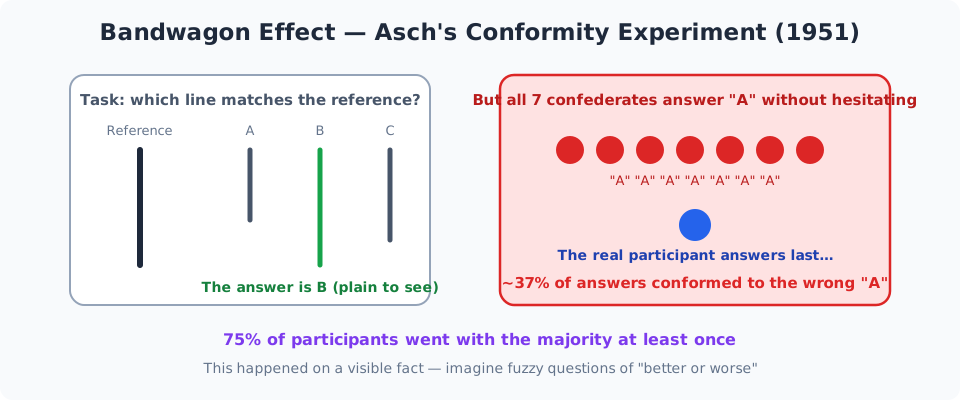
The task is almost comically easy. You see one reference line, then pick which of three comparison lines is “the same length.” Answered alone, accuracy is essentially 100% — it’s an eye test.
The trick is in the seven or so “other participants” answering alongside. Only one person is a real participant; the rest are confederates. On designated trials, every confederate gives the same obviously wrong answer, with total confidence. The real participant now faces a conflict between their own eyes and the unanimous majority.
The results made psychology history:
- Across all responses, participants conformed to the majority’s obvious error about 37% of the time
- About 75% of participants went along with the majority at least once
- In the control condition (answering alone), errors were near zero
This happened on the most objective question imaginable — the length of a line in front of your face. Imagine how much more powerfully majority opinion operates on fuzzy questions like “which restaurant is better” or “which opinion is right.”
Conformity Has Two Engines
Post-Asch research sorted the reasons we ride the majority into two families. Knowing the distinction lets you diagnose your own drift.
The first is “informational influence” — the inference that “if this many people chose it, there must be a good reason,” using the crowd’s behavior as data. Choosing the busy restaurant on the logic that “the crowd’s judgment beats mine” is, in itself, a reasonably rational shortcut.
The second is “normative influence” — conforming to avoid standing out or being excluded. In post-experiment interviews, many of Asch’s participants said, “I thought the answer was different, but I didn’t want to look strange.” When answers were written privately instead of spoken aloud, conformity dropped sharply — confirming how much of the effect is social pressure.
The ramen line is informational; swallowing your objection in a meeting is normative. Real situations mix both, but simply asking “am I riding this for the information, or under the pressure?” sharpens your view of yourself considerably.
Snowballs in Elections, Rankings, and Bubbles
Elections are where the term appears most often. The tendency for support to flow toward the candidate reported as “leading” has been studied in many countries, and the possibility that horse-race coverage shapes actual results is a classic problem in media ethics. (The opposite — sympathy flowing to the trailing side — is the known “underdog effect”; which one wins depends on circumstances.)
Rankings and reviews are the modern bandwagon’s main arena. In a famous music-download experiment, the same set of songs produced different hit songs depending on whether participants could see others’ download counts — early random popularity snowballed into runaway leads. Some fraction of every hit is manufactured not by quality but by tiny initial luck amplified through social influence. Combine this with the review skew covered in the survivorship bias article, and star ratings read very differently.
Investment bubbles share the structure. “Everyone’s buying so it rises; it rises so everyone buys” is the psychological engine that inflates prices away from fundamentals. From tulip bulbs to cryptocurrencies, the asset changes; the loop hasn’t changed in centuries.
Trends and social media put “the majority” on permanent display via trending tabs and view counts. Riding a trend is one way to enjoy it — just keep hold of the fact that “talked about” and “good” are different axes.
The Fix: Separate the Headcount from the Reasons
The core countermeasure: evaluate “how many people back this” and “why they back it” separately.
- About to choose something “because it’s popular”? Ask whether you can state one reason for the popularity
- Read reviews for specific descriptions (evidence), not star counts (headcount)
- In meetings, have everyone “write their opinion down first” before discussion (blocks normative influence)
- When your opinion matches the majority, ask once: “am I confident, or just comfortable?”
The third — “write first” — is especially powerful in organizations. When the loudest voice or the most senior person speaks first, everything after rides their bandwagon, and the meeting becomes not “an aggregation of everyone’s judgment” but “ratification of the first remark.” Think independently, then aggregate — which happens to be the precondition for the “wisdom of crowds” discussed below.
To be clear, riding the majority is not always wrong. Choosing the standard product or the busy shop functions perfectly well as a shortcut when information is scarce. The failure modes are deciding important questions by headcount alone — and abandoning your own observations (in Asch’s terms, your own eyes) under majority pressure.
Living with Reviews and Rankings
Three practical questions.
Isn’t Using Reviews and Rankings Rational?
Yes — with conditions. Aggregating many independent evaluations often beats individual judgment. But there are two traps. First, evaluations that aren’t independent. A review written after reading earlier reviews, a purchase made after seeing the ranking — these influence each other, and what looks like “many independent judgments” may be “the first judgment, amplified” (a phenomenon called an “information cascade”). Second, as the survivorship bias article covers, the people who write reviews are themselves a skewed sample. If you borrow the power of numbers, first ask whether those numbers judged independently.
Doesn’t This Contradict the ‘Wisdom of Crowds’?
Great question — they are two sides of one coin. The wisdom of crowds (the average of many estimates beating the experts) holds only under the condition that each judgment is independent. The famous ox-weighing contest produced an accurate average because entrants wrote their guesses without seeing each other’s. If everyone had answered after seeing prior guesses, the average would have been dragged by the first few. In other words, the bandwagon effect is the poison that kills the wisdom of crowds. “Write first” in meetings is how you keep the wisdom and skip the poison.
What About People Who Deliberately Avoid Whatever’s Popular?
The urge to avoid what the majority has is called the “snob effect,” which Leibenstein analyzed in the same paper as the bandwagon effect — they are a matched pair. The appeal of limited editions and hidden gems runs on this psychology. The fascinating part: the snob effect also takes “what the majority is doing” as its reference point. Whether you ride the bandwagon or bet against it, as long as the axis of decision is “other people’s numbers,” you have drifted from your own needs and tastes. If you can choose the standard item or the limited edition based on “is it good for me?” — that is the freest state there is.
Related Cognitive Biases
See “in-group bias,” where conformity fuses with group boundaries; “normalcy bias,” conformity to everyone else’s stillness; and the “Abilene paradox,” where a whole group conforms to an outcome nobody wanted.

Summary
This article covered the “bandwagon effect.”
On a problem at the level of an eye test, 37% of answers flowed toward the majority’s error. “Everyone’s choosing it” overwrites our own eyes far more than we think. And ours is the era in which “everyone” is visualized around the clock — rankings, view counts, trending tabs.
What I try to practice is receiving the headcount and the reasons separately. Demote the headcount to one input among many; verify the reasons with my own eyes. When the bandwagon’s music starts up, that is exactly the moment to quietly choose: am I boarding for the information, boarding under the pressure — or not boarding at all?
To return to the full list of cognitive biases, follow the link below.
Thank you for reading. We hope to see you in the next article.
Also popular with readers
📚 Series: Cognitive Bias Guide (16/26)