Thank you for visiting this site. This article covers “in-group bias.”
The instant you learn a stranger comes from your hometown, warmth arrives out of nowhere. A candidate from your alma mater somehow gets a softer interview. Fellow fans of your team feel like allies on first meeting. Humans change how they evaluate and treat people for no reason other than “we belong to the same group.” This is in-group bias — the psychological starting point of conflict and polarization.
What Is In-Group Bias?
In-group bias is the tendency to evaluate members of your own group (the in-group) more favorably, and treat them better, than members of outside groups (out-groups).
Family, hometown, alma mater, company, department, favorite team, political party, smartphone brand. We belong to countless groups, and each one draws its own line between “us” and “them.” Everyone inside the line receives an unexamined head start:
- In-group success → “that’s our people for you”
- Out-group success → “they got lucky”
- In-group misconduct → “there must have been circumstances”
- Out-group misconduct → “that’s just how those people are”
As you may notice, this is self-serving bias and the fundamental attribution error scaled up to the level of groups. When “easy on myself, hard on others” grows into “easy on us, hard on them,” a personal quirk plugs directly into social division.
Discrimination Born from a Preference in Paintings
The most shocking study in the history of in-group research is social psychologist Henri Tajfel’s “minimal group experiment,” published in 1971.
Tajfel wanted to know: “what is the minimum condition for people to favor their own side?” Shared interests? Long acquaintance? A history of conflict? He stripped the conditions down to almost nothing.
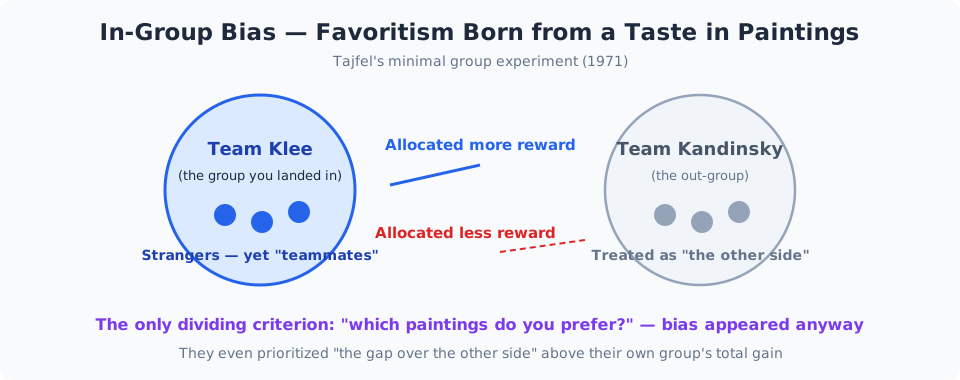
Boys were shown abstract paintings by Klee and Kandinsky and split into two groups by “which painter’s work do you prefer?” (in reality the assignment was essentially random). Members had never met, were not told who shared their group, and would never meet afterward. A group with no substance whatsoever — truly “minimal.”
The boys were then asked to allocate rewards to other participants. The result: they systematically allocated more to total strangers whose only connection was “liking the same paintings.”
An even more striking finding: when the allocation options were designed to test priorities, the boys tended to prioritize “maximizing the gap over the out-group” above “maximizing the in-group’s absolute take.” Rather than our side getting 10 while theirs gets 8, they preferred our side getting 7 while theirs gets 3. They wanted the relative gap — “we’re on top” — even at the cost of absolute gain.
One meaningless line — a taste in paintings — and favoritism plus rivalry auto-generate. The experiment showed that the psychological raw material of discrimination and conflict comes pre-installed in humans, no stakes or history required.
Why Do We Favor “Us”?
The leading framework is “social identity theory,” which Tajfel himself developed to explain his results.
The core idea: your self-esteem is built not only from “yourself as an individual” but also from the standing of the groups you belong to. When your old school wins the championship you feel pride; when your team takes the title, “we are the best.” The group rising is you rising.
So people procure self-esteem indirectly: rate the in-group up (favoritism) and rate the comparison out-group down (disdain). The boys choosing “maximize the gap” is elegant evidence — if a group’s whole reason for existing is “comparison,” then the thing worth earning is not profit but difference.
There is an evolutionary layer as well. For our ancestors, group cohesion was survival itself. If individuals who deployed loyalty to kin and vigilance toward outsiders quickly were the ones who lived, then a high-speed “us/them” classifier wired into our brains is no surprise. The problem is that today this classifier fires on lines that have nothing to do with survival — smartphone brands, baseball teams.
Polarized Feeds, Old-Boy Networks, and Turf Wars
Social media polarization is in-group bias’s amplifier. Inside the echo chambers described in the confirmation bias article, only in-group opinions circulate, and the out-group is narrated as a single lump — “those people over there.” The operative distortion is the “out-group homogeneity effect”: you can see the variety within your own group, while the out-group looks like “they’re all the same.” The most extreme statement from the other camp circulating as “what they all think” is this effect’s textbook demonstration.
Alumni favoritism in hiring is the classic institutional form. Give credentials a boost merely for shared school ties, and the organization homogenizes while fairness evaporates. The combination of halo effect plus in-group bias deserves special vigilance in hiring.
Interdepartmental turf wars are the miniature version. Sales versus engineering, headquarters versus the field. Even within one company the “us/them” line is drawn in no time, producing the mutual refrain “they just don’t understand the real work.” When departmental pride starts outranking company-wide outcomes, Tajfel’s boys are re-running “maximize the gap” in your org chart.
Sports fandom, for what it’s worth, is arguably the healthy outlet. As noted in the self-serving bias article, your team’s losses will always look like bad refereeing — but that level of distortion stays within entertainment. Since the bias cannot be deleted, having a harmless place to discharge it is, I think, no bad thing.
The Robbers Cave Experiment: How Conflict Was Undone
For countermeasures, the essential study is social psychologist Muzafer Sherif’s 1954 “Robbers Cave experiment” (Robbers Cave is the name of the campsite).
Sherif gathered 11-year-old boys at a summer camp and had two groups live separately. Once each group had bonded, he staged competitions between them — and, as predicted, intergroup hostility ballooned: flags were burned, and the dining hall came to the brink of brawls.
The remarkable part is the “reconciliation” phase. Sherif first tried “pleasant shared time” — movie nights, meals together. It failed; mere shared space reignited the conflict.
What worked was “shared problems neither group could solve alone.” The camp’s water supply failed (both groups had to repair it together); a truck stalled (everyone had to pull the rope). After repeated “superordinate goals” like these, hostility visibly dissolved — by the last day the boys wanted to ride home on the same bus.
The lesson is crisp: the “us/them” line is not erased by lectures — it is redrawn by working across it. Organizations that heal departmental rifts through mixed-team projects are applying exactly this principle.
The Fix: Redraw the Line, and Meet Individuals
The countermeasures for in-group bias:
- Set superordinate goals (create shared stakes that benefit both rival groups)
- Meet out-group members “as individuals” (one-on-one contact, bypassing the group label, shatters the homogeneity illusion)
- In evaluations, ask: “would I rate this the same if the affiliation were hidden?” (blind resume screening institutionalizes this question)
- When tempted to say “they’re all the same,” suspect the out-group homogeneity effect is firing
One more thing worth internalizing: the “us/them” line can be redrawn any number of times. The sales-versus-engineering line vanishes in the context of “our company versus the competitor.” The nation-versus-nation line vanishes in the context of “humanity versus climate change.” You cannot delete in-group bias — but you can choose which line to live by. That is the most constructive arrangement available with this bias.
Is Loving Your School or Country a Bad Thing Too?
Where’s the Line for School Pride and Patriotism?
Attachment to your groups is a healthy emotion — the foundation of belonging and cooperation. Trouble starts when love of the in-group arrives bundled with disdain or hostility toward out-groups. Research confirms that “in-group love” and “out-group hate” are separate psychologies, and the former does not necessarily entail the latter. Being proud of your school and demeaning someone else’s are different acts. The health check: is your attachment staying within “I love us,” or sliding into “they are inferior”?
Why Does the Out-Group Homogeneity Effect Happen?
Mostly a difference in contact volume. You interact with in-group members daily, so their individual differences are impossible to miss. Of the out-group you have only media fragments and stereotypes, so a handful of samples gets painted across the whole. It is the group-level version of the availability heuristic. The remedy is simple: actually talk with an ordinary individual from the out-group. Knowing one exception puts an unrepairable crack in the image of “they’re all the same.”
How Do I Defuse Turf Wars on the Ground?
Apply Robbers Cave in miniature. First, verbalize the common problem (a “common enemy” without the enemy): keep rephrasing “sales versus engineering” as “our company versus the customer’s problem,” and the line slowly shifts. Second, engineer small joint wins with mixed members — a shared improvement project. Third, make one personal acquaintance in the other department. The moment “those engineering people” becomes “engineering — where Tanaka works,” the homogeneity illusion loses its grip.
Related Cognitive Biases
See “self-serving bias” and the “fundamental attribution error” — the individual-scale versions that this bias extends to groups — and “confirmation bias,” which fortifies the in-group inside echo chambers.
Summary
This article covered “in-group bias.”
One meaningless line — a preference in paintings — was enough for people to favor “teammates” they had never met and to start chasing a gap over the other side. The raw material of division is factory-installed in our brains, requiring no stakes and no history. Tajfel’s result teaches us that social media polarization is not the work of uniquely bad actors.
The hopeful part, shown by Robbers Cave, is that lines can be redrawn through shared work. The us/them classifier cannot be switched off, but you choose which lines to thicken. On the day you catch yourself about to say “they’re all the same,” I hope this article comes to mind.
To return to the full list of cognitive biases, follow the link below.
Thank you for reading. We hope to see you in the next article.
Also popular with readers
📚 Series: Cognitive Bias Guide (15/26)