Thank you for visiting this site. This article covers “self-serving bias.”
Score well on a test, and you think “my studying paid off.” Score badly, and it’s “the questions were unfair” or “I wasn’t feeling well.” When a project succeeds you remember your own contributions; when it fails you remember everyone else’s shortcomings. Most of us recognize this. This asymmetry of attribution — “success is my doing, failure is anything but me” — is self-serving bias.
What Is Self-Serving Bias?
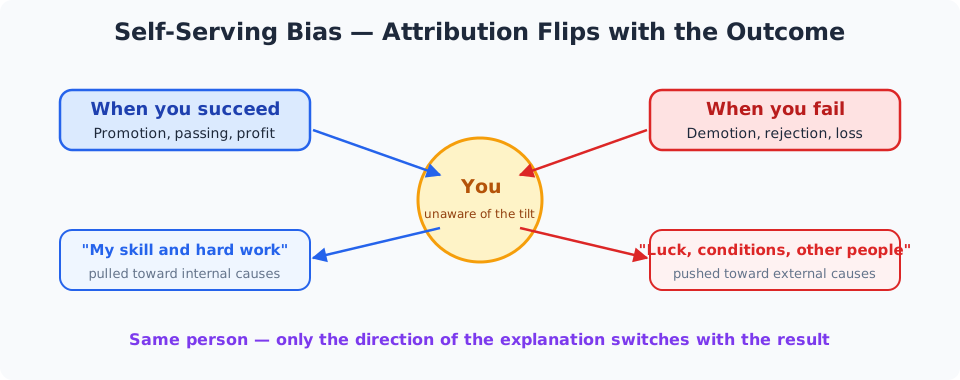
Self-serving bias is the tendency to credit good outcomes to your own ability and effort (internal factors), while blaming bad outcomes on luck, circumstances, or other people (external factors).
Psychology calls the assignment of causes to events “attribution.” Self-serving bias is the phenomenon in which the direction of attribution conveniently flips depending on whether the result was good or bad.
- Got promoted → “my ability was finally recognized” (internal)
- Passed over → “management has no eye for talent” (external)
- Investment gained → “my read was right” (internal)
- Investment lost → “the market was irrational” (external)
Each explanation sounds plausible on its own. The problem is that within the same person, the direction of the explanation reverses conveniently with every result. Since psychologists Miller and Ross organized the research in the 1970s, the pattern has been confirmed in an enormous body of studies.
When Spouses’ Contributions Add Up to More Than 100%
The study that best conveys the charm of this bias is a famous 1979 survey of married couples by psychologists Ross and Sicoly.
The researchers asked each spouse separately: “what percentage of the housework do you think you contribute?” — item by item: making breakfast, cleaning, shopping, childcare.
If the estimates were accurate, the two percentages should sum to 100. Instead, for most couples the total far exceeded 100%. Husbands and wives alike rated their own contributions much higher than their partners did.
The cause is not mere vanity. The deeper mechanism is memory asymmetry. Every time you took out the trash, every dish you washed — all of it is stored in your own head. But much of what your partner did happened out of your sight and never entered your memory at all. “All of my effort is visible to me; only a fraction of yours is” — this informational tilt inflates self-assessed contributions with zero bad faith involved.
The structure extends far beyond marriage. Author order on joint papers, royalty splits in bands, credit on team projects — when everyone feels “I did the most work,” it may be that nobody is lying; everyone’s memory is simply rigged in their own favor.
Testing It Against Sports Interviews
Self-serving bias is easiest to observe in the world of sports.
Studies analyzing win/loss comments in newspapers and broadcasts report a consistent pattern. Winners’ comments center on internal attributions — “our training paid off,” “the team’s unity was strong” — while losers’ comments show a jump in external attributions: “the refereeing,” “the wind,” “no luck today.”
What’s fascinating is that fans do it too. When your team wins, it’s “proof of who’s better”; when it loses, “we were robbed.” Two fan bases walking away from the same game with descriptions of two entirely different games is known as the group extension of this bias — “group-serving bias.” Our group’s successes reflect our group’s strength; our failures were caused from outside.
In sports it’s a running joke, but the same structure operates in conflicts between nations and in blame-shifting between departments. “We are righteous; they are unfair” can be sincerely true for both camps at once — that becomes much easier to understand once you see it as the collective version of this bias.
Why Does the Mind Favor Its Owner?
Explanations for self-serving bias fall into two main families.
The first is “self-esteem defense.” Admitting a failure reflects your ability is a direct attack on your self-image. To avoid the pain, the mind reaches for external explanations first. Success, conversely, is prime material for boosting self-image, so internal explanations are welcomed. On this view, self-serving bias is the psyche’s immune system doing its job of protecting self-worth.
The second is the “information asymmetry” we saw in the housework study. Your own effort, ingenuity, and struggle are fully visible to you; other people’s reach you only in fragments. There is also the point that people generally act “intending to succeed” — so success feels like the plan working (your doing), while failure feels like plan disruption (outside interference).
Critically, when these two combine, the person experiences no distortion whatsoever. They connected the information they could see, honestly, and the conclusion just happened to favor them. This is why being called out feels genuinely unjust — and why the retort “no, this time the conditions really were bad” comes so naturally.
The Side Effect That Stops Growth
Self-serving bias has an honorable function: protecting mental health. Left unchecked, though, it has side effects that compound quietly.
The biggest: you stop learning from failure. If every cause of failure lies outside you, there is no reason for you to change. The investment loss filed under “bad market” repeats in the next market. The rejected proposal filed under “the client doesn’t get it” repeats with the next client.
The second side effect is the slow erosion of relationships. Keep steering credit toward yourself and blame toward others, and trust drains away quietly. On teams, especially, everyone is overestimating their own contribution (the over-100% state), so the grievance “I’m not being fairly recognized” arises structurally, with no villain required.
Meanwhile, inside your own head, both success and failure route to the same conclusion — “I am competent” — and the gap between self-image and actual skill widens. The “external yardsticks” from the Dunning-Kruger article earn their keep here as well.
The Fix: Add One Internal Factor to Every Failure
You cannot delete self-serving bias, but you can practically contain its side effects.
- In failure postmortems, after listing the external factors, always add one thing you could have changed
- In success reviews, do the reverse: name one way “you got lucky”
- For joint work, don’t estimate contributions after the fact — keep a work log as you go (records correct memory’s asymmetry)
- When someone else’s “excuses” irritate you, ask whether you’ve given the same explanation from the other side
The point is not to ban external analysis. Often the environment or luck really was at fault, and self-blame that ignores this is just bad for you. The goal is ratio correction: even mixing 10% internal factors into a 90% external explanation keeps the doorway to learning open. Anyone who can answer “what did I change after that failure?” is living with this bias well.
Isn’t It a Necessary Evil? And What About at Work?
Don’t We Need This Bias to Stay Confident?
Yes — it is considered an adaptive bias. Intriguingly, research reports that people with depressive tendencies show a weaker version of it, attributing successes and failures comparatively flatly (the “depressive realism” hypothesis). The self-favoring tilt, in other words, is also a cushion that keeps the mind forward-looking. So the goal is not “removing the bias” but consciously correcting it only in high-stakes learning moments. There is no need to run rigorous self-audits on life’s small events.
What About Genuinely Humble, Self-Critical People?
Individual differences exist, and so do cultural ones. The cultural finding is famous: studies repeatedly show the bias is weaker — or even reversed into self-criticism — in East Asia, compared to the West. In cultures where modesty is a virtue and group harmony is prized, crediting success to “everyone around me” is the adaptive move. That said, some studies find the bias reappears in anonymous settings and private self-ratings — suggesting “the attribution you voice” and “the attribution in your heart” may be different things.
How Do I Handle a Colleague Who’s Always Making Excuses?
Saying “stop making excuses” head-on only backfires, because to them these are not excuses but facts. What works is skipping the attribution debate entirely and moving the conversation to “variables you can control next time.” Not “whose fault was it?” but “what moves are available on our side next round?” — list them together. You can agree on behavioral improvements without ever settling where the blame lives. And building a culture of saying “we had some luck and some help” on the good days lowers the psychological bar for naming internal factors on the bad ones.
Related Cognitive Biases
See the “fundamental attribution error” — the matching asymmetry of being lenient with yourself and harsh with others — plus the self-assessment distortions of the “Dunning-Kruger effect” and “hindsight bias.”
Summary
This article covered “self-serving bias.”
Household contributions summing past 100% teach us that even with nobody lying, everyone’s world looks tilted in their own favor. Credit fights and blame-shifting arise structurally, no villains required.
My own practice is to add one “factor I could change” to every explanation of a failure. Keep the self-esteem cushion, but never close the doorway to learning. I suspect this small habit is what separates the people who repeat the same failure from the people who grow stronger with each one.
To return to the full list of cognitive biases, follow the link below.
Thank you for reading. We hope to see you in the next article.
Also popular with readers
📚 Series: Cognitive Bias Guide (9/26)