Thank you for visiting this site. This article covers “optimism bias.”
Cancer, car accidents, divorce, fraud. Statistically these can happen to anyone, yet most of us feel, somewhere inside, “I’ll probably be fine.” We postpone buying insurance, ignore the follow-up notice from a health checkup, and draft yet another plan on the assumption that “this project will finish on schedule.” This groundless brightening of the future is optimism bias.
What Is Optimism Bias?
Optimism bias is the tendency to estimate your own chances of bad events as below average, and your chances of good events as above average.
The phenomenon was systematically demonstrated by psychologist Neil Weinstein in a 1980 study. He asked university students about good events — “owning a home,” “a high starting salary” — and bad ones — “divorce,” “a heart attack,” “getting fired” — with the question: “compared to the average of your classmates, how likely is this to happen to you?”
The results were consistent. The great majority rated good events as “more likely than average for me” and bad events as “less likely than average for me.” Everyone being luckier than average is a logical impossibility. Weinstein named the pattern “unrealistic optimism.”
Later research found the tendency across ages, sexes, and nationalities — appearing in roughly 80% of the population. Optimism bias is standard-issue human equipment.
The Brain Tunes Out Bad News Only
Why doesn’t reality correct our optimism? Live long enough and you see people get sick and have accidents. Neuroscientist Tali Sharot and colleagues answered this from the brain’s side.
In their experiments, participants first estimated “my probability of experiencing cancer, burglary, and other misfortunes,” then were shown the actual statistics. Later, they estimated their own probabilities again.
The interesting part is how the estimates were updated:
- Told “the risk is lower than you thought” → estimates revised firmly downward
- Told “the risk is higher than you thought” → estimates barely revised at all
The brain, in other words, performs asymmetric learning: “learn from good news, tune out bad news.” No amount of experience can shrink optimism under those rules. This belief-updating on convenient information only is, in a sense, the time-axis extension of the “seeing only what you want to see” mechanism from the confirmation bias article.
The Planning Fallacy: Why Deadlines Die Worldwide
Optimism bias’s workplace incarnation is the famous “planning fallacy.” Named by Kahneman and Tversky, it is the tendency to estimate completion dates optimistically while ignoring your own past track record.
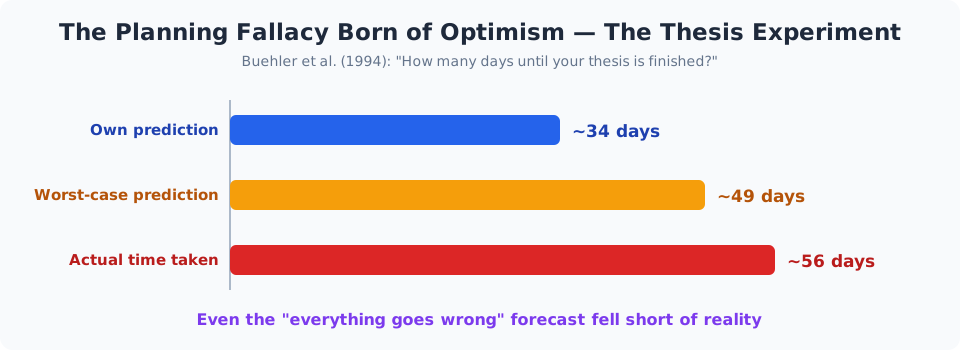
The emblematic experiment: in 1994, psychologist Roger Buehler and colleagues asked students writing their theses to predict “how many days until your thesis is done?”
| Prediction vs. reality | Days |
|---|---|
| Students’ prediction (average) | ~34 days |
| Actual time taken (average) | ~56 days |
| ”If everything goes as badly as possible” prediction (average) | ~49 days |
Reality took 1.6 times the prediction. But look at the third row: even the worst-case pessimistic scenario failed to catch up with reality.
When we plan, we play a mental movie of “the version where things go smoothly.” Illness, interruptions, unmotivated days — obstacles we can’t concretely foresee never make it into the movie. And even when we’ve failed identically before, we file it under “special circumstances that time” (self-serving bias’s external attribution at work). From the Sydney Opera House arriving ten years late and wildly over budget, down to our own “I’ll finish this today,” the planning fallacy operates at every scale.
The Real-World Cost of “Not Me”: Insurance, Disasters, Checkups
Optimism bias exacts its toll in the form of insufficient preparation.
Insurance and savings: the feelings “I won’t get seriously ill” and “that’s far in the future” postpone necessary provisions. Flip it around, and the anxiety-stoking tone of insurance advertising is the mirror image of the fact that, left alone, humans drift optimistic.
Ignored checkup results are the textbook case. The follow-up notice arrives and goes unanswered — “it’s probably nothing.” The bad-news-tune-out circuitry, expressed directly as behavior.
Disaster preparedness follows suit. Knowing your home sits in a hazard zone yet doing nothing involves optimism bias and normalcy bias working in relay: optimism bias blocks preparation in normal times; normalcy bias blocks evacuation in the emergency. One underestimates the future where you become a victim; the other reclassifies the present danger as normal.
Startups and new ventures run on optimism as both fuel and poison. Where a hard look at survival statistics would stop anyone from trying, optimism supplies the push — but budget on optimism, and the fuel turns straight into poison.
The Fix: The Outside View and the Premortem
Two countermeasures established in behavioral economics.
The first is the “outside view.” When planning, start not from the inside imagination — “how will my plan unfold?” — but from the statistics: “how long did similar work take, on average, in the past?” Set aside your motivation and clever ideas for a moment and anchor on the base rate of “projects like this one.” This is Kahneman’s canonical prescription for the planning fallacy.
The second is the “premortem.” Before a project begins, the team gathers under one premise: “it is one year from now, and this plan has failed miserably. What happened?” Everyone writes down reasons. Narrating the future as an “already-failed past” surfaces concrete obstacles the optimistic movie never showed. Its other genius: voicing failure stops being “jinxing it” and becomes “the assignment.”
At the individual level, small tricks help too:
- After estimating, “multiply by 1.5” before you commit (adjust the coefficient to your own track record)
- Before planning, recall “what fraction of similar tasks actually finished on schedule”
- For bad news (follow-up tests, risk statistics), adopt the rule: “don’t close the page until you’ve decided one action”
Wouldn’t It Be Better to Just Be Pessimistic?
Not really. Optimism pays real dividends. Optimists attempt more challenges, tolerate stress better, and repeatedly show better health indicators. An inability to see the future brightly is itself a marker of depression. The goal is not switching to pessimism but the division of labor: “optimistic in spirit, statistical in planning.” Let optimism supply the energy to attempt things; hand the numerical decisions — money, timelines, insurance — to the outside view. That two-handed approach is the realistic optimum.
How Is This Different from Normalcy Bias?
They fire at different moments. Optimism bias is a distortion of “forecasting the future” — underestimating risks that haven’t happened yet (so you don’t prepare). Normalcy bias is a distortion of “reacting to the present anomaly” — classifying danger already unfolding as within normal range (so you evacuate too late). In disaster terms: not buying emergency supplies is optimism bias; not moving when the alarm sounds is normalcy bias. Together they form the worst combination — “unprepared, and late to flee” — which is why disaster planning targets both as a pair.
What’s the Single Easiest Way to Beat the Planning Fallacy?
For personal work, collect data on your own estimates. Record “estimated time” and “actual time” per task for a few weeks and your personal optimism coefficient (actual ÷ estimate) emerges as a number. In my experience the coefficient is surprisingly stable — from then on, promising “estimate × my coefficient” is all it takes. For teams, publishing two dates instead of one — “the 50%-confidence date” and “the 90%-confidence date” — makes both the optimism and the reality visible.
Related Cognitive Biases
See “normalcy bias,” optimism’s partner in disaster psychology; “self-serving bias,” which files failures under exceptions; and “confirmation bias,” which shares the tune-out-the-bad-news structure.
Summary
This article covered “optimism bias.”
Eighty percent of people believe they are safer than average, the brain files away only the good news, and deadlines are being broken all over the world today. Optimism bias is the most universal evidence we have that our “predictions” are contaminated by our wishes.
And yet optimism remains a precious resource — it powers our attempts and protects the mind. Keep the optimistic spirit, but let statistics write the plan. Dream freely; delegate the numbers to past performance and the outside view. That, I think, is the best possible arrangement with this bias.
To return to the full list of cognitive biases, follow the link below.
Thank you for reading. We hope to see you in the next article.
Also popular with readers
📚 Series: Cognitive Bias Guide (10/26)