Thank you for visiting this site. This article covers the “spotlight effect.”
The day you left home with bed hair you couldn’t fix. The day you stained your shirt. The day you misspoke in a meeting. Have you ever spent all day tormented by the feeling that “everyone saw it” and “they’ll remember forever”? Experiments say otherwise: the number of people who noticed your slip-up is about half of what you imagine. The light you feel shining on you usually exists only inside your own head.
What Is the Spotlight Effect?
The spotlight effect is the tendency to grossly overestimate how much your appearance, behavior, and mistakes are noticed and remembered by others.
The name comes from the stage. Like an actor lit under a spotlight, you feel “I am at the center of everyone’s gaze.” But the audience — the people around you — are each living under their own spotlight, with almost no spare attention for the details of anyone else.
The phenomenon was named by psychologists Thomas Gilovich and Kenneth Savitsky. Their experiments, published around 2000, were the first to measure the gap between “feeling watched” and “actually being watched” in numbers.
The Embarrassing T-Shirt Experiment
The signature experiment is known as the “Barry Manilow T-shirt experiment.”
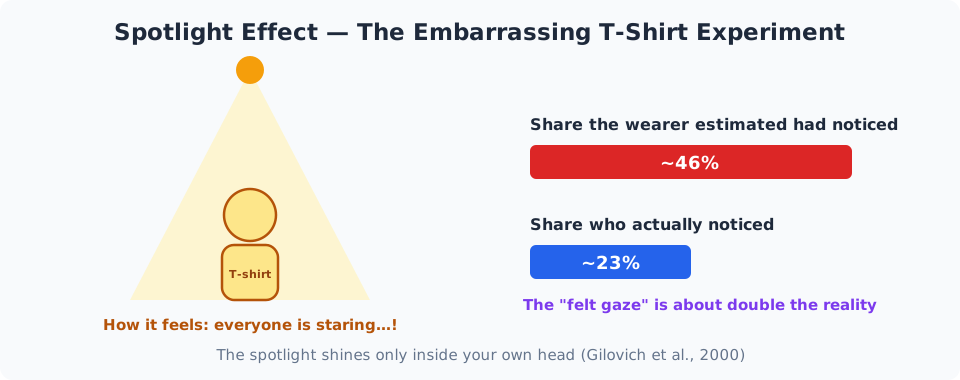
Student participants were made to wear a T-shirt with a large print of the singer Barry Manilow’s face — a shirt the students of that era found “deeply uncool and embarrassing.” Wearing it, each participant walked into a room of other students, stayed briefly, and left.
Afterward, the wearer was asked “what percentage of the students in the room do you think noticed the shirt?” — while the students in the room were asked “whose face was on the shirt?” The results:
| Measure | Rate |
|---|---|
| Wearer’s estimate (who noticed) | ~46% |
| Actually noticed | ~23% |
The gaze the wearer felt was about double the reality. Follow-up experiments found the same gap with a “cool” T-shirt the wearer was proud of. For better or worse, the very sense that “my appearance is being noticed” is inflated.
The team ran a parallel experiment on remarks in group discussions, confirming that people rate the impact of their own comments — brilliant ones and blunders alike — far higher than the other participants do. The stain, the ugly shirt, the verbal stumble: none of them survive in others’ memories at even half the intensity you imagine.
Why Does the Light Feel Real?
The mechanism is explained by the “insufficient adjustment” we met in the anchoring article.
From the instant you saw it in the mirror, your bed hair or stain has your full attention. That means “100% salience — to me” becomes the starting point (the anchor). You know intellectually that “others probably won’t look that closely,” so you adjust downward — but as always, the adjustment stops short. What remains is an estimate far above the actual attention paid.
The second factor is the asymmetry of viewpoints. You are the lead actor in every scene of your own life — and a passerby in everyone else’s. Our feelings cannot process this obvious fact correctly. Everyone is busy screening “the movie where I’m the star,” and almost no one remembers one scene from somebody else’s film. The spotlight effect is the illusion that “a pivotal scene in my movie must be a pivotal scene in yours too.”
A sibling phenomenon is the “illusion of transparency” — the overestimate not of your visible surface but of your interior: the sense that your nervousness or agitation is leaking out for all to see. Experiments show an audience picks up less than half the trembling a speaker feels.
Stage Fright, Social Media Fatigue, and Cringe Memories
The spotlight effect is behind a large share of everyday misery.
Fear of public speaking, decomposed, has this prediction at its core: “if I fail, everyone will laugh and remember forever.” But as the experiments showed, the audience retains less than half of what you estimate. Practically no listener remembers your presentation slip a week later. (You will. Only you.)
Social media fatigue connects directly. Obsessing over reactions, rereading a post fearing it came out weird, deflating over comparisons — all of it runs on the premise that “every follower is scrutinizing my posts.” In a real timeline, each post gets a few seconds of attention. Nobody reads your posts as carefully as you do.
Dwelling on past embarrassments works the same way. That cringe-inducing remark from ten years ago that you replay at 2 a.m.? Ask anyone who was actually in the room — they almost certainly don’t remember it. The only person in the world still screening that scene at the original intensity is you.
Overthinking clothes and accessories falls here too. Recall how little you remember of the outfits of people you passed yesterday — and realize everyone else is just as blank about yours.
The Cure: Everyone in the Audience Is Starring in Their Own Show
For the spotlight effect, knowledge itself is the best medicine.
- When embarrassment hits, recall the experimental result: “actual attention is about half of what I feel”
- Ask yourself: “do I remember what the person I passed yesterday was wearing?” (If not, neither do they)
- On a bad day, write down an estimate of “how many people will remember this in one week”
- For a failure you can’t shake, actually ask a trusted person: “hey, do you remember that?” — and check
That last verification is especially worthwhile. Experience once how far your “felt gaze” misses the measured reality, and your internal exchange rate for embarrassment changes permanently.
There is also a liberating side to this effect. The fact that nobody is watching is not loneliness — it is freedom. Try something and fail, and the audience keeps no record. The new outfit, the clumsy hobby project, the awkward first post — they receive a tenth of the attention you fear. So you might as well begin.
But Surely People Are Watching in the Social Media Era?
How Is This Different from the Illusion of Transparency?
The target differs. The spotlight effect overestimates attention to “what is visible from outside” (appearance, behavior, mistakes); the illusion of transparency is the sense that “what is invisible from outside” (nerves, agitation, lies, attraction) is leaking through. At a job interview: “they’re looking at the wrinkles in my suit” is the spotlight effect; “they can tell I’m nervous” is the illusion of transparency. In practice, bundle them: “surface and interior alike — half of what I feel is getting through.”
What About Being ‘Watched’ Online?
True, posts persist and can spread. But separate “the possibility of being seen” from “the amount of attention actually paid.” Barring viral pile-ons, attention to an ordinary post evaporates in moments, and most followers never see it at all (often it is never even displayed). Meanwhile, not posting things that could hurt you in a future job search is not spotlight anxiety — it is ordinary information hygiene. Manage the record carefully; discount the attention by half. That division is the realistic one.
So I Can Stop Caring About Grooming?
Interestingly, no. Others won’t remember your details — but as the halo effect article explains, an overall impression forms in an instant and colors every judgment after it. Nobody sees “the one wrinkle in your shirt,” but the gestalt of “put-together” versus “disheveled” absolutely registers. No need to agonize over details — just tune the overall impression. Set the spotlight effect beside the halo effect and you can see exactly where grooming effort pays.
Related Cognitive Biases
See the “anchoring effect” (whose insufficient adjustment powers the inflated “felt gaze”), the “halo effect” (the power of overall impressions), and “self-serving bias” (another self-centered estimate).
Summary
This article covered the “spotlight effect.”
The people who noticed the embarrassing T-shirt numbered half the wearer’s estimate. Your bed hair, your verbal slip, your decade-old cringe memory — the world’s most devoted observer of all of them has always been you.
This is that rare bias where merely knowing it makes life lighter. If nobody is watching, the reasons to fear failure are cut in half too. Knowing that the spotlight exists only inside your head, go ahead and casually start the thing you have been wanting to do.
To return to the full list of cognitive biases, follow the link below.
Thank you for reading. We hope to see you in the next article.
Also popular with readers
📚 Series: Cognitive Bias Guide (11/26)