Thank you for visiting this site. This article covers the “fundamental attribution error.”
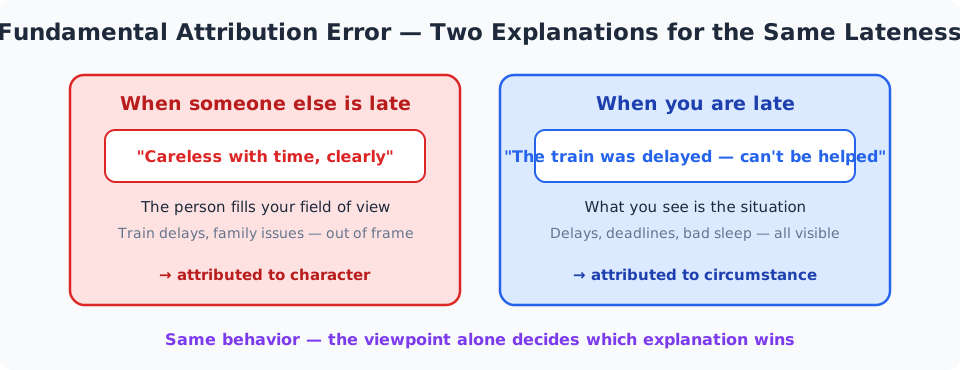
A colleague walks into the meeting late, and you think, “careless with time, this one.” The following week you are late yourself — and think, “the train was delayed, nothing I could do.” Same behavior; but for others we explain it by character, for ourselves by circumstances. This asymmetry ranks among the most important biases in all of social psychology.
What Is the Fundamental Attribution Error?
The fundamental attribution error is the tendency to over-attribute other people’s behavior to their character, ability, and disposition (internal factors) while underweighting the influence of their situation and environment (external factors).
“Attribution” is the mental act of assigning causes to behavior. When a store clerk is curt with you, there are two candidate causes:
- Internal: “an unfriendly person” (their character)
- External: “rush hour,” “maybe they just absorbed an unreasonable complaint” (their situation)
Logically both are live options, yet with other people the human brain leaps straight to the internal explanation. The tendency is so strong and so universal that psychologist Lee Ross named it the “fundamental” error in 1977. It is almost always the first bias introduced in social psychology textbooks.
The Castro Experiment: A Coerced Essay Still Read as Sincere
The classic demonstration is the 1967 “Castro experiment” by psychologists Jones and Harris.
Participants read an essay either “supporting” or “criticizing” Castro’s government in Cuba, then answered: “what do you think the writer privately believes about Castro?”
The crucial manipulation was the briefing. Half the participants were told “the writer freely chose which side to argue.” The other half were told “the writer was assigned the position by an instructor — they had no choice.”
If the position was freely chosen, inferring belief from the essay is reasonable. If it was assigned, the essay is no evidence of belief at all — the person forced to write in support might privately oppose.
The result was startling: even the group told the position was assigned still judged the pro-Castro essayist to be “probably a genuine supporter.” Handed explicit information about the situation (coercion), people still wired the behavior (the essay) directly to the person’s inner self. The word “fundamental” earned its place in this result.
Why Can’t We See Other People’s Situations?
The mechanism can be explained by the physical structure of viewpoints.
When you observe someone else’s behavior, the person occupies the center of your visual field. Movements, expressions, words — everything salient is “the person,” while their surrounding circumstances (this morning’s disaster, the burden they carry, the pressure they’re under) are simply not in the frame. Attention nominates what it can see as the cause, so “the person” gets picked.
When you explain your own behavior, what fills your view is the situation. You cannot see your own face — but the delayed train, the unreasonable deadline, the sleepless night are all vividly present. So your own behavior gets explained by circumstance. This asymmetry of viewpoint is called the “actor-observer bias,” the flip side of the fundamental attribution error.
There is also the fact that character explanations are cognitively cheap. A one-word label — “careless” — looks like a universal tool that explains and predicts behavior with zero investigation. It is the attribution version of the evaluation shortcut we saw in the halo effect article.
Cultural differences are documented too: East Asians attend somewhat more to situational factors than Westerners in comparative studies — but the effect never reaches zero, and the error itself is observed across every culture tested.
From Pile-Ons to Poverty Debates
Online pile-ons and character verdicts are this bias’s modern battlefield. From a clipped few seconds of video or a single post, an inference about “what kind of human being this must be” spreads instantly. The Castro experiment showed people wire behavior to character even when handed the context — with context stripped away entirely, the leap is even more reckless. It is worth knowing that inferring personality from seconds of behavior is, cognitively speaking, an extremely low-accuracy inference.
Attitudes toward service workers show it daily. Slapping the label “incompetent” on the server who mixed up an order is easy; the understaffed shift, the trainee’s first day, the crashed POS system are all invisible from the customer’s seat. Judging people while treating “what I can’t see” as nonexistent — that is this bias’s everyday face.
Debates about poverty and unemployment are where the social stakes peak. Explaining hardship purely through internal factors — “lack of effort,” “personal responsibility” — pushes birth environment, the economy, illness, and disaster out of the frame. The point is not that individual effort is irrelevant; it is that the very feeling that internal factors explain everything is the bias operating.
Workplace evaluations deserve the same question: before ruling an underperforming report “not capable,” were the resources provided, the quality of the handover, and the sanity of the targets examined with equal seriousness?
The Fix: Name Three Situations Before You Judge
The countermeasure is to deliberately pull the invisible situation into view.
- When someone irritates you, name three situational factors that could explain the behavior (force-generate non-character explanations)
- Swap viewpoints: “in that situation, what would I have done?”
- When evaluating someone, start the sentence with “in this situation…” instead of “this person…”
- When you catch yourself excusing your own failure by circumstance, check whether you extend the same excuse to others
The first — “three situations” — is simple but potent. The three don’t need to be correct. The goal is reminding your brain that non-character explanations exist. You remain free to conclude “no, it really is their character” afterward — but that conclusion is now vastly more trustworthy than the reflexive verdict was.
The habit pays practical dividends too. A character label — “that’s just how they are” — ends thought; a situational factor leaves room for improvement. File a report’s mistake under “careless personality” and there is no move to make; frame it as “a situation with no checklist” and you can change it tomorrow. Situational attribution is kindness to others and a problem-solving tool at the same time.
Remaining Questions, Including the Link to Self-Serving Bias
Three fine points worth covering.
How Does This Relate to Self-Serving Bias?
Put the two side by side and the full map of human attribution appears. Self-serving bias is favoritism toward yourself — “my successes are internal, my failures external.” The fundamental attribution error is laziness toward others — “their behavior is internal, full stop.” Compose them and you get the golden pattern of every quarrel: “my failure was the situation; your failure is your character.” From marital spats to international conflict, most blame games run on this composite. Knowing only one of the two is half the picture — learn them as a set.
Isn’t the Character Explanation Sometimes Right?
Sometimes, yes. Repeated behavioral patterns often do reflect a person’s traits, and character-based prediction has genuine uses. The problem is sample size. “They tend to miss deadlines,” concluded after ten observations, is observation; “a careless person,” concluded after one late arrival, is a leap. A practical rule: ask “how many observations back this judgment?” — and at one or two, hold the character label and suspect the situation. What the Castro experiment exposed is precisely the danger of pronouncing on someone’s interior from a single behavioral sample.
How Should I Handle Mistakes by Reports or Children?
Start from the principle that “changing the situation is faster than changing the person.” When a mistake happens, time spent designing “what setup would have made this mistake impossible?” prevents recurrence better than interrogating “why weren’t you paying attention?” This is the same philosophy as the blameless “postmortem” culture described in the survivorship bias article. One useful asymmetry to remember: when praising, internal attribution (“your idea made the difference”) is what fuels motivation.
Related Cognitive Biases
See “self-serving bias,” its constant partner; the “halo effect,” a sibling shortcut of personality labeling; and “in-group bias,” where the verdicts scale up to whole groups.
Summary
This article covered the “fundamental attribution error.”
Even an essay written under orders was read as its author’s sincere belief. The situation behind another person’s behavior is structurally invisible to us. Judge people without knowing this, and the world gradually fills with “terrible people.”
Before judging, name three situations. I hold myself to this. Sometimes the conclusion doesn’t change even after three. And yet, for anyone who keeps the habit of looking for situations, the population of “unforgivable people” keeps shrinking. That is a gift to others — and, just as much, to your own peace of mind.
To return to the full list of cognitive biases, follow the link below.
Thank you for reading. We hope to see you in the next article.
Also popular with readers
📚 Series: Cognitive Bias Guide (14/26)