Thank you for visiting this site. This article covers the “halo effect.”
A product endorsed by a well-liked actor somehow looks higher-quality. A candidate with an elite degree looks “probably good at the job” before they say a word in the interview. Think calmly, and the actor’s likability has nothing to do with the product’s quality, and academic credentials are not job performance. This phenomenon — “evaluations that should be separate bleeding into each other” — is the halo effect.
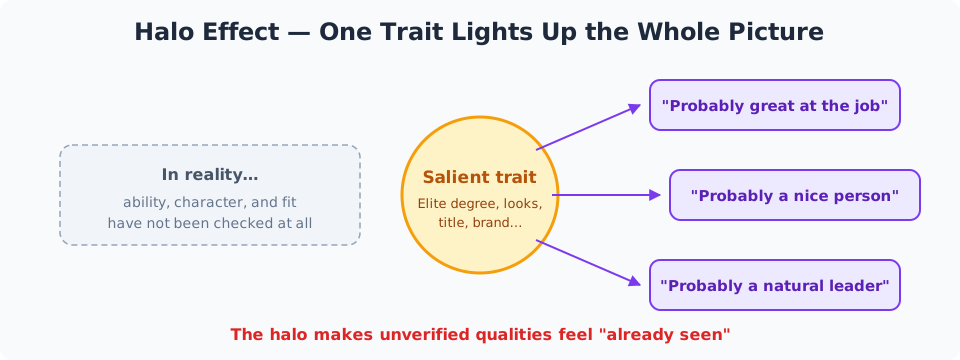
What Is the Halo Effect?
The halo effect is the phenomenon in which one salient feature of a person or thing drags along and distorts your evaluation of its other, unrelated features.
The halo is the ring of light painted behind saints. One radiant trait shines like a halo, illuminating — apparently — the entire person.
It works in both directions:
- Attractive appearance → personality and competence look better too (positive halo)
- Sloppy clothes → the work looks like it will be sloppy too (negative halo)
Either way, the structure is identical: traits you have never verified are being inferred from the one trait that stands out.
Thorndike’s Army Study
The halo effect was first systematically identified by psychologist Edward Thorndike. In a study published in 1920, he had army officers rate their soldiers on multiple dimensions — “physique,” “intelligence,” “leadership,” “character.”
Something strange emerged: the supposedly independent rating dimensions showed abnormally high correlations. Soldiers rated as physically impressive were also rated high on intelligence, leadership, and character.
Physique and intelligence are not, in reality, that correlated. The officers believed they were rating each dimension independently, but in practice they were painting every column with a single brush: “generally good” or “generally bad.”
The study reshaped the world of personnel evaluation, and a century later it remains a staple of rater training.
Looks Sway Grades and Verdicts
Since Thorndike, the halo effect has been demonstrated in many arenas. Most famous is the line of experiments testing how far physical attractiveness moves “evaluations that have nothing to do with looks.”
In one experiment, the same essay was graded with different authors’ photos attached. The essay accompanied by an attractive photo received higher marks — for the identical text.
Mock-trial experiments repeatedly find that attractive defendants receive lighter sentences for the same charges (with one fascinating exception: for crimes that “weaponize attractiveness,” like fraud, sentences get harsher instead).
In education, teachers tend to grade the tests of “intelligent-looking” students more gently — while students, for their part, grow genuinely stronger in the subjects taught by “teachers they like.” Between evaluator and evaluated, the halo shines in both directions.
Why Does the Brain Use Halos?
Why would the brain use such a crude method of evaluation at all? Understanding the reasons reveals the halo effect to be “a specification of the brain,” not “a character flaw.”
First, evaluation is expensive. Verifying a person’s ability, character, and reliability item by item takes enormous time and information. Yet daily life constantly demands forming some relationship with a stranger within minutes. So the brain takes the shortcut of “inferring the whole from the most accessible feature.” The halo effect is the side effect of that shortcut.
Second, the shortcut worked reasonably well in the old environment. In a band of a few dozen familiar faces, salient traits and inner reputations were naturally cross-checked through daily life. Today we are asked to judge in a 30-minute interview, a 15-second ad, the instant of a profile photo — inference runs free with no chance of verification.
Third, the brain loves a consistent story. A jagged portrait like “attractive but sloppy at work” is hard to store and sits uneasily. The brain quietly sands off the bumps into a smooth narrative: “a lovely person all around” or “a hopeless one.”
The countermeasure, then, is not to stop this automatic processing (impossible) but to deliberately insert verification procedures at the evaluations that matter.
Halos in Interviews, Advertising, and Brands
Job interviews are halo country. Degrees, previous employer names, appearance, speaking style — salient traits transmute into unverifiable impressions like “seems sharp” and “seems driven.” Structured interviews (same questions, same order, per-item independent scoring for every candidate) are recommended precisely to suppress the halo effect.
Performance reviews show the classic pattern of one big win (or failure) dragging every other rating for the period. The rep with great sales numbers tends to score high on “teamwork” and “mentoring” too.
Advertising’s image strategy is the halo effect used on purpose. The likable celebrity, the polished packaging — devices that bathe the product in a glow that comes from somewhere other than the product.
Country and corporate brands carry halos too. “German-made, so it must be solid.” “Research from a famous university, so it must be right.” These substitute origin or title for item-level verification. Trusting authority is a partly rational shortcut — but it trips you exactly where the title fails to guarantee the contents.
Halo vs. Pygmalion vs. Reverse Halo
Several psychological effects get confused with the halo effect, so here is the map:
| Effect | In one line |
|---|---|
| Halo effect | A salient trait distorts the “evaluation” |
| Reverse halo (devil) effect | A salient flaw drags the whole evaluation down |
| Pygmalion effect | Being expected to succeed raises actual performance |
| Golem effect | Being expected to fail lowers actual performance |
The key distinction: the halo effect is a distortion inside the evaluator’s head only, while the Pygmalion effect changes the target’s actual behavior and results.
A boss assuming a subordinate is “brilliant” because of their degree is the halo effect. That subordinate then being handed the challenging assignments, accumulating experience, and becoming genuinely excellent is the Pygmalion effect. In reality the two chain together, and “a first impression grows into a real difference in ability.” First impressions do not stay inside anyone’s head.
Defending Against the Halo Effect
The defense is Thorndike’s failure, inverted: decompose the evaluation into items and judge each on independent evidence.
- In interviews and reviews, write down “the specific facts supporting this rating” for every single item
- When someone “just seems excellent,” identify exactly which trait the impression is coming from
- When choosing products, build a “performance and price comparison table” that excludes the celebrity and the design
If you evaluate people for a living, check whether the correlations across your own rating sheet are suspiciously high. If every item carries the same score, you may be looking not at item-level evaluation but at “one impression, painted across the whole form.”
But First Impressions Are Accurate, Aren’t They?
What’s Really Behind That Feeling
It is true that judgments from brief observation show real accuracy in research (so-called “thin-slicing”). But the accuracy is limited to externally observable traits — expressiveness, sociability. For inner qualities like integrity, intelligence, and precision at work, first impressions turn out to predict almost nothing. And that is the halo effect’s trap: “partly accurate” is exactly what tempts us to trust the parts that aren’t.
How Is This Different from Stereotyping?
The direction differs. A stereotype applies “a fixed image of a group to an individual” (judging personality by star sign, say). The halo effect extends “one trait of an individual to that individual’s other traits.” In practice they often work together: credential screening, for example, mixes “a group generalization” with “inference from a single accomplishment.”
What If You’re the One Benefiting from a Halo?
Clean clothes and a courteous first impression are, in my view, fine — they are within the bounds of social manners. But build trust on impression management unmoored from substance, and the gap with reality eventually lands on you. Use the halo to get heard at the door; win with substance after that. That line is the healthy way to use it.
Related Cognitive Biases
The structure of one piece of information contaminating other judgments recurs across biases. See the “anchoring effect,” where the first number drags every estimate, and the “Barnum effect,” where descriptions that fit anyone feel like they fit you.
Summary
This article covered the “halo effect.”
Instead of evaluating each dimension carefully, the brain cheats: it paints the whole with one standout trait. From a 1920s army to a modern hiring panel, the cheat has not changed at all.
When you are the evaluator: decompose into items and back each with facts. When you are the one being evaluated: know that first impressions and visible accomplishments count for more than seems fair. The halo effect is worth knowing both as a shield and as a tool.
To return to the full list of cognitive biases, follow the link below.
Thank you for reading. We hope to see you in the next article.
Also popular with readers
📚 Series: Cognitive Bias Guide (12/26)