Thank you for visiting this site. This article covers the “availability heuristic.”
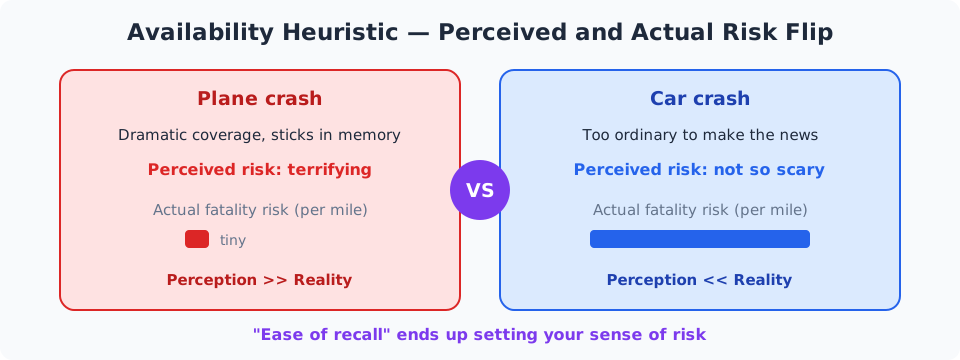
Many people are afraid of flying. But how would you react if told that the car ride to the airport is far more dangerous? Statistically, the fatality risk per mile traveled is orders of magnitude higher for cars. And yet the plane still feels scarier. This bias is the reason why.
What Is the Availability Heuristic?
The availability heuristic is the tendency to judge events that come to mind easily (that are highly “available” in memory) as more probable than they actually are.
A heuristic is “a mental shortcut used in place of rigorous calculation.” Strictly speaking, knowing how likely an event is requires statistics. But the brain skips that tedious work and substitutes a much cheaper test: “can I recall an example quickly?”
Ease of recall, however, is easily inflated by factors that have nothing to do with frequency:
- You saw it recently (it was in this week’s news)
- It was vivid (the footage was shocking)
- It touched you personally (it happened to someone you know)
In short, “whatever gets covered often” and “whatever makes a striking image” ends up feeling far more common than it really is.
Kahneman and Tversky’s Experiment
This bias, too, was systematized by Daniel Kahneman and Amos Tversky, in 1973. One famous question from their experiments:
In English, are there more words that start with K, or more words with K as the third letter?
Most participants answered “words starting with K.” In fact, words with K in third position (ask, like, make…) are roughly twice as numerous.
Why the error? Because words starting with K are easy to retrieve, while searching your memory by third letter is hard. Ease of recall and actual count are different things — but the brain simply adopted recall ease as its answer for “how many.”
Why the Brain Takes Shortcuts
Why would the brain use an inaccurate shortcut at all? A useful frame here is the “System 1 and System 2” model Kahneman popularized in his later work.
System 1 is fast, automatic, and unconscious — it reads a face’s mood at a glance and understands your native language without effort. System 2 is slow, effortful, and deliberate — it does mental arithmetic and checks documents.
The problem is that System 2 is profoundly “lazy.” Looking up statistics and computing probabilities is System 2’s job, but the brain avoids that costly processing whenever it can, settling for System 1’s instant answer: easy to recall = happens a lot.
Crucially, this shortcut was mostly correct in the ancestral environment. When humans lived in bands of a few dozen, the events you frequently saw and heard about really were the frequent events. Recall and frequency only came apart once media began delivering “rare events from far away” every single day. This bias, in other words, is a feature optimized for an old environment, misfiring in the information age.
How Far Off Are Our Estimates of Death Causes?
A classic study put numbers on the gap between impression and statistics. In the 1970s, psychologist Sarah Lichtenstein and colleagues asked ordinary people to estimate annual deaths from various causes.
The results showed a sharp pattern:
- Dramatic, newsworthy causes — tornadoes, floods, homicide → massively overestimated
- Quiet, unreported causes — asthma, diabetes, stroke → massively underestimated
In the data of that era, asthma killed several times more people than tornadoes, yet most respondents ranked tornadoes higher. The same held for homicide versus suicide: heavily covered homicide was overestimated relative to reality.
The direction of the errors lined up neatly with the direction of news coverage. People thought they were reporting death statistics, but they were actually reporting “how many times I’ve seen this cause of death on the news.”
Your internal ranking of risks may be built from airtime, not statistics. This study makes that point with numbers.
The Risk Distortions the News Creates
Distorted risk perception is the most consequential effect. Plane crashes, random street attacks, shark attacks — all are covered dramatically, so they feel frequent. Meanwhile bathtub drownings and falls at home, which kill far more people annually, trigger almost no vigilance because they never make the news.
After the September 11 attacks, so many Americans avoided planes in favor of cars that one estimate puts the resulting extra road deaths at more than 1,500 above the usual rate. The memory of terrorism inflated the perceived risk of flying — and pushed people into the objectively more dangerous choice.
Lotteries are propped up by the availability heuristic too. Jackpot winners get media profiles; the tens of millions of losers do not. Only “the winners” are available in memory, so the odds of winning feel inflated.
Business decisions are riddled with it as well. The project whose priority skyrockets “because we just got a complaint,” or the investment justified solely by a recent success story — these are textbook cases of judging by memory freshness instead of statistics.
The “Felt Reality” Gap, Amplified by Social Media
A distinctly modern angle on this bias is the gap between statistical safety and felt safety.
In the United States, for example, violent crime rates fell dramatically over recent decades — yet year after year, surveys find a majority believing crime is rising. The more crime footage circulates on the news and social media, the stronger the feeling that “things are getting dangerous.” Statistical safety and felt safety can move in opposite directions.
Short-form video is an even stronger amplifier than television. Shocking clips spread fastest, and the algorithm boosts whatever draws reactions. “Things that almost never happen,” harvested from the entire planet, stream through your feed daily. For the availability heuristic, no environment could be better designed to cause misfires.
The world you see is sorted not by “frequency” but by “shareability.” Just knowing this structure changes how you relate to news and social feeds.
The Fix: Separate “Easy to Recall” from “Frequent”
The countermeasure comes down to one thing: check the statistics, not the impression.
- When judging a risk, look up “annual incidents and deaths” rather than the volume of coverage
- When something “seems to be everywhere lately,” ask whether it actually increased or only its coverage did
- In decision-making, check whether “the most recent case” is steering you — then widen the data window
The most effective single habit is asking yourself: “why do I feel this is risky?” If the only answer you can produce is “because I saw it on the news,” that risk perception deserves suspicion.
Should We Just Stop Watching the News?
How Is This Different from Learning from Experience?
Learning from your own direct experience is valid in most situations. The problem is that most of a modern person’s “memories” consist of secondhand information via media, not lived experience. Judging your neighborhood’s safety from what actually happens on your street is a reasonable heuristic; judging it from national news is just reflecting coverage volume. Step one is asking: “is this memory something I experienced, or something I saw through a screen?”
So What’s the Right Way to Use News?
I would not go as far as “stop watching.” News has real value for knowing “what happened.” The trap is trying to read “how often things happen” out of it. News is structurally built to give rare events the biggest coverage, which makes it a terrible source of frequency information. Events from the news; frequencies from statistics. Match the source to the question and you are most of the way there.
The Blind Spot: Risks That Are Hard to Recall
The greater real-world damage may come not from vivid risks but from these. Lifestyle diseases, falls at home, inadequate disaster preparation — things that progress slowly or make no dramatic footage never lodge in memory, so they get neglected. The contrarian habit of “checking statistics precisely for the risks that don’t feel scary” is what prepares you for these quiet heavyweights.
Related Cognitive Biases
The structure of recall distorting judgment connects deeply to other biases. “Survivorship bias,” where only success stories enter your field of view, is a close cousin of the availability heuristic.
Also essential for thinking about risk perception is the “false positive paradox,” which shows how badly our intuition misjudges what a positive test result means.
Summary
This article covered the “availability heuristic.”
As long as the brain substitutes “ease of recall” for “likelihood,” our sense of risk is effectively held hostage by media coverage volume. Fearing the dramatic accident while dying in the mundane one is an inversion nobody can laugh at.
When something feels frightening, or something feels like it is suddenly everywhere, pause once and look up the statistics. I believe that single habit changes the accuracy of your judgment more than almost anything else.
To return to the full list of cognitive biases, follow the link below.
Thank you for reading. We hope to see you in the next article.
Also popular with readers
📚 Series: Cognitive Bias Guide (4/26)