Thank you for visiting this site. This article covers the “framing effect.”
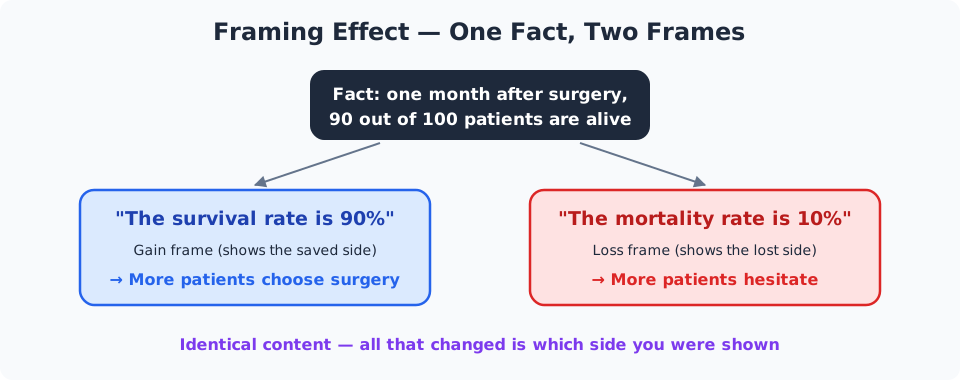
Suppose you are deciding whether to have surgery. Which makes you more willing to proceed — a doctor saying “the one-month survival rate is 90%,” or one saying “the one-month mortality rate is 10%”? The two sentences state exactly the same fact. Yet experiments confirm that patients told the survival rate are clearly more likely to choose surgery. This is the framing effect.
What Is the Framing Effect?
The framing effect is the phenomenon in which logically identical content produces different judgments and choices depending on how it is framed.
A frame is like the frame around a painting. Just as the same picture makes a different impression in a different frame, the same fact lands differently depending on “which side of it you choose to show.”
- “90% survival rate” vs. “10% mortality rate”
- “90% fat free” vs. “contains 10% fat”
- “30% of successful people do this” vs. “70% of people who do this don’t succeed”
A rational decision-maker would reach the same conclusion either way. The fact that wording sways us means we are responding not to the facts, but to the presentation of the facts.
The “Asian Disease Problem” That Flipped Preferences
The framing effect became famous through the “Asian disease problem,” a survey-style thought experiment published in 1981 by Daniel Kahneman and Amos Tversky, the founders of behavioral economics.
Participants were given this scenario:
The U.S. is preparing for an outbreak of an unusual disease expected to kill 600 people if nothing is done. Two programs have been proposed. Which do you choose?
The first group saw the programs framed in terms of “lives saved”:
- Program A: “200 people will be saved”
- Program B: “1/3 probability all 600 are saved; 2/3 probability no one is saved”
Under this frame, 72% chose the certain Program A. Better to save 200 for sure.
A second group saw the exact same programs framed in terms of “lives lost”:
- Program C: “400 people will die”
- Program D: “1/3 probability no one dies; 2/3 probability all 600 die”
A equals C, and B equals D — do the arithmetic and they are identical. Yet under this frame the preference flipped: 78% chose the gamble, Program D.
Confronted with the certain loss of “400 people will die,” people cannot accept it and want to gamble on the slim chance of saving everyone. The same people, facing the same problem, swing between the safe option and the gamble on wording alone — that is what this experiment demonstrated so vividly.
Why Does Wording Alone Change Decisions?
Behind the framing effect sits the core idea of “prospect theory,” which Kahneman and Tversky developed in the same period. Two points matter.
First, people evaluate outcomes not as absolute states but as changes from a reference point — and that reference point moves easily with wording. Told “200 will be saved,” your reference point becomes “everyone dies,” and the situation reads as a gain. Told “400 will die,” your reference point becomes “everyone lives,” and the very same situation reads as a loss.
Second is “loss aversion,” covered in its own article: losses hurt roughly twice as much as equivalent gains feel good. As a result, gain frames make us want to lock in the sure thing (risk aversion), while loss frames make us willing to gamble to avoid the loss (risk seeking).
The framing effect, then, is not merely about “word impressions.” It is a phenomenon in which wording moves the brain’s reference point and switches the entire gain-loss calculation. That switch is what flipped the preferences in the Asian disease problem.
Framing in Advertising, Medicine, and Politics
Food labels are the most familiar example. A “90% fat free” yogurt feels healthier than one that “contains 10% fat” — the same product. “Contains 1000mg of taurine” looks far more potent than “contains 1g.” Even the choice of unit is a frame.
Price presentation uses it constantly. “$120 annual fee” feels more expensive than “33 cents a day.” “A 10% commission” sounds worse than “you keep 90%.” Cashback points versus discounts are another pair of nearly equivalent offers received very differently.
In medicine, framing is literally a matter of life and death. As noted at the top, whether treatment options are explained via survival or mortality rates changes patient choices. This is why modern informed-consent guidance increasingly recommends presenting both frames side by side.
Politics and news are framing’s main battlefield. The same policy is described as “strengthening the safety net” or “a handout”; the same economic indicator is reported as “a three-year high” or “slowing month over month.” Neither is a lie — which is exactly what makes framing so slippery.
Charity and environmental appeals are where positive applications are studied. Research shows loss frames (“what will be lost without your help”) work better in some contexts and gain frames (“what your help will achieve”) in others — findings now applied in the design of behavioral “nudges.”
Try Flipping the Frame Yourself
The best immunization against framing, I believe, is flipping the wording yourself. Some practice:
- “9 in 10 patients have no side effects” → flipped: “1 in 10 patients gets side effects”
- “80% of members renew” → flipped: “1 in 5 members quits”
- “Cancel now with zero fees” → flipped: “wait, and cancellation will cost you”
The moment you flip it, the impression changes completely. And the crucial point: both versions are factually true.
Repeat this exercise and you start seeing the structure in ads and proposals — “ah, this is written in a gain frame.” Once you see the structure, you can extract “the fact itself” from outside the frame and judge that instead.
The Fix: Pull Out the Numbers and Line Them Up
The countermeasures for the framing effect:
- For important decisions, extract just the numbers and write them out both ways (90% survive = 10% die — write both)
- Say the claim out loud “in the opposite frame”
- When comparing options, convert all of them into “the same frame” first
- Convert any “just $X a day” pitch back into annual and total cost
The first is the most effective. Frames live in words, so converting words into numbers strips most of the frame’s magic away. For a major contract or a medical decision, the small effort of writing the numbers on paper is well worth it.
And when you are the one presenting information, you carry responsibility for framing’s power. Choosing a frame that nudges someone toward their own benefit is legitimate craft; choosing a frame that distorts their judgment for your benefit alone is manipulation by fact. “Technically true” is not an alibi for framing — communicators, of all people, should remember that.
Where Clever Wording Ends and Deception Begins
How Is This Different from the Anchoring Effect?
Both biases distort judgment through “how information is presented,” but the mechanism differs. Anchoring is when “the first number you see” becomes a baseline that pulls later estimates toward it. Framing is when “the wording of identical content” moves your reference point and changes the preference itself. Roughly: anchoring reacts to “the size of a number,” framing to “the angle of the cut.” Real-world advertising frequently deploys both at once.
The Ethics of Truthful Manipulation
This is the genuinely difficult part. Framing itself is unavoidable — communicating anything means choosing some frame (“frameless language” does not exist). The problem arises when the presenter deliberately steers the audience toward a choice they would not have made under another frame. This is why fine-print disclaimers and exaggerated claims are regulated as deceptive advertising in many jurisdictions. A good honesty test for any communicator: “would my claim still stand if I printed the opposite frame next to it?”
How Do I Train Resistance to Framing?
The “flip practice” above is the cheapest and most effective method. Whenever you see a headline or an ad slogan, rephrase it in the opposite frame in your head. Even once a day, within a few weeks you develop the sense of “seeing through the frame.” Another recommendation: when you write, “deliberately draft both frames.” Experience manipulating frames as a sender is the fastest way to build resistance as a receiver.
Related Cognitive Biases
Below are articles on “loss aversion” and “prospect theory,” the foundations beneath the framing effect, and the “anchoring effect,” another bias where presentation moves judgment.

Summary
This article covered the “framing effect.”
The same fact, cut differently, produces opposite choices. What the Asian disease problem teaches is that much of what we receive as “fact” is really “fact seen through a frame someone chose.”
The heart of the defense is to pull the numbers out of the words and flip the frame yourself. The habit of removing the frame to look at the painting itself is a powerful tool for a life saturated with information, from advertising to the news.
To return to the full list of cognitive biases, follow the link below.
Thank you for reading. We hope to see you in the next article.
Also popular with readers
📚 Series: Cognitive Bias Guide (5/26)