Thank you for visiting this site. This article covers “loss aversion.”
Suppose you are offered this bet: “Coin flip. Heads, you win $200. Tails, you pay $100.” Compute the expected value and it is +$50 per flip — clearly favorable. Yet most people decline. The pain of possibly losing $100 outweighs the pleasure of winning $200. This asymmetry is loss aversion — the foundation stone of behavioral economics.
What Is Loss Aversion?
Loss aversion is the human trait of feeling a loss about twice as strongly as a gain of the same size.
Compare the joy of finding $100 with the sting of losing $100. Same amount — but the loss lingers far longer, doesn’t it? Estimates vary by experiment, but a psychological impact of 2 to 2.5 times for losses versus gains is the figure measured again and again across many studies.
The trait forms the core of “prospect theory,” published by Daniel Kahneman and Amos Tversky in 1979 — the main work behind Kahneman’s 2002 Nobel Prize in economics, with loss aversion as its beating heart.
Return to the coin flip: experiments repeatedly find that people accept the bet only when “the winning amount is roughly double the losing amount.” That coefficient of 2 is the pain multiplier of loss made visible.
The Value Function: Your Inner Gain-Loss Meter
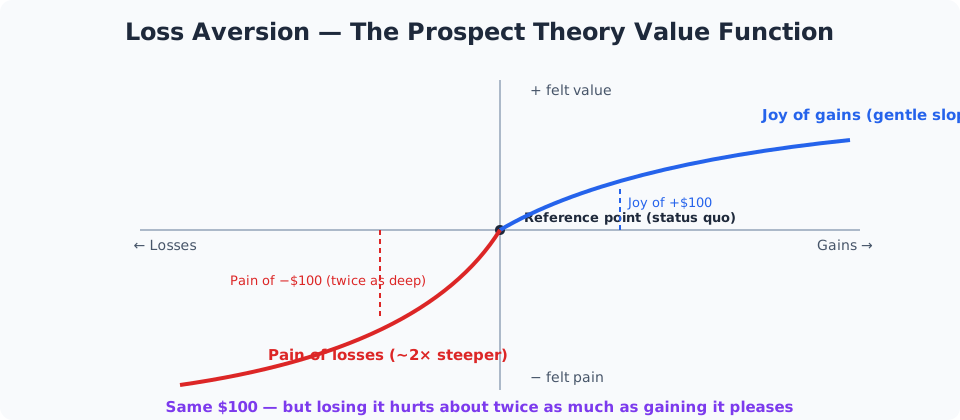
To see loss aversion visually, meet prospect theory’s “value function” — a graph of how objective amounts of gain and loss map to felt value (this article’s diagram sketches it).
The graph packs in three features of human gain-loss perception.
First, “we feel changes from a reference point.” People sense gain and loss not from absolute wealth but from movement relative to “where I am now.” A person whose salary falls from $50,000 to $48,000 suffers; a person whose salary rises from $45,000 to $48,000 rejoices. Same $48,000.
Second, “the loss side of the curve is about twice as steep as the gain side.” This asymmetry is loss aversion itself. The depth of pain at losing $100 is drawn roughly twice the height of joy at gaining $100.
Third, “sensation dulls with distance.” The joy of $100 becoming $200 is large; the joy of $10,000 becoming $10,100 is faint. The same dulling on the loss side produces the dangerous psychology of “I’m deep in the red anyway — time for one big gamble” (the second half of the Asian disease problem in the framing article lives exactly in this region).
Redrawing humanity as a creature with these three features was prospect theory’s revolution. A remarkable share of everyday irrationality falls cleanly out of this one curve.
Even Pro Golfers Putt with Loss Aversion
Loss aversion is not confined to the lab. For the definitive field example: economists Pope and Schweitzer’s 2011 study of professional golfers’ putts.
In golf, finishing a hole one stroke under par is a “birdie,” at par a “par,” one over a “bogey.” The key: a golfer’s mental reference point sits at par. A birdie putt is thus “a putt to capture a gain,” while a par putt is “a putt to avoid a loss (bogey).”
The researchers analyzed over 2.5 million putts from the pro tour. Controlling for distance, position, and other conditions, par putts (loss avoidance) succeeded at a clearly higher rate than birdie putts (gain seeking) under identical conditions.
Even pros with prize money on the line focused harder when “avoiding a bogey.” Since tournaments are decided by total strokes, a birdie stroke and a par stroke are worth exactly the same — yet the pain of loss reached all the way into the strokes of the world’s best. By the researchers’ estimate, this distortion cost top players substantial prize money every year.
The Machinery Inside Insurance, Ads, and Cancellation Fees
Loss aversion is built into commerce everywhere as the basic component for extracting money from us.
“Today only” and “almost gone” advertising is the technology of converting not-buying into “losing something you were meant to have.” That “you’ll lose out if you don’t buy” moves people better than “you’ll gain if you buy” is settled marketing folklore. Limited time, limited stock, flash sales — all applications of the loss frame.
Overpriced insurance and extended warranties lean on it too. Insurance itself is a rational product, but the reason “a $5 extended warranty on a $30 gadget” sells so well — despite being overpriced relative to probability and damage — is that even the possibility of a small loss registers as pain.
Cancellation and early-termination fees work the same way. Even when the amount is small, the presented loss — “cancelling costs $30” — blocks the calm calculation of comparing it against the accumulating monthly fees.
Expiring points notifications deserve mention. Ever rushed into an unneeded purchase because “500 points expire soon”? Money that never existed becomes “yours” for a moment — and from then on, losing it hurts.
The Fix: Think in Expected Values and Repetitions
You cannot delete loss aversion, but you can shrink its influence on decisions.
- When torn, compute the expected value on paper (numbers do not apply the emotional 2× weighting)
- Think not about the single instance but “what happens if I repeat this same decision 100 times?”
- When the feeling “I’ll lose out if I don’t buy” arises, estimate “what I lose if I do buy” with equal seriousness
- Decide insurance and warranties by comparing “probability × damage” against cost (not by the size of the anxiety)
The second — “think in repetitions” — is especially potent. The opening coin flip tempts refusal as a one-shot, but offer “100 flips” and acceptances soar, because intuition can grasp that repetition drives results toward the expected value. Life’s small decisions (add the warranty? buy the sale item?) are in fact games repeated hundreds of times. Frame them as policy decisions judged by expected value, not single instances judged by pain, and loss aversion’s voice gets quieter.
One caveat worth keeping: loss aversion is not always wrong. Guarding fiercely against irreversible losses — your entire savings, your health, your reputation — is entirely rational. The failure mode is applying the 2× weighting to small recoverable losses and thereby passing up favorable opportunities forever.
Questions About Risk Aversion and More
Three supplements.
Isn’t This Just Risk Aversion?
Similar, but distinct. Risk aversion is disliking “variance in outcomes” — a preference traditional economics treats as perfectly rational. Loss aversion is a special hatred of “falling below the reference point.” The difference shows in the domain of losses. Pure risk aversion would choose safety there too — but real humans, desperate not to lock in a loss, turn into gamblers in the loss domain (holding losing stocks forever, doubling bets to win it back). That reversal — “cautious in gains, reckless in losses” — is loss aversion’s signature.
Why Are Humans Built This Way?
The evolutionary account is compelling. In an environment at subsistence margins, missing a big gain is a disappointment; taking a big loss is death. Not losing a day’s food mattered more than gaining an extra day’s worth. If loss-sensitive individuals survived at higher rates, our inherited oversensitivity is no mystery. The problem is that the same alarm now fires for losses that threaten nothing — a missed sale, expiring loyalty points.
How Do I Handle Loss Aversion in Investing?
Investing is where loss aversion bites hardest. The classic failure pattern — “take profits quickly, never realize losses, let losers rot” — is so widespread it has its own name: the “disposition effect.” The remedy is systematization, full stop. Write the sell rules (stop-loss line, profit-taking conditions) at purchase time; stop checking prices daily; reduce the sheer number of decisions with automatic investing. Decide before the emotion fires; execute as decided after it fires. The goal is not to defeat loss aversion but to never let it into the decision seat.
Related Cognitive Biases
See the “sunk cost fallacy” and the “endowment effect” — loss aversion’s two most famous offspring — and “prospect theory,” the theoretical foundation.
Summary
This article covered “loss aversion.”
Feeling loss twice as strongly as gain — this one simple asymmetry makes us refuse positive-expected-value bets, bends the putts of professional golfers, and opens our wallets for “today only” ads. Loss aversion is the shadow boss behind a whole family of cognitive biases: trace the sunk cost fallacy, the endowment effect, or status quo bias to their roots, and you arrive here.
Think in expected values and repetitions. That is my entire countermeasure. Overwrite the instinct that doubles one moment’s pain with a policy set at the scale of a lifetime. Do that, and loss aversion returns to its proper job — as nothing more than the alarm system that protects you.
To return to the full list of cognitive biases, follow the link below.
Thank you for reading. We hope to see you in the next article.
Also popular with readers
📚 Series: Cognitive Bias Guide (18/26)