Thank you for visiting this site. This article covers the “endowment effect.”
Ever listed something on a resale app and caught yourself pricing it above market — “I’m not letting it go that cheap”? To the buyer it is just a used item; to you it is “my things, with history.” That temperature gap is not a personality quirk. Experiments confirm that humans value the identical item roughly twice as high simply because they own it. This is the endowment effect.
What Is the Endowment Effect?
The endowment effect is the phenomenon in which, the moment you own something, the amount you demand to give it up far exceeds the amount you would pay to acquire it.
In traditional economics, an item’s value should not depend on who owns it. If a mug is worth $5 to you, then both “the most you’d pay to buy it” and “the least you’d accept to sell it” should hover near $5.
Real humans, though, quote wildly different prices for the same item depending on whether they are acquiring it or parting with it. The asymmetry was demonstrated spectacularly by the famous mug experiment.
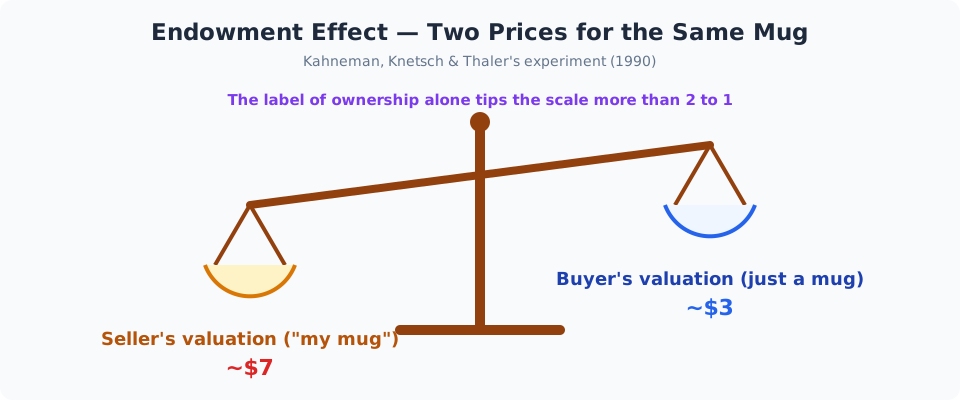
The Mug Experiment: Sellers $7, Buyers $3
The signature experiment was published in 1990 by Daniel Kahneman, Jack Knetsch, and Richard Thaler, staged in a Cornell University classroom.
It is simple. Students were randomly split into two groups; one group received a free university “logo mug.” Students holding mugs (sellers) were asked “what’s the lowest price you’d sell for?”; students without (buyers) were asked “what’s the most you’d pay?”
The split was fully random — preferences for mugs should not differ between groups, so asking prices and offer prices should roughly match. The results:
| Role | Price stated (median) |
|---|---|
| Sellers (received the mug minutes earlier) | ~$7 |
| Buyers (no mug) | ~$3 |
For a mug received free just minutes before, sellers demanded more than double what buyers offered. Naturally, almost no trades happened.
The genius of the design is that no time was allowed for “attachment to grow.” This was not a keepsake of years — it was a mug held for minutes. Yet the mere label “mine” inflated its perceived value twofold. Replicated across items, countries, and age groups, the endowment effect stands among the most robust findings in behavioral economics.
Why Do “My Things” Look More Valuable?
The leading explanation is “loss aversion,” covered in its own article.
For someone without the mug, buying it is “acquiring a gain.” For the owner, selling it is “losing a possession.” Since losses weigh about twice as heavily as gains, the owner demands roughly double the buyer’s joy-price as compensation for the pain of parting. It is no coincidence that the experiment’s 7-to-3 ratio lines up neatly with loss aversion’s coefficient of about 2.
More recently, “psychological ownership” has drawn attention as a complementary account. Once we own something, we begin treating it as an extension of the self — which is why an insult to your belongings feels like an insult to you. The owner’s valuation is “the item’s own worth” plus “its worth as a piece of me,” which is exactly why it diverges from everyone else’s.
Intriguingly, weak versions of the effect arise from merely touching or imagining owning an item. The retail folk wisdom that putting a product into a shopper’s hands lifts purchase rates has experimental backing: quasi-ownership inflates value.
The Machinery of Free Returns, Trials, and Trade-Ins
The endowment effect is wired deep into modern marketing.
“Free returns within 30 days” is the flagship. Returns should be a cost to the seller — yet the offer is a powerful sales engine. Once a product sits in your home and enters use, it becomes “mine,” and returning it becomes “the pain of losing a possession.” Return rates run far lower than most people imagine: the moment “I can always return it” persuades you to take possession, the game is mostly decided.
Free trial periods share the structure. Canceling a subscription you’ve used for a month is no longer a question of “would I sign up?” — it has been quietly swapped for “will I give up the convenience I now have?”
Car and appliance trade-ins demand caution in the opposite direction. As sellers, we overprice our own beloved car relative to the market. The feeling that “it can’t possibly be worth that little” may mean not that the appraiser is cheating you, but that your own yardstick has been inflated by ownership (get competing quotes regardless).
Game item giveaways apply it too: hand players a powerful limited-time item first, then let it expire. The design converts the pain of loss into spending.
The Real Reason Decluttering Stalls
The endowment effect reaches beyond money and into your closet.
When tidying, we ask ourselves, “should I throw this away?” That framing is the trap. Discarding = losing a possession, so the endowment effect and loss aversion resist at full strength. The reasons that bubble up — “might need it someday,” “it has memories” — are your brain generating rationales to dodge a loss.
The effective move is to invert the question:
“If I didn’t own this, would I buy it today at this price?”
The question moves the arena from “the pain of letting go” to “the value of acquiring.” Anything you answer “no” to was, once the ownership plating is stripped, worth only that much to you. The famous tidying criterion “does it spark joy?” is, I think, well-founded for the same reason — it flips the viewpoint from “the pain of losing” to “the joy of having.”
The Fix: Reset Ownership, Then Appraise
The countermeasures, distilled — the core is to peel off the “mine” label before re-evaluating:
- Torn over letting something go? Ask: “if I didn’t own it, what would I pay for it?”
- Selling something? Anchor on actual transaction prices for comparable items (the market), not your own feel
- Holding a “free returns” or “trial” product? Before the deadline, declare one day “purchase decision day” and judge coldly
- Distinguish the truly precious from the rest (this is not an argument for owning nothing)
That last point deserves emphasis. Attachment to keepsakes and genuinely treasured things is not a bias — it is the richness of a life. The problem is the “mine” spell settling over things you barely use, taxing your space, money, and judgment. Know the counter-spell, and you get to choose which things keep their magic.
How Is Attachment Different from the Endowment Effect?
They overlap, but they can be told apart. Attachment is “value grown through time and memories” — real value. The endowment effect is “an automatic markup that fires the instant you own something” — as the mug experiment showed, it needs zero memories. The practical test: “can I tell a concrete story about this object?” If yes, attachment. If you can’t tell the story but still can’t let go, suspect the endowment effect.
Does the Endowment Effect Apply to Stocks Too?
It does. The tendency to see the stocks you hold as more promising than the evidence warrants is widely observed, and the recommended question in investing is the same: “if I didn’t hold this stock, would I buy it today?” If the answer is no, the only case for holding may be “because I already do.” This one question audits both the sunk cost fallacy (fixation on your purchase price) and the endowment effect (fixation on ownership) at once.
Can the Endowment Effect Be Used for Good?
Yes — most clearly in habit building. Systems that accumulate “streaks” and “day counts” turn the record into “your possession,” making a break feel like a loss. This is why a language app’s learning streak binds people so effectively. Likewise, when you want a team to adopt a new process, involve the members in designing it — the system becomes “ours,” and people protect what is theirs. Ownership, aimed well, becomes the ally of persistence.
Related Cognitive Biases
See “loss aversion,” the foundation beneath the endowment effect, and its can’t-let-go siblings, the “sunk cost fallacy” and “status quo bias.”
Summary
This article covered the “endowment effect.”
Even a mug owned for minutes looks twice as valuable. The result teaches that part of our sense that “this is precious” flows not from the thing, but from ownership itself. The bullish resale listing, the subscription you can’t cancel, the decluttering that never happens — one root.
The counter-spell is “if I didn’t own it, would I buy it today?” Check each thing’s bare value with that question — and whatever you still want to keep afterward, that is what is truly valuable to you.
To return to the full list of cognitive biases, follow the link below.
Thank you for reading. We hope to see you in the next article.
Also popular with readers
📚 Series: Cognitive Bias Guide (20/26)