Thank you for visiting this site. This article covers “hyperbolic discounting.”
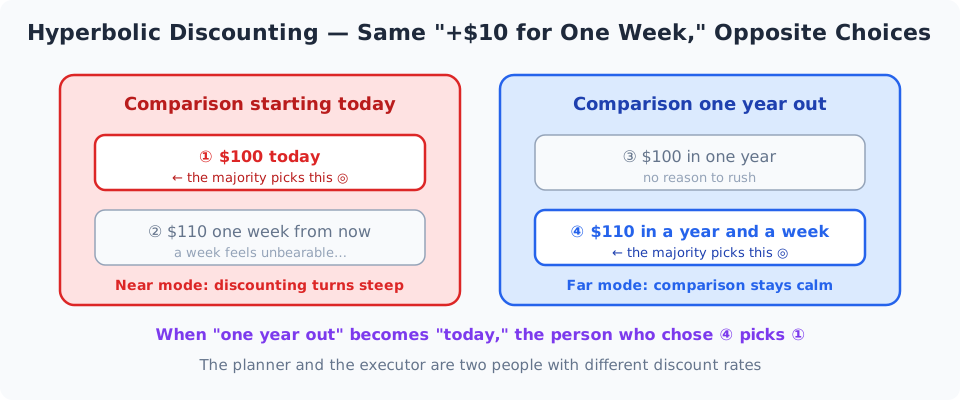
Answer two questions on instinct. Which would you take: “① $100 today” or “② $110 a week from now”? Most people take ① — “$100 today.” Now: “③ $100 a year from now” or “④ $110 in a year and a week”? This time the majority picks ④.
Look coldly, and ①-vs-② and ③-vs-④ are the identical deal: “wait one week, gain $10.” Yet the moment the reward moves within reach, we cannot wait. This “special treatment for right now” is hyperbolic discounting.
What Is Hyperbolic Discounting?
Hyperbolic discounting is the human trait of discounting future rewards gently when they are far away, but steeply — explosively — as they approach the present.
Start with “discounting.” Living creatures, humans included, value future rewards below present ones. Preferring “$100 today” to “$100 next year” is natural and even rational (you could invest it meanwhile, and promises get broken). Traditional economics assumed this discounting proceeds at a “constant rate” — the cost of waiting a week should be the same whether that week is this week or next year’s.
But real human discounting is not constant. As the opening quiz shows, “a week, a year from now” is painless to wait through, while “a week, starting today” is unbearable. Because the discount curve resembles a mathematical hyperbola, the trait was named hyperbolic discounting. Behavioral economics also calls the underlying “special treatment of the present” by another name: “present bias.”
Preference Reversal: Your Future Self Will Betray You
Hyperbolic discounting’s most important consequence: with the mere passage of time, preferences flip. This is called “preference reversal.”
Look at the quiz again. Comparing at the one-year mark (③ vs ④), you were the sensible person who chose “wait a week for $110.” But time flows, that “one year from now” becomes “today” — and you transform into the person grabbing “$100 right now.” Nothing about the situation changed. Only time passed, and the decision reversed.
This structure loops endlessly through daily life:
- Sunday night: “diet starts tomorrow” (the distant self is wise) → Monday lunch: “it’s a work thing, so… tomorrow” (the immediate self folds)
- Start of month: “this month I save” → payday: “there’s something I want, so next month”
- First day of summer break: “I’ll pace the homework” → the last night: “why didn’t I?”
The daily renewal of “I’ll get serious tomorrow” isn’t weak willpower so much as the brain switching discount rates between when it evaluates “tomorrow’s me” and when “today’s me” acts. Plans are drafted by the calm, far-mode brain; execution is judged by the near-mode brain. In effect, the planner and the executor are two different people.
The Businesses Aimed at Your Present Bias
Hyperbolic discounting is wired into the machinery that targets your wallet.
Revolving credit and installment plans are the flagship. The immediate reward — “the product is yours right now” — registers at full strength, while “the total future payments” arrive pre-shrunk by discounting. Even when the annualized rate is plainly expensive, “just $50 a month” meshes perfectly with present bias.
Mobile games’ “recover now” purchases run the same play. Choosing between “wait a few hours, free” and “$1, right now” is a hyperbolic discounting experiment in the wild. Designing wait times and then selling the skip is the monetization of present bias.
First-month-free subscriptions place the reward (access) in the present and launch the pain (payment) into the future. Future payments arrive discounted and light, so the signup barrier collapses.
Retirement savings is present bias at societal scale. We know intellectually that “living costs decades from now” matter, yet they lose to today’s temptations. This is why so many countries lean on structures that bypass willpower — payroll deductions, automatic enrollment. Policy has already conceded the point: this problem is solved by design, not by resolve.
The Fix: Bind Yourself with Commitment Devices
The core countermeasure is clear: while the calm far-mode self is in charge, shackle the options of the near-mode self who comes later. Such mechanisms are called “commitment devices.”
The classic example is Odysseus of Greek myth. Sailing past the Sirens, whose song lures sailors to their deaths, he ordered his crew: “tie me to the mast — and no matter how I beg, do not untie me.” The calm present self knew the self who heard the song could not be trusted.
Modern commitment devices include:
- Automated saving and investing (transfer on payday, automatically — remove willpower from the loop)
- “Deadline slicing” (carve one distant deadline into small weekly ones — the timeless cure for the summer-homework problem)
- Physical removal of temptation (phone in another room; don’t stock the snacks)
- Declarations and forfeits (announce your goal publicly; use services that donate your money if you fail)
One more finding from recent research is delightful: vividly imagining your future self weakens present bias. In one experiment, people shown age-progressed photos of their own faces raised their savings intentions. As long as “future you” remains a blurry stranger, the brain won’t sacrifice for them. Turning your future self into “someone you know” quietly works.
So Is It Just Weak Willpower After All?
The discovery of this field is precisely that it can’t be dismissed that way. Hyperbolic discounting is observed in virtually all humans (and in pigeons and rats), a standard specification of the brain. Individual differences exist; a zero reading does not. The problem with the “weak will” explanation is that its only prescription is “try harder.” Admit it is a specification, and the prescription becomes “engineer fewer moments where willpower is tested.” In savings, study, and exercise alike, the people who deliver results are mostly not the strong-willed — they are the skilled builders of environments where willpower rarely gets called on.
Is the Marshmallow Experiment Story True?
The marshmallow experiment (toddlers who resist one marshmallow for 15 minutes get two) became famous through follow-ups linking longer waits to better academic outcomes. Today, however, replication studies have substantially discounted the original claims. Adjusting for family background and similar factors shrinks the link between waiting time and later success considerably. The strong narrative — “childhood self-control determines everything” — is no longer supported. The evidence now fits better with viewing self-control as a skill that environment and mechanism can compensate for, not an inborn verdict.
Is Enjoying the Present a Bad Thing?
Not at all. A life that sacrifices every present for the future would imply a discount rate of zero — which is its own kind of unnatural. The only problem state is when the things your calm self wants to stop or start get overturned by immediate temptation, every single time. The test is simple: “when the me of one year from now looks back at this choice, will they sign off on it?” A splurge or a rest that future-you endorses is legitimate investment in present happiness; the procrastination you already know future-you will curse is hyperbolic discounting at work. Choosing to enjoy — and then enjoying — needs no defense.
Related Cognitive Biases
See “status quo bias” (postponing change), the “sunk cost fallacy” (chained to the past), and the overview of behavioral economics that contains them all.
Summary
This article covered “hyperbolic discounting.”
At a year’s distance we choose wisely; the moment the choice arrives in front of us, we cannot wait. The fact that “the self that plans” and “the self that executes” are different people with different discount rates converts procrastination and impulse spending from “character flaws” into “problems solvable by design.”
Like Odysseus, bind yourself while you are calm. Automation, sliced deadlines, temptation out of reach. Every mechanism that reduces willpower’s screen time cancels one more betrayal of your future self. The way to make “tomorrow” in “I’ll get serious tomorrow” become today is not grit — it is engineering.
To return to the full list of cognitive biases, follow the link below.
Thank you for reading. We hope to see you in the next article.
Also popular with readers
📚 Series: Cognitive Bias Guide (21/26)