Thank you for visiting this site. This article covers “survivorship bias.”
“Most successful people wake up at 4 a.m. — so wake up early and you’ll succeed.” You have surely seen claims like this. They sound plausible, but the reasoning has a fatal flaw: the far greater number of people who woke at 4 a.m. and did not succeed were never interviewed, never wrote books, and simply do not exist as data.
What Is Survivorship Bias?
Survivorship bias is the statistical distortion that arises when only the subjects that survived some selection process are observable, while the dropouts vanish from view — warping the whole picture.
The point is that this is not a problem of “fake data.” The data in front of you may be perfectly genuine — but fail to notice that the sample consists only of survivors, and you can be led to conclusions that are exactly backwards.
- Common traits of successful founders → dozens of times more people did the same things and failed
- “My grandmother drank every day and lived to 90” → the drinkers who died young tell no tales
- The philosophy of century-old companies → firms with the same philosophy that went under aren’t around to be studied
Judge only by what you can observe, and the selection filter itself becomes invisible.
The Bullet Holes on the Returning Bombers
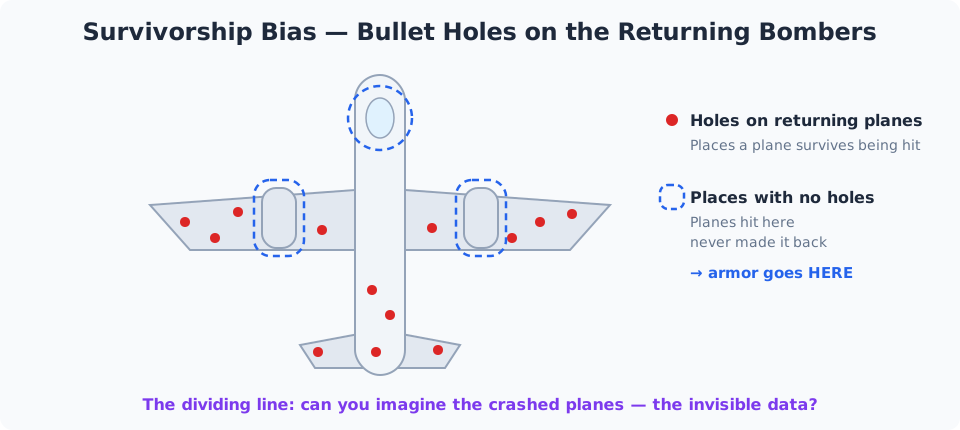
The most famous illustration is the World War II bomber story.
The U.S. military was surveying battle damage on bombers that returned from missions. The bullet holes clustered on the wings and fuselage, so the initial plan was: “reinforce the areas with the most holes.” Protect where planes get hit — apparently perfectly logical.
But statistician Abraham Wald proposed the exact opposite: “armor the places with no bullet holes.”
His reasoning: the survey covered only “planes that made it back.” If aircraft riddled through the wings and fuselage were flying home, those are places a plane can be shot and still survive. The absence of holes in the engines and cockpit means planes hit there never came back.
Whether you can imagine the crashed planes — “the data that didn’t survive” — flips the conclusion 180 degrees. No example captures the essence of survivorship bias more vividly.
Do Cats Falling from Higher Floors Survive More?
A famous, stranger case: the “feline high-rise syndrome” statistics.
In 1987, a New York animal hospital analyzed its records of “cats brought in after falls from height” and found something odd: cats that fell from the 7th floor or higher appeared to survive at higher rates than cats that fell from lower floors.
The finding was widely reported with the explanation that “in longer falls, cats have time to right themselves and spread the impact.” That aerial-righting effect is considered real — but a second possibility was later pointed out.
Namely: cats killed instantly by falls from great heights are never brought to a hospital at all. Owners bring in “cats that might still be saved.” Since the data contains only hospital arrivals, the high-floor sample may have been skewed from the start toward cats with survivable injuries.
Even a seemingly neutral dataset from an animal hospital hides a selection step at the front door — “how did this data get collected?” A textbook case.
Feel the Numbers: Ten Thousand Challengers
The danger of survivorship bias snaps into focus once you attach concrete numbers. A hypothetical:
One year, 10,000 people debut as video streamers. Five years later, 10 have succeeded enough to make a living. The media interviews those 10, hunting for common traits — and all 10 say they “posted every single day.” The headline writes itself: “The Power of Daily Posting — Practiced by 100% of Successful Streamers.”
Persuasive-looking data. But the denominator is missing. Suppose 8,000 of the 10,000 challengers posted daily, and 10 of them succeeded. The success rate of daily posting is a mere 0.125%. No honest person could write “post daily and you’ll make it” over that number.
There is an even nastier possibility. Among the 2,000 who didn’t post daily — were there zero successes, or a few who simply never got interviewed? Studying only the 10 winners can never answer that comparison.
Whenever you see “X% of successful people do Y,” summon this picture of the ten thousand. What you need is not the percentage among winners but the reversed number: “of everyone who did Y, what percentage succeeded?”
Success Stories, Testimonials, and Fund Performance
Autobiographies and interviews of the successful contain survivorship bias structurally. Behind the famous story of “dropped out of college, founded a company, changed the world” stand countless people who made the same choice and vanished from the stage. What looks like the winners’ common trait may simply be “the common trait of everyone who tried.”
Health-cure testimonials are the classic. “This supplement cured my cancer” may be sincerely true for the writer — but the people it didn’t cure post no testimonials. This is exactly why testimonials cannot establish efficacy.
In investing, past-performance data for funds demands caution. Poorly performing funds get liquidated along the way, so the average track record of currently existing funds looks better than reality. Professionals insist on “survivorship-bias-free” databases for precisely this reason.
The feeling that “they built things to last back in the day” is survivorship bias too. The 50-year-old appliance still running is the exceptional survivor of its generation; the broken majority went to the dump decades ago, along with our memory of them.
The Power of Organizations That Collect Failure Data
The flip side of survivorship bias: systems that deliberately collect the vanished data — the records of failure — hold enormous value.
Aviation is the flagship example. The industry maintains systems where personnel can anonymously report “near misses” — incidents that didn’t become accidents — under a principle of non-punishment for reporters. Collecting not just the conspicuous outcome (crashes) but the vast body of near-miss data is credited with aviation’s dramatic long-term fall in accident rates.
Software engineering has spread the culture of the “postmortem” — a blameless written review after an outage that records structural causes rather than culprits. There is even an academic field, “failure studies,” devoted to systematically analyzing failures.
Most companies hold success-story showcases; few share failures with equal energy. From the survivorship standpoint, the more precious learning material is the failure that disappears untold. I believe organizations where failure can be reported safely gain a permanent edge in learning speed on that basis alone.
The Fix: Hunt for the Missing Data
The countermeasure is to retrace Wald’s reasoning: deliberately search for the dropouts who never made it into the data in front of you.
- At every success story, ask: “how many people did the same thing and failed?”
- Check the “denominator” (the success rate among 10,000 challengers matters more than the common traits of 100 winners)
- Check how the data was collected (what selection did it pass through on the way to you?)
- Deliberately collect failure and withdrawal cases (records of failure are rarer and more valuable than records of success)
The question “what is the denominator?” is the universal tool. Testimonials, success stories, track records — discount heavily any information whose denominator you cannot see. That habit alone dodges most of the traps.
So Is Learning from Successful People Pointless?
The Right Way to Use Success Stories
Not pointless — but the learnable content is limited in kind. What success stories reliably teach is concrete know-how: what pitfalls and techniques the road contains. What they cannot support is “laws of success” — causal claims of the form “do this and you will win.” Establishing a law requires the failures’ data. Read the winner’s tale as “a map,” never as “a warranty.” That distinction does the practical work.
How Is This Different from Confirmation Bias?
The distortion happens in different places. Confirmation bias occurs inside your head — a habit of picking evidence that fits your beliefs. Survivorship bias occurs before the data ever reaches you — the world itself shows you a pre-filtered sample. A perfectly fair-minded person still falls to survivorship bias. Being immune to correction by personal effort makes it, in a sense, the nastier of the two.
Where Do People Trip Over This Most in Daily Life?
My pick: “reviews and ratings.” Review writers skew toward people with strong feelings (delighted or furious), while the customers who quietly stopped using the product leave nothing. Restaurant reviews over-represent regulars versus one-time visitors. Keep in a corner of your mind that reviews are “the voices of those who stuck around” — that a star rating is not “the average satisfaction of all buyers” — and you shop with different eyes.
Related Cognitive Biases
Drawing wrong conclusions from skewed samples is a recurring structure. The “availability heuristic,” which estimates frequency from recallable examples, is survivorship bias’s close kin. For statistics fans, “Berkson’s paradox” — spurious correlations created by selection — is required reading.


Summary
This article covered “survivorship bias.”
The success stories we read, the longevity secrets, the philosophies of venerable companies — all of it is data that has already passed through the filter called survival. Forget the filter for one moment, and the data stops telling the truth and starts guiding you to its opposite.
When some common trait or law of success starts to persuade you, remember the bombers that never came home. The data you cannot see often carries the most important information of all.
To return to the full list of cognitive biases, follow the link below.
Thank you for reading. We hope to see you in the next article.
Also popular with readers
📚 Series: Cognitive Bias Guide (22/26)