Thank you for visiting this site. This article covers “normalcy bias.”
When a fire alarm sounds, almost nobody starts evacuating immediately. Most people’s first thoughts are “probably a malfunction” or “must be a test.” When an earthquake alert blares, we look around the room to see what everyone else does. This mental reflex of stuffing the abnormal back into the box labeled “normal” is normalcy bias — the cognitive bias disaster researchers treat as the leading cause of delayed evacuation.
What Is Normalcy Bias?
Normalcy bias is the tendency, when facing danger or abnormal events, to underestimate them — “this is within normal range,” “I’ll be fine.”
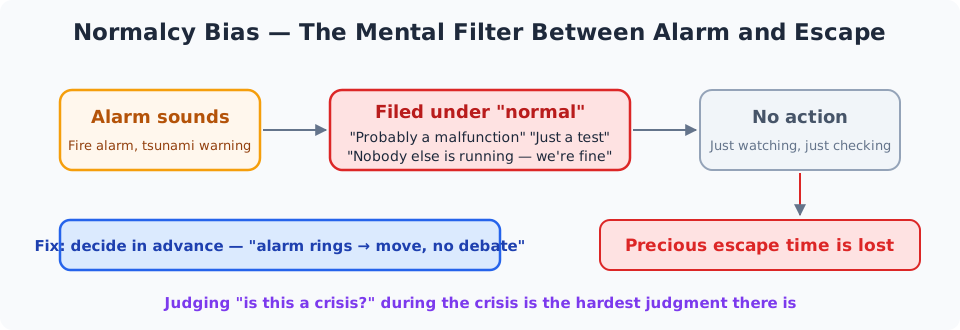
It looks like simple carelessness, but the bias has a functional reason to exist. Daily life brims with small anomalies: odd noises, delays, false alarms. Responding at full alert to all of them would wreck body and mind. To preserve peace of mind, the brain ships with a filter that classifies anomalies as “business as usual.”
The problem is that this filter keeps operating during genuine crises. The tsunami warning and the fire alarm get filed under “the usual thing again,” and precious evacuation minutes drain away.
The Mechanism of Delayed Evacuation
Disaster psychology surveys report consistent patterns in emergency behavior.
First, people who act immediately on an alarm are a minority. Most people “check for information” and “see what others are doing.” Here the people nearby play a decisive role: if nobody else is fleeing, that becomes reassurance — “see, it’s fine.” This is the “majority synchronization bias,” and it works hand in glove with normalcy bias.
In the famous smoke-filled room experiment, participants alone in the room reported the smoke quickly — but seated with confederates instructed to act unbothered, they kept ignoring the smoke as it thickened. “Nobody’s moving, so it must be fine” — when everyone may be sitting still for exactly the same reason.
After the 2011 Great East Japan Earthquake, surveys documented large numbers of people who did not evacuate, or evacuated late, despite major tsunami warnings. The testimony — “I didn’t think the tsunami would reach here,” “it never came in past earthquakes” — is normalcy bias speaking in its own words.
The Passengers Who Kept Their Seats in the Smoke
The case that showed the world how lethal normalcy bias can be is the 2003 Daegu subway arson in South Korea.
A fire set aboard a stopped train spread smoke into an oncoming train that pulled up alongside. About 200 people died. What shocked the public afterward were photos from inside the second train: passengers still seated, unmoving, as smoke poured into the car. Many stayed in place, covering their mouths.
They were not blind to the situation — the smoke was in front of their faces. Analysts concluded the initial escape was fatally delayed by reasoning like “there’s been no announcement, so it must be okay” and “everyone else is still sitting.” The precise combination of normalcy bias and majority synchronization.
What makes this case so important is its lesson: even when danger is visible, people can fail to move. What blocks evacuation is not only missing information. The final wall is the psychological hurdle of declaring to yourself “this is a real emergency” — and standing up before anyone else does.
Surveys elsewhere repeatedly find the same: in office buildings where fire alarms ring, almost nobody starts evacuating. The starting point for any countermeasure is accepting the premise: “I could be one of the passengers in that photo."
"Still Fine” Beyond Disasters
Normalcy bias is not reserved for catastrophes.
Health warning signs written off as “just fatigue” or “just age” — delaying the doctor’s visit — are the body’s alarms being stuffed into the normal box.
Corporate scandals and deteriorating results breed the same air: “not at our company,” “this quarter is a fluke.” An organization where small anomaly reports get crushed as “overreacting” has institutionalized normalcy bias.
Security incidents repeat the pattern: the first response of “probably a false positive” delays the initial containment, over and over.
The Kamaishi Students and the Power of Training
Can normalcy bias be overcome? There is a hopeful real-world answer: the evacuation of elementary and junior high school students in Kamaishi, Japan, during the 2011 tsunami.
Kamaishi’s students had received years of tsunami-preparedness education built on “three principles of evacuation”:
- “Don’t trust assumptions” (don’t relax even in the hazard map’s safe zone)
- “Do your utmost” (never think “this is high enough” — keep going higher)
- “Be the first to flee” (don’t wait for others; show them your back as you run)
On the day, the children did exactly as trained — sprinting for high ground almost the moment the warning sounded. Junior high students pulled elementary schoolers by the hand, and adults who saw the running children followed. Nearly every student under school supervision survived, an outcome later celebrated widely.
Note that the three principles are countermeasures aimed squarely at normalcy bias and majority synchronization. “Don’t trust assumptions” blocks the filing-under-normal reflex; “be the first to flee” severs the conformity chain of “nobody’s running, so we’re fine.” Biases cannot be willed away — but education and drills can overwrite behavior. Kamaishi is the proof.
The Fix: Decide Everything in Peacetime
What makes normalcy bias so vicious is that calmly judging “is this a crisis?” in the middle of a crisis is close to impossible. So the strategy is to minimize on-the-spot judgment.
- Pre-commit behavioral triggers (decide now: “when the alarm sounds, I evacuate without debating why”)
- Run drills “as if real”, repeatedly (behavior your body has memorized beats the bias)
- Become the “first evacuee” (one person moving flips majority synchronization into a force for good — the whole room follows)
- In organizations, write it down: “false-alarm reports and evacuations are never punished”
That last point matters enormously. A culture that mocks false alarms teaches people to hesitate before raising any alarm, institutionalizing normalcy bias. “False alarms welcome; misses forbidden” is the iron rule, in disaster response and business alike.
Optimism Bias, Panic, and Reluctant Family Members
How Is This Different from Optimism Bias?
They fire at different moments. Optimism bias distorts “forecasts of the future” — underrating risks that haven’t happened (“I won’t get sick,” “I won’t crash”). Normalcy bias distorts “reactions to the present anomaly” — classifying danger already underway as within normal range. A clean division: optimism bias is why you didn’t prepare; normalcy bias is why you didn’t run when the siren sounded.
Isn’t Suppressing Panic a Good Thing?
It genuinely is — and here lies one of disaster psychology’s key findings. Movies have taught us to picture “panicking crowds stampeding,” but in real disasters, the casualties from people NOT moving far outnumber the casualties from panic. The human default under threat is closer to freezing than to frenzy. That is why the crucial message on the ground is not “stay calm” but “start moving now.” Calm is already in surplus. What’s missing is the first step.
How Do I Get a Family Member Moving When They Won’t Budge?
Arguing someone out of normalcy bias mid-emergency costs time you don’t have. What works is what Kamaishi taught: show them your back. Instead of debating “it’s dangerous, let’s go,” pick up the bag and walk to the door. Human conformity pulls both ways — toward staying and toward fleeing — and one person moving in earnest transforms the room. The best peacetime preparation: agree on a family rule now, before anything happens — “when the alarm sounds, we move without discussion.”
Related Cognitive Biases
Below are related biases that warp risk estimation. The “availability heuristic” — fearing the memorable accident while misreading statistical risk — is normalcy bias’s mirror twin.
Summary
This article covered “normalcy bias.”
Normalcy bias is a healthy function — the guardian of everyday peace of mind — that turns its fangs on us in emergencies. It is safest to assume you cannot will yourself into “spotting the real one when it counts.”
Which is why deciding your rules of action in peacetime — so you can move without thinking — is very nearly the only countermeasure there is. Alarm rings: evacuate. Something feels wrong: see the doctor. A false alarm becomes a funny story. Decide it all now, and when the day comes, that decision protects your life and the lives around you.
To return to the full list of cognitive biases, follow the link below.
Thank you for reading. We hope to see you in the next article.
Also popular with readers
📚 Series: Cognitive Bias Guide (23/26)