Thank you for visiting this site. This article covers the “gambler’s fallacy.”
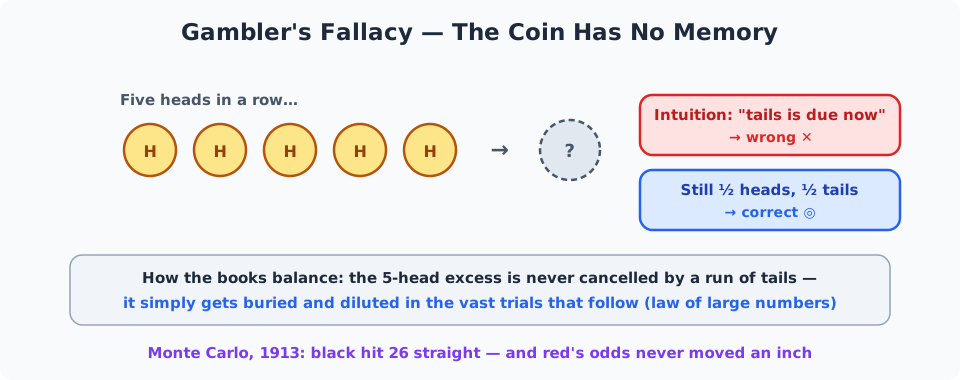
A coin lands heads five times in a row. What comes next? Most people’s intuition whispers, “surely tails by now.” When red keeps hitting at roulette, we itch to bet black; lottery players avoid the store that just sold a jackpot — “lightning won’t strike twice there.” The gambler’s fallacy is the demonstration that this intuition — “chance owes us a correction” — is completely, mathematically wrong.
What Is the Gambler’s Fallacy?
The gambler’s fallacy is the error of believing, about independent random trials, that “one outcome has run long, so the opposite outcome has become more likely.”
A fair coin remembers nothing. After five straight heads, the probability of heads on the next flip remains exactly one half. After ten straight, or a hundred — the same. “The coin has no memory” — that is what the word independent means.
Yet intuition keeps insisting “tails is due,” because our heads carry a false model: “chance settles its accounts.” Over the long run heads and tails approach fifty-fifty, so a run of heads must be paid back in tails — right? That interpretation of “over the long run” is precisely the weak point, as we’ll see.
The Night Black Hit 26 Times at Monte Carlo
A famous event is said to have given the fallacy its name.
On August 18, 1913, at the casino in Monte Carlo, a roulette wheel produced black 26 times in a row. As the streak grew, bettors mobbed the table: “after this many blacks, red is guaranteed.” The stakes swelled with each spin; from around the 15th black, money reportedly piled onto red without pause.
But the wheel has no memory. However many blacks precede it, the probability of red on the next spin does not move. The bettors lost, and lost, and lost — and the casino is said to have made a fortune in a single night.
The lesson: witnessing a rare streak is exactly when the gambler’s fallacy grips people hardest. Twenty-six consecutive blacks has a probability around 1 in 67 million — a staggering rarity. But “a rarity that has already happened” exerts zero influence on the next spin. The astonishment at the streak converts itself directly into the conviction that “the next one must differ.”
The Books Balance by Dilution, Not Cancellation
At the root of the gambler’s fallacy is a misreading of the “law of large numbers.” Grasp this, and the bias collapses at the foundation.
What the law of large numbers guarantees is only this: as the number of trials grows, the PROPORTION of heads approaches 50%. It does not guarantee that the difference in COUNTS between heads and tails shrinks.
Concrete numbers. Suppose heads opens with a run of 5.
- Flip 1,000 more times at exactly half-and-half (500 each): the running total is 505 heads vs 500 tails. The count gap is still 5 — but the heads proportion has closed to 50.2%.
- Flip 100,000 more: with the gap still 5, the proportion is 50.0025%. Essentially 50%.
Chance, in other words, settles the books not by “producing extra tails to cancel the run” but by “burying the run inside an enormous number of trials until it dilutes away.” No tails-heavy stretch is ever required.
The intuition “tails must be coming” mistakes this “dilution” for “cancellation.” Kahneman and Tversky mockingly named the mistake the “law of small numbers”: we expect even tiny sequences to display the fifty-fifty character of the whole. The reason H-H-H-H-H “doesn’t look random” is that our mental image of randomness alternates far more politely than real randomness does.
Umpires and Judges Lose to “It’s Due” Too
The gambler’s fallacy operates far outside casinos — inside professional judgments that are supposed to be impartial.
A 2016 study by economist Daniel Chen and colleagues analyzed large-scale records of three kinds of professional decisions. All three showed the same lean:
- Baseball umpires: on borderline pitches, after calling a strike, the probability of calling the next similar pitch a ball goes up
- Loan officers: after approving one application, they became more likely to reject the next
- Asylum judges: after a run of approvals, the next application was more likely to be denied
Umpires and judges are obligated to treat each case independently. Yet the feeling — “strikes can’t keep coming like this,” “this many approvals in a row is strange” — quietly tilted the verdicts the other way. The sequence, not the substance of the case in front of them, was moving the conclusion.
As the study shows, the gambler’s fallacy is not a gambling story — it is the general human itch to “correct” any streak we see. After a run of strong interview candidates, is your bar for the next one creeping up? After a string of passes in quality inspection, are you starting to want a fail? Every “it’s about time” in a context demanding independent judgment is a suspect.
Lotteries, Investing, and the Sex of Babies
Lotteries have a whole folk strategy of chasing “overdue numbers” that haven’t appeared lately — but the machine has no memory, and every number’s odds are identical every draw. Chasing “hot numbers” is equally meaningless as long as the machine is fair (a biased machine would change things, but finding one in a modern lottery is practically impossible).
In investing, “it’s fallen this many days straight — a bounce is due” is the fallacy’s classic form. A caveat: stock prices are not perfectly independent trials, which complicates the picture. What does not change is that “the number of down days” is, by itself, no evidence of a bounce. Forecasting a rebound requires substantive grounds — earnings, supply and demand. “It’s due” is not grounds.
The sex of babies attracts the same expectation — “three girls in a row, so the next must be a boy” — but each birth is essentially independent, with near-even odds every time.
Slot machines and pachinko “waves” follow suit: as long as the draw is a probability lottery, “a cold machine is due to pay” has no statistical backing. Worse, that feeling is precisely the fuel for chasing losses deeper.
The Fix: Ask “Independent, or Connected?”
The countermeasure compresses into one question:
“Does the past outcome physically influence the next one?”
Coins, roulette, lotteries, random draws: if the answer is no, the past sequence is useless for prediction. When you catch yourself feeling “it’s due,” tell yourself: that is the state of believing a coin has memory.
Sometimes the answer is yes. Draw cards from a deck without replacement, and each revealed card genuinely changes the next probabilities (this is why card counting works). An athlete’s condition, a machine’s wear, the weather. If you can concretely explain the mechanism of connection, the past is information. If you can’t explain it but still feel a “flow” or a “wave,” you are on the bias’s side of the line.
In practice:
- In sequential judgment work, watch for “the previous result bleeding into the current judgment” (shuffle the order when possible)
- About to decide something on the basis of “it’s about time”? Try to state, in numbers, what “time” it is
- When the phrase “win it back” surfaces in your head, recognize it: that is loss aversion talking, not probability
What About the Hot Hand and Lucky Lottery Stands?
Is the ‘Hot Hand’ a Fallacy Too?
A wonderful piece of scientific history. The basketball intuition that “a player who’s hit several shots is likelier to hit the next” — the “hot hand” — was declared an illusion by a famous 1985 study. Reading streaks as waves of form was labeled the reverse twin of the gambler’s fallacy. But reanalysis in the 2010s uncovered a subtle statistical bias in the original method, and the current leading view is that a modest hot hand really exists. This makes sense: shots can be connected through the player’s physical state (they are not independent). The moral is the same dividing line: machine lotteries have no waves; human performance can.
How Is This Different from Regression to the Mean?
The classic confusable pair. The gambler’s fallacy expects “a swing back” in independent trials (coins don’t swing back). Regression to the mean is a correct statistical phenomenon in outcomes that mix skill and luck: extreme values tend to be followed by values closer to the average (after a career-best test score, the luck component tends to fade). So the thought “it will come back down” is wrong for coins and right for skill-plus-luck systems. The same intuition flips between error and truth depending on whether the target is pure independent chance or a mixture. The regression article covers this in depth.
Is Buying from the Store That Sold the Last Jackpot Smart?
As long as the draw is fair, every ticket has the same odds wherever you buy it. “That store won’t hit again” (gambler’s fallacy) and “that store is lucky” (misapplied hot hand) are equally groundless. One denominator trick is worth knowing, though: high-volume stores show more jackpot wins simply because they sell more tickets. Famous stands produce many winners because they sell enormously — per-ticket odds are unchanged. The survivorship bias article’s rule — “check the denominator” — earns its keep here too.
Related Cognitive Biases
Learn it as a pair with the “regression to the mean” article; see also “survivorship bias” (the shared failure to check denominators) and the “Monty Hall problem” (probability intuition betrayed).
Summary
This article covered the “gambler’s fallacy.”
On the night black hit 26 times, what bankrupted the bettors was not bad luck but a false probability model: “chance must settle its accounts.” And that same model is running today in umpires’ calls and loan officers’ desks — places as far from a casino as it gets.
The coin has no memory. And the books balance by dilution, not cancellation. Those two facts are all you need to carry. When “it’s due” wells up, pause one breath and ask: does this feeling have probabilistic grounds, or am I just startled by a rare-looking streak? Learn to ask that, and you will never pay this bias’s tuition.
To return to the full list of cognitive biases, follow the link below.
Thank you for reading. We hope to see you in the next article.
Also popular with readers
📚 Series: Cognitive Bias Guide (24/26)