Thank you for visiting this site. This article covers “status quo bias.”
How many years has it been since you reviewed your phone plan? Plenty of people know that switching would save them hundreds a year, yet keep postponing — “too much hassle,” “the current one works fine.” Same with bank accounts, insurance, the power company. Half-knowing that change would pay, we keep choosing things as they are. That psychology is status quo bias.
What Is Status Quo Bias?
Status quo bias is the tendency to over-select the current state of affairs even when changing would objectively be the better move.
The name comes from economists Samuelson and Zeckhauser. In their 1988 paper, they ran an experiment on choosing investments for an inherited portfolio. The group choosing from scratch weighed the options roughly evenly. But in the group told “the money is currently already invested in option X,” far more people kept choosing “whatever it’s currently in” — regardless of the contents. Identical options; only “which one is the status quo” changed the choice.
The crucial point: this is different from “deliberating and concluding the current state is best.” Status quo bias is squatting in the current state while skipping the deliberation altogether. The losses that accumulate from squatting are quiet ones — no single moment of pain, just a slow, steady drain.
Why Organ Donation Consent Differs 10x Between Countries
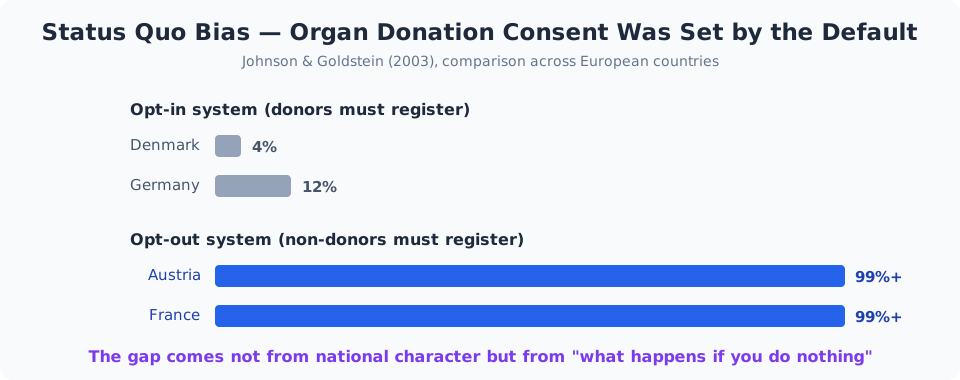
The famous worldwide demonstration of this bias is the comparison of European “organ donation consent rates” published by psychologists Johnson and Goldstein in 2003.
Between neighbors with similar cultures and religions, consent rates differed unbelievably:
| Country | Consent rate | System |
|---|---|---|
| Denmark | ~4% | Those who want to donate must register (opt-in) |
| Germany | ~12% | Those who want to donate must register (opt-in) |
| Austria | 99%+ | Those who do NOT want to donate must register (opt-out) |
| France | 99%+ | Those who do NOT want to donate must register (opt-out) |
Germany and Austria are neighbors sharing language and culture. Yet consent stands at 12% versus over 99%. What creates the gap is not national character but purely the design of “what happens if you do nothing” — the default.
Citizens of both countries choose freely. But on a topic as heavy as organ donation, the vast majority never “go through a procedure to change the current state.” The default becomes the nation’s answer. This “default effect” is status quo bias operating at the scale of social institutions.
The data teaches a slightly frightening lesson: a nontrivial share of what we believe we “chose of our own will” may in fact be “a default someone designed, which we simply never changed.”
Why Do We Squat in the Status Quo?
Status quo bias is a bundle of several psychologies. Let’s take it apart.
First, “loss aversion.” Any change carries both upside and downside. Since the pain of things getting worse weighs about twice the joy of things getting better, even a change with favorable odds “feels” like a bad deal. Much of the arithmetic inside status quo bias is loss aversion.
Second, “the asymmetry of regret.” Research shows that regret over “acting and failing” stings more sharply, in the short run, than regret over “not acting and losing out.” Switch plans and fail, and you berate yourself — “why did I meddle?” Lose money by not switching, and you shrug — “oh well.” Since acting is forecast to hurt more, doing nothing feels safer.
Third, “overweighting the cost of change.” The paperwork, the research time, the adjustment period — real costs, and vividly concrete, which makes them loom large. The benefits forfeited by staying put are distant and blurry. Between “30 minutes of paperwork today” and “$300 saved per year,” the latter wins any sober comparison — and the former wins the felt one.
And fourth, simple “attention limits.” Life is a torrent of decisions and there is no time to review them all. Much status quo maintenance is not even a choice — it is the result of never making it onto the review list at all. Which is why the “scheduled audit” below works as a countermeasure.
Zombie Subscriptions, Frozen Portfolios, and Stalled Reforms
Unused subscriptions are the modern flagship. Paying month after month for streaming services and apps you no longer use, forever “meaning to cancel.” It is fair to say part of the subscription business model’s revenue flows not from service value but from the psychological cost of the “change” called cancellation.
Frozen investment portfolios involve status quo bias too. Holding losers is usually explained by loss aversion, but it also rides the default of “keep holding.” Rebalancing is universally recommended and rarely executed — resistance to change itself.
Stalled organizational reform shares the structure. Objections like “there’s no precedent” and “the current way works” are often not critiques of the new proposal but resistance to change as such. A rational comparison would put the current way on trial alongside the proposal. Noticing the asymmetry — “the status quo continues unexamined while only the proposal faces strict review” — is what determines an organization’s metabolism.
Career choices feel it as well: postponing a job change or reskilling with “maybe things are fine as they are.” Staying put feels like “not deciding,” but in reality it is re-ratifying the decision to choose the status quo, every single day.
The Fix: Demote the Status Quo to Just Another Candidate
The heart of the countermeasure is stripping the status quo of its “exemption from review.”
- Re-ask: “if I were signing up today, would I choose my current plan?” (zero-base thinking)
- Put an annual “fixed-cost audit day” on the calendar (force items onto the review list)
- When hesitating over a change, line up “the cost of changing” versus “the annual cost of not changing” in numbers
- Teach the self that fears “regretting action” this: “the regret of inaction arrives later, and it compounds”
The zero-base question is the universal tool. Like “if I were starting from zero today” from the sunk cost article, it demotes the current state from “the incumbent to defend” to “one candidate among several.” If the status quo wins the re-examination — keep it, proudly. That is no longer status quo bias; it is a status quo that passed review.
And when you find yourself on the other side — the designer of defaults — recognize the power you hold. Defaults that serve the user’s interest, like automatic pension enrollment, have produced results worldwide as “nudges.” Cancel-hostile onboarding that milks subscriptions is the same power, abused. Default design alone can steer lives.
The Border Between Prudence and Status Quo Bias
Isn’t Being Conservative and Careful a Good Thing?
It is — prudence is a virtue. The distinction to draw is between “choosing the status quo after examination” and “squatting in it without examination.” The former is prudence; the latter is the bias. And in domains where change genuinely carries heavy risk — a production system’s stability, a treatment plan — leaning toward the status quo is often rational. The failure mode is blanket avoidance extending even to low-risk, high-return changes.
Is There Evidence That Changing Makes People Happier?
There is a delightful study. Economist Steven Levitt gathered people agonizing over decisions — job changes, moves — and ran a large experiment where they “let a coin flip decide.” At follow-up months later, those whose coin came up heads and chose “change” reported higher happiness than those whose tails kept them where they were. One study, certainly — but the finding that “if it’s close enough to agonize over, change has the edge” suggests our default in moments of doubt is tilted too far toward staying.
Can I Fix My Lazy Personality?
The practical answer: you don’t need to. Everyone has status quo bias, and willpower won’t erase it. What works is machinery. Fix a “review day” on the calendar once a year, and the review happens even while you stay exactly as lazy as before. To go a step further, adopt personal rules like “when torn, try the change” and “if it’s reversible, just do it first.” A reversible change that fails simply returns you to the default — nothing lost but the lesson gained.
Related Cognitive Biases
See “loss aversion” and the “endowment effect” — components of status quo bias — and the “sunk cost fallacy,” where past investment blocks the exit.
Summary
This article covered “status quo bias.”
What separated 12% from 99% in organ donation consent was not the will of the people but the design of the default. The lesson: “doing nothing” is not a neutral choice — it is a choice to ride somebody’s design.
Ask again: “if I were signing up today, would I pick this?” Strip the status quo of its no-review privilege and make it compete on the same field as every other candidate. If it wins that trial, then it is no longer a bias. It is your choice.
To return to the full list of cognitive biases, follow the link below.
Thank you for reading. We hope to see you in the next article.
Also popular with readers
📚 Series: Cognitive Bias Guide (19/26)