Thank you for visiting this site. This article covers the “sunk cost fallacy.”
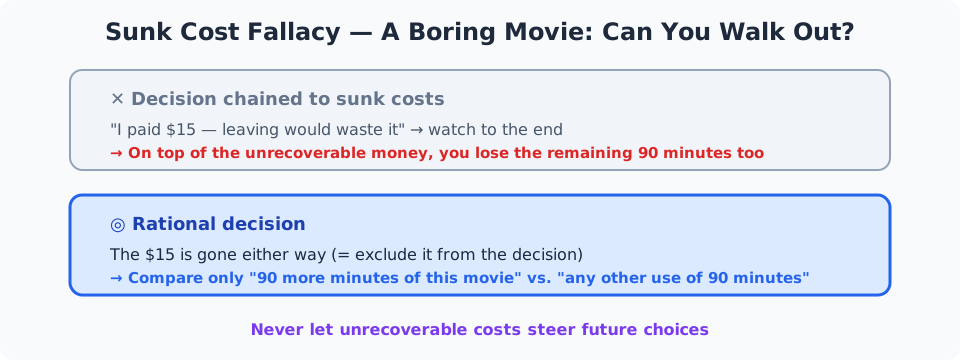
Thirty minutes into a movie, you know for certain: “this is not good.” Can you get up and leave? Most people think “I paid $15 — that would be a waste” and sit through to the end. But think it through: the $15 is gone whether you stay or leave. For the sake of money that will never come back, you hand over another 90 minutes of your life. This is the sunk cost fallacy.
What Is the Sunk Cost Fallacy?
A sunk cost is money, time, or effort already spent that no choice can ever recover.
Economics textbooks are unambiguous: unrecoverable costs should have no influence on future decisions. The only valid inputs are “the costs and benefits from here forward.”
Actual humans, however, get dragged by the feeling of “I can’t let everything I’ve poured in go to waste” into irrational persistence. That psychology is the sunk cost fallacy (also called the sunk cost effect).
Behind it sits behavioral economics’ “loss aversion.” Because losses hurt roughly twice as much as gains please, we instinctively avoid the moment when “quitting = the past investment is officially declared a loss.”
Could You Choose the $50 Ski Trip?
The classic laboratory demonstration is a famous questionnaire study by psychologists Arkes and Blumer in 1985:
You bought a $100 ticket for a ski trip to Michigan. Later you bought a $50 ticket for a ski trip to Wisconsin, which you expect to enjoy more. Then you realize the two trips fall on the same weekend. Neither ticket can be refunded or resold. Which trip do you take?
Rationally, the answer is “the more enjoyable Wisconsin trip ($50).” The $150 is gone either way; the only thing you can still choose is “which weekend to enjoy.”
But in the study, the majority of participants chose Michigan ($100) — not the trip they’d enjoy more, but the one that cost more. The urge not to “waste the $100” overwrote the comparison of enjoyment.
The beauty of this study is its minimalism: even with the incentives stripped this bare, humans still get pulled by sunk costs.
The Concorde Fallacy
The sunk cost fallacy has an alias: the “Concorde fallacy,” after the supersonic airliner jointly developed by Britain and France.
Midway through development, it was already substantially clear the Concorde would never be profitable. Terrible fuel economy, noise regulations restricting its routes, few seats. Analyses forecasting commercial failure existed before it ever entered service.
Yet neither government could stop. The logic: “we’ve spent such colossal sums already — we can’t quit now.” Development continued, and the Concorde retired in 2003 having remained a commercial failure to the end.
The longer the decision to quit is delayed, the deeper the wound. That even a national flagship project could not escape this trap tells you how strong the bias is.
Uncut Losses, Game Spending, and Zombie Projects
The investment loss you can’t cut is the flagship example. When a stock falls, the thought “selling now makes the loss real” paralyzes the sell order. But the only question relevant to holding is “will this stock rise from here?” Your purchase price means nothing to the market.
Mobile game spending shares the structure. “After all I’ve spent, quitting now would waste everything” — from the operator’s perspective, a superb retention device. Business models that deliberately pile up players’ sunk costs are not rare.
Loss-making projects persist in every company. References to the past — “we’ve been at this two years,” “look how many people we’ve committed” — delay the exit decision. If every proposal to withdraw is met with “all our effort will have been wasted,” that is the sunk cost fallacy speaking.
Relationships and careers are not exempt. Continuing something solely because “I’ve done this job five years already” or “we’ve been together so long” may be a decision anchored in past investment rather than in the life ahead.
”Getting My Money’s Worth” Is Mental Accounting
Behind the sunk cost fallacy lies “mental accounting,” proposed by behavioral economist Richard Thaler. Understanding it exposes what the feeling of “what a waste” actually is.
People manage money in their heads through separate accounts by purpose — “food,” “entertainment,” “travel.” The moment you buy the movie ticket, a “this movie” account opens in your head, with $15 posted on the expense side.
The key: that account stays open, in the red, until it is offset by the income of “I enjoyed it.” Walk out mid-film and the account is force-closed at a $15 loss. The fierce resistance to “closing the books in the red” — that is the true identity of “getting my money’s worth.”
So people sit through the boring movie and close the books as “well, I watched it, so I got my value.” In reality they’ve added 90 minutes of time to the loss — but the mental ledger records it as “recovered.”
Once you see this machinery, the countermeasure makes sense too. The question “if I were starting from zero today…” is a tool for stepping outside the ledger — setting the open account aside and looking at the situation fresh.
The Name Came from Animal Behavior Research
The term “Concorde fallacy” has a surprising origin: animal behavior science. It first appeared in a 1976 paper by evolutionary biologist Richard Dawkins and a colleague, coined within research asking whether animals let past investment bind their behavior.
An animal that has poured effort into a nest or its young appears to defend them more fiercely the more it has invested. If the judgment is based on “amount already invested,” then animals commit the sunk cost error too. But there is a rival interpretation: past investment merely correlates with “how valuable the thing is to defend,” and the animal is rationally judging future value. Researchers debated this for years.
The subsequent research trend is the fascinating part. Clear sunk-cost behavior proved hard to observe in non-human animals and in human toddlers — while in adult humans it shows up consistently and strongly. The sense of “waste” seems to be deeply entangled with distinctly human baggage: the concept of money, and the self-esteem cost of admitting “I wasted it.”
Supposedly intelligent adults choosing less rationally than animals and children — in that sense, the sunk cost fallacy is a rather ironic bias.
The Fix: “If I Were Starting from Zero Today…”
The most powerful question against the sunk cost fallacy, in my view, is this:
“If none of the past investment existed and I saw this situation fresh today, would I choose to continue?”
The question forcibly severs the past from the decision. If your zero-base answer is “I wouldn’t start this,” then the only thing keeping you in is sunk cost.
Other effective methods:
- Set exit conditions numerically “before you begin” (predefined stop-loss lines)
- Have the withdrawal decision evaluated by a disinterested third party
- Treat the word “waste” appearing in your reasoning as a warning light
Predefined exit conditions are especially strong — you delegate the decision to your cooler self, the one who existed before emotions got involved.
How Is This Different from Perseverance?
This is the question I hear most.
You can tell them apart by whether the reason points backward or forward. “I continue because there is promise ahead” is perseverance; “I continue because of everything I’ve put in” is the sunk cost fallacy. The same conclusion — continue — with entirely different grounds. The reliable test: “forgetting everything invested so far, would I want to continue on today’s terms alone?” If you can’t articulate future promise and only the past investment comes out, that is the red flag.
Am I Not Allowed to Use Past Experience in Decisions?
You are — you should. Here is the subtle part: what must be severed from the decision is “unrecoverable cost,” not “information gained.” The lesson from two years of a difficult business — “this market is brutal” — is precious input for estimating future prospects. Use the past not as “how much did I spend” but as “what did I learn.” That conversion is the correct usage.
If I Keep Quitting Things, Won’t I Never Finish Anything?
A fair worry — but sunk cost hygiene does not recommend “quitting quickly.” It recommends exactly one thing: judge continuation by future prospects. If the prospects are there, continue proudly — and most worthwhile endeavors will pass that test. Even more practical: set your exit conditions before you start. Decide in advance “if we reach X and it still isn’t working, we stop” — and then, within that window, you can commit at full strength without second-guessing. An exit line is not the enemy of perseverance; it is its ally.
Related Cognitive Biases
The “loss aversion” psychology beneath the sunk cost fallacy is covered in depth in the prospect theory article. It is also intimately tied to “status quo bias,” choosing the current state even when change pays.
Summary
This article covered the “sunk cost fallacy.”
Money already paid and time already spent return under no possible decision. And yet the feeling of “what a waste” demands that we hand over additional future time and money. From a $15 movie ticket to a national aerospace program, the structure is identical.
When torn, ask yourself: “starting from zero today, would I choose this?” If the answer is no — it may be time to summon the courage to stand up and leave the theater.
To return to the full list of cognitive biases, follow the link below.
Thank you for reading. We hope to see you in the next article.
Also popular with readers
📚 Series: Cognitive Bias Guide (17/26)