Thank you for visiting this site. This article covers the “decoy effect.”
Imagine the concession stand at a movie theater sells popcorn in two sizes: small for $3 and large for $7. Most people think “the large is pricey” and pick the small. Now add a “medium for $6.50.” Strangely, almost nobody buys the medium — but sales of the large surge. “Only 50 cents more? Might as well get the large.” The medium that nobody buys is doing honest work as a “decoy” to sell the large.
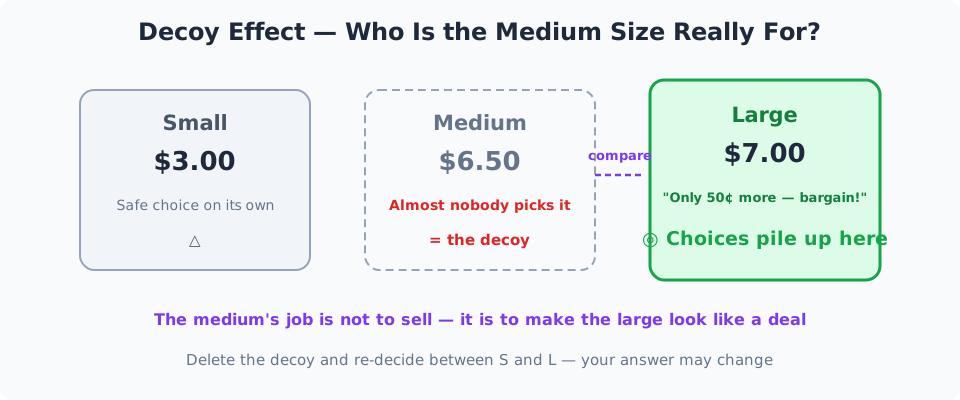
What Is the Decoy Effect?
The decoy effect is the phenomenon in which adding a clearly inferior option (the decoy) makes a specific other option more likely to be chosen. In psychology it is also called the “asymmetric dominance effect.”
For a rational decision-maker, adding an option nobody would choose should change nothing. If you are torn between A and B, the arrival of an unchoosable C alters nothing about A or B themselves.
Real humans, however, see A and B differently once C appears. That is because options are not evaluated in isolation — they are evaluated by comparison with whatever sits next to them. The decoy effect exploits precisely this trait: we can only measure value through comparison.
The Economist Subscription Experiment
The decoy effect became famous through an experiment behavioral economist Dan Ariely described in his book, using The Economist’s actual subscription plans.
Ariely asked students to choose among these three real plans:
- ① Web only: $59
- ② Print only: $125
- ③ Print + web bundle: $125
A strange lineup. If ② and ③ cost the same, there is no reason to pick ②. Indeed, the results:
| Plan | Share choosing it |
|---|---|
| ① Web only, $59 | 16% |
| ② Print only, $125 | 0% |
| ③ Bundle, $125 | 84% |
Since nobody chose ②, it looks meaningless. So Ariely removed it and gave another group the remaining two options. The results transformed:
| Plan | Share choosing it |
|---|---|
| ① Web only, $59 | 68% |
| ③ Bundle, $125 | 32% |
Deleting an option nobody had chosen flipped the majority from 84% to 32%.
Here is the trick. Placed next to ③ “bundle, $125,” option ② “print only, $125” generated the comparison “same price, but the web version comes free.” Option ② was never there to be bought — it was there to make ③ shine.
Why Does an Inferior Option Move the Decision?
Let’s dig into the mechanism. The key phrase is “asymmetric dominance.”
Choosing between web-only at $59 and the bundle at $125 is actually a hard comparison: price versus content. There are two yardsticks, and no clear way to decide which one matters more. The brain is terrible at comparisons where the yardsticks don’t line up, and when it cannot decide, it drifts toward the cheaper option or the status quo.
Enter the decoy (print-only, $125), and everything changes. Against the bundle, the decoy is “same price, less content” — beaten on every yardstick. Meanwhile the web-only versus decoy comparison remains muddled.
Now the brain contains exactly one crisp comparison: “the bundle utterly dominates the decoy.” Into a problem with no tiebreaker, an option that is “clearly winning” has appeared, and the brain leaps at it with relief. The hard question “which is best?” has been quietly swapped for a different one — “which victory is easiest to see?” — and we never notice the swap.
The decoy effect, in short, is the phenomenon of mistaking ease of comparison for magnitude of value.
Decoys All Around: From Menu Tiers to Subscriptions
Good-better-best menus are the most familiar application. Price a steak dinner at “premium $50, classic $35, basic $25” and most diners pick the middle. Even if the premium rarely sells, it works as the reference point that makes the middle look like “the sensible choice — neither extravagant nor cheap.” The pull toward avoiding extremes is called the “compromise effect,” a close relative of the decoy effect. In the anchoring article, we looked at the same tiering from a different angle — “the high price sets the reference point.” On a real menu, anchoring, decoys, and the compromise effect all operate at once.
Subscription pricing keeps the Economist design alive and well. When you spot “a middle plan that costs almost as much as the top plan but does less,” odds are good it is a decoy steering you upward.
Three-tier electronics lineups are another staple. The flagship model may sell few units, but its job is making the mid-tier look like “a great deal.” The budget model, meanwhile, catches the “I don’t want the cheapest one” sentiment and props up the mid-tier’s sense of quality.
Real estate viewings and hiring sometimes use it too — showing a lackluster property before the one the agent wants to sell. Plant the comparison, and the evaluation of the favorite reliably shifts.
Look around and you will find that a remarkable share of the world’s “three options” are engineered to make you pick the middle or the top.
The Fix: Delete the Decoy and Rethink
Once you understand the mechanism, the defense is simple.
- Facing three or more options, first delete the ones you would obviously never choose, then re-decide between the two that remain
- When you catch yourself wondering “who would ever buy this plan?” — suspect a decoy
- Judge by absolute standards, not comparisons (not “is the large a good deal?” but “do I actually want $7 worth of popcorn?”)
- Before buying, ask: “if this had been a two-option choice, which would I have picked?”
The third point — absolute standards — is the most powerful. The decoy effect can only operate in the arena of “comparison.” The moment you drag the decision back to your own criterion — “which one fits my actual needs?” — it no longer matters what is sitting on the shelf next door.
A note for sellers: using the decoy effect calls for care. Arranging your lineup thoughtfully is ordinary price design, but listing products that don’t exist or that you have no intention of selling crosses into bait advertising, regulated under consumer-protection law. The minimum line: every option must be real and actually purchasable.
Is Picking the Middle Option a Bad Habit?
What Exactly Is Wrong with Always Choosing the Middle?
Choosing the middle is not inherently bad. Often the middle genuinely fits your needs, and as a time-saving heuristic it has real merit. The problem is choosing it solely because it is the middle. Sellers are free to design “where the middle sits,” so the middle-picking habit amounts to “automatically landing wherever the seller decided you should land.” Pick the middle if you like — but check once whether “the size, features, and price fit your actual use.” That single check is enough.
How Is This Different from Anchoring?
Both are biases where “adjacent information distorts judgment,” but they work differently. Anchoring is when “the first number you see” becomes a baseline that pulls your estimates toward it. The decoy effect is when “the comparison structure among options” changes, making one option look like the winner. A handy mnemonic: the $300 bottle atop the wine list is an “anchor” making everything else look cheap; the pointless middle plan nobody orders is a “decoy” flattering one specific plan.
Does Having More Options Make Me More Vulnerable?
Yes — more options mean more pairwise comparisons, strengthening the pull toward “the easy win.” Worse, an overabundance of options is itself known to lower satisfaction and encourage putting decisions off (covered separately as the “paradox of choice”). Practically, a two-stage approach works against both decoys and choice fatigue: first cut the field to two or three options using your own must-have criteria, and only then compare.
Related Cognitive Biases
Below are articles on the “anchoring effect” and “framing effect,” which share the theme of presentation distorting judgment, and the “paradox of choice,” which tackles the sheer number of options.
Summary
This article covered the “decoy effect.”
An option nobody chooses quietly steers the choices we make. The 84% → 32% reversal in the Economist experiment is hard evidence that humans select options not by “standalone value” but by “ease of comparison.”
The heart of the defense: delete the decoy and rethink — and drag the decision from the arena of comparison back to the arena of your own criteria. Next time you look at a three-tier menu or pricing page, pause and ask “who designed this lineup, and why?” The world’s price tags will start to look a little different.
To return to the full list of cognitive biases, follow the link below.
Thank you for reading. We hope to see you in the next article.
Also popular with readers
📚 Series: Cognitive Bias Guide (6/26)