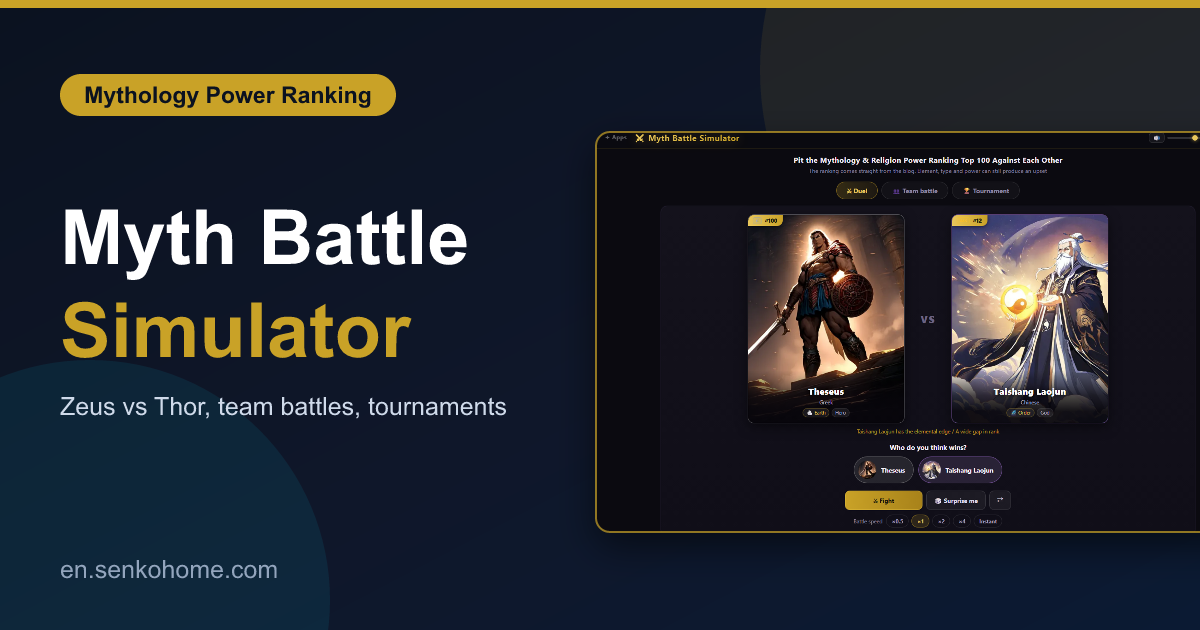
Thank you for visiting the site. This article is about the “Myth Battle Simulator”, a free browser app that takes the hundred gods, monsters and heroes from this blog’s power ranking and lets you put any two of them in a ring.
The ranking series has been running on this site for a long time, and the question I get asked most is not “why is Thor where he is” but “okay, but would Thor beat Susanoo?”. A list cannot answer that. So I built the thing that can, and I made sure it reads the same numbers as the articles, so that a fight settles arguments about the ranking rather than starting new ones.
How a Fight Works
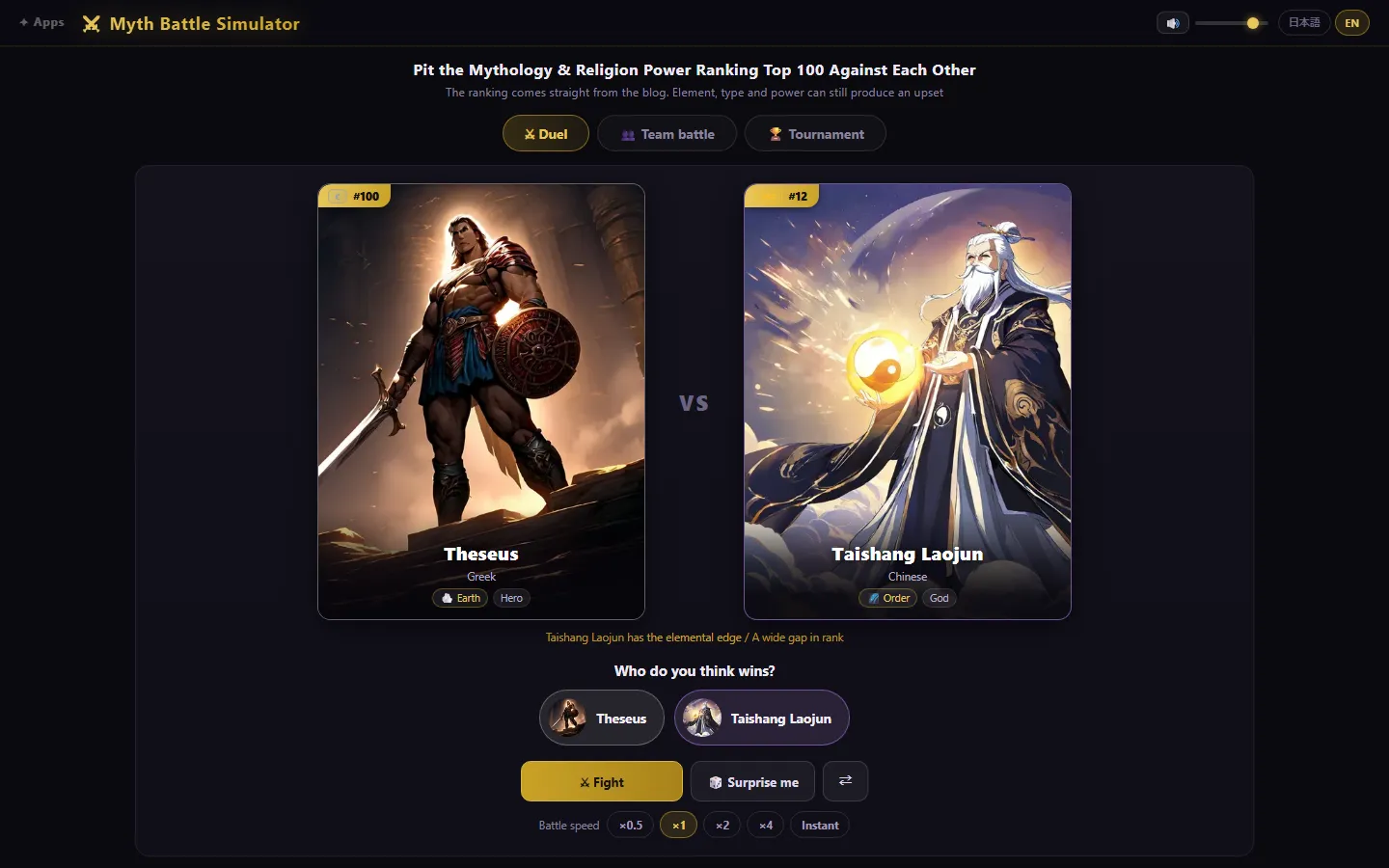
Tap the left frame and pick a fighter, tap the right frame and pick another, decide in your head who wins, and press fight. The battle plays out blow by blow with the powers each figure actually has in the myths: Zeus throws the thunderbolt, Thor swings Mjölnir, Shiva opens the third eye. There are several hundred of these powers across the entrants, and I went back to the source texts for each of them rather than inventing stats.
Three things decide the result.
- “Tier”. The ranking sorts the hundred into tiers, exactly as the articles do, and a fighter almost never beats someone in a higher tier. Within the same tier it can go either way
- “Element”. Fire beats earth, earth beats lightning, lightning beats water, water beats fire, and light and dark hurt each other badly. A lower-ranked god with the right element can pull off an upset
- “Powers”. How each side’s abilities interact. A god who cannot be killed by any weapon is a different problem from one who hits very hard
The same pairing always gives the same fight, which I did on purpose, so that “Zeus beats Odin” is a statement you can check rather than a coin toss. Pressing “fight again” gives you a different sequence of events with the same inputs, for when you want to see another way it could have gone.
Every fighter’s name links back to their article, so if you have just watched Gugalanna, the Bull of Heaven, get flattened and want to know who that was, it is one tap away.
Teams and Tournaments
One-on-one is the core, but the two modes I ended up playing most are the other ones.
“Team battle” lets the two sides be different sizes, so a crowd of lesser gods can gang up on one great one. The question that mode exists for is the one in this article’s title: how many lower-ranked gods does it take to bring down the number one? The answer depends a great deal on which ones you pick, and finding a combination that works is, frankly, the best part of the app.
“Tournament” fills a bracket and runs it, and you can watch any match in it. Filling one with a single pantheon, all Greek or all Japanese, and seeing who comes out on top is a good way to spend a quarter of an hour.
It Reads the Ranking, It Does Not Replace It
The point I most want to make is that the app does not have its own opinion. The order, the tiers and the strengths come straight from the ranking articles, which are the source of truth, and if an article changes, the app changes with it. The articles explain why a figure sits where they sit, with the passages from the Eddas, the Mahabharata or the Kojiki that justify it. The app shows what that placement means when two of them meet.
If you have not read the ranking, the overview is here, and it is the better place to start.

Summary
This article introduced the Myth Battle Simulator.
It is a companion to the power ranking rather than a game in its own right: the ranking tells you who is stronger and why, and the simulator lets you watch it happen, argue with it, and try to find the combination of lesser gods that takes down the top of the list. If you have ever read a ranking and thought “I’d like to see that”, this is for you.
I hope you will read the next article as well.
Also popular with readers
📚 Series: Free Browser Apps I Built (6/11)