Thank you for visiting. This article is the fourth installment in a series explaining the original texts of Egyptian mythology.
In the previous three articles, we looked at the creation myth, the Osiris myth, and the afterlife. This time, we survey the Egyptian pantheon (the big picture of the gods), including the gods who appeared in those stories. From the distinctive mechanism in which gods merge — “syncretism” — to the animal-formed gods, and the great event of the world’s first monotheistic attempt, the “Aten religious reform” — this is the installment that explains the world of the Egyptian gods all together.
For an overview map of Egyptian mythology’s original texts as a whole, please see this summary article.
A Pantheon That Swelled Over 3,000 Years
The greatest feature of the Egyptian gods is their number and breadth. Over a history of about 3,000 years, each city enshrined its own gods, and each time a dynasty changed, its guardian god was promoted to chief god of the state.
So the original texts for knowing the Egyptian gods are not one. The funerary texts like the Pyramid Texts and Book of the Dead (Articles 1–3), the hymns and myths carved on temple walls in various places, and the stories and magical texts written on papyrus — by overlaying these, the figures of the gods emerge.
Amun-Ra — a Country Where Gods “Merge”
The key to understanding the Egyptian gods is the mechanism of “syncretism.” In Egypt, rather than two gods opposing and one disappearing, it commonly happened that they merged into one greater god.
Its greatest example is “Amun-Ra.” Amun was originally a local god of Thebes (present-day Luxor), his name meaning “the hidden one.” When a dynasty from Thebes unified and prospered over Egypt, Amun rose to be the state’s supreme god. At that time, rather than contending with the sun god Ra, the longtime supreme god, he united with him as “Amun-Ra.” An ultimate god combining the seen and the unseen — “hidden power” and “the shining sun.” The Amun hymns of the New Kingdom praise him as “king of the gods,” and one of the largest temples in history was built at Karnak.
This mechanism worked everywhere. The Memphis creator god Ptah (Article 1) too was linked with Ra, or enshrined merged with the funerary god Sokar. The secret of the flexibility that let Egyptian religion last 3,000 years lay in this idea of “merging rather than opposing.”
The gods were also enshrined by city in the family form of a “triad.” At Thebes, Amun (father), Mut (mother), Khonsu (the moon child); at Memphis, Ptah, Sekhmet, Nefertem. The same family form as humans was reflected in the world of the gods too.
The Wisdom God Thoth — Lord of Writing, Magic, and the Moon
Among the Egyptian gods, the one who bore an especially wide role is the ibis- (or baboon-) formed wisdom god “Thoth.”
Thoth was taken to be the inventor of writing (hieroglyphs) and the guardian of scribes. As a moon god he governed the calendar, and as the scribe of the gods he records every event. In the judgment scene we saw in Article 3, it is Thoth who writes the result of the scale on papyrus. In the Osiris myth (Article 2) too, he appeared as a helper who gave Isis magic words and healed Horus’s wounds.
What shows Thoth’s presence in the original texts is a myth about the calendar. When the sky goddess Nut was forbidden to bear children, Thoth gambled with the moon and won “five days’ worth of light,” adding five days outside the year (360 days). On these “added five days” Osiris, Isis, and the others are said to have been born — a story telling the origin of the Egyptian calendar (360 + 5 days). The Greeks later identified Thoth with their Hermes, and from that came “Hermes Trismegistus (thrice-great Hermes),” the ancestor of mystical thought.
Hathor — Goddess of Love and Joy, and the “Eye of Ra”
The goddess “Hathor,” crowned with cow horns and a sun disk, governs love, beauty, music, wine, and joy — the goddess most beloved by the people. At the temple of Dendera she was enshrined with the sound of the sistrum (a rattling instrument), and as a goddess who protects childbirth, she gathered the women’s devout faith.
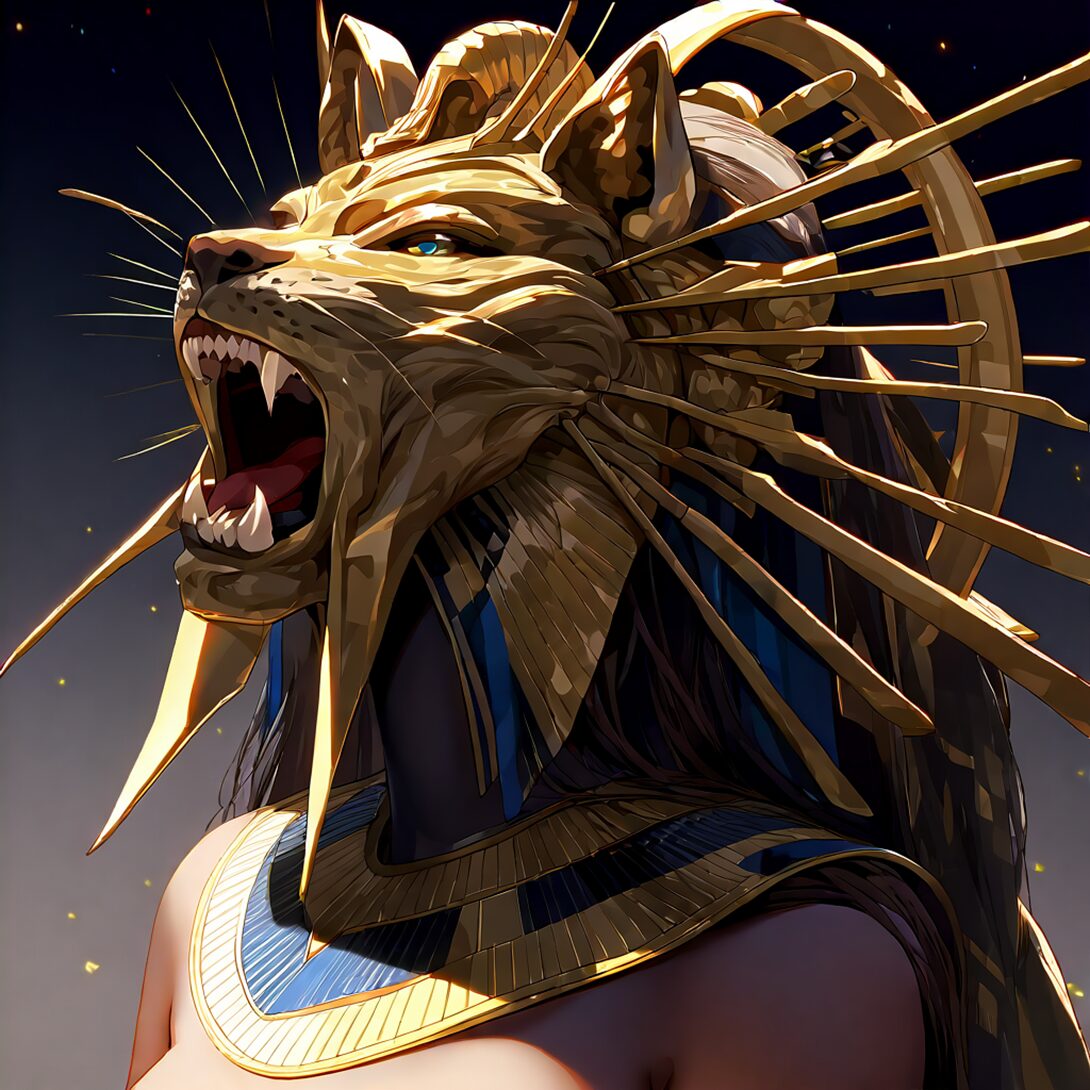
But Hathor has an entirely different, terrible face. In the myth of the “destruction of humankind” we saw in Article 1, the “Eye of Ra” that the aged Ra sent to punish humankind’s rebellion was Hathor = Sekhmet. The gentle love goddess, once angered, turns into the lion-headed Sekhmet and grows drunk on blood. The Egyptian goddess was a being that holds in one body two faces — blessing and destruction. The myth of the “distant goddess,” soothing and bringing back the angry goddess, became the core of Hathor worship.
Gods Close to Daily Life
Besides the great state gods, Egypt had countless gods who protect people’s daily lives. Let me list the representative ones.
| God | Form | Domain |
|---|---|---|
| Bastet | Cat | Protection of the home, fertility, music. The festival at her sacred site Bubastis was a national event |
| Bes | Bearded dwarf | Guardian of home and childbirth. A folk favorite carved on bedrooms and mirrors |
| Taweret | Hippopotamus | Guardian goddess of pregnant women and childbirth |
| Sobek | Crocodile | The Nile’s power and kingship. Chief god of the Faiyum |
| Khnum | Ram | The creator god who shapes humans on a potter’s wheel (Article 1) |
| Serqet | Scorpion | A goddess who protects from poison. One of the four goddesses guarding Tutankhamun’s shrine |
| Maat | Feather goddess | Truth, justice, cosmic order. The “feather” balanced against the heart in judgment (Article 3) |
Worth noting is that many of these are in animal form. The Egyptians did not think the animals themselves were gods; they revered the power and nature of animals as a “manifestation” of a god’s power. The cat symbolizes the power to protect the home from mice and snakes; the crocodile, the Nile’s violent power. At sacred sites, sacred beasts were cherished and, when they died, carefully made into mummies. In later ages, hundreds of thousands of cat and ibis mummies have been found, telling of the depth of that faith.
The Aten Religious Reform — the World’s First Attempt at “Monotheism”
In the 3,000-year religious history of Egypt, the greatest event occurs in the New Kingdom. In the 14th century BC, Pharaoh Amenhotep IV embarked on an unprecedented reform overturning the faith in the gods until then.
The one he made the sole god was the “Aten,” the sun disk itself. The king changed his own name to “Akhenaten (one beneficial to the Aten)” and built a new capital, Akhetaten (present-day Amarna). Further, he halted the worship of the traditional gods, beginning with the supreme god Amun, closed the temples, and had the gods’ names erased from inscriptions. Leaving in a polytheistic country only a single god — this is known as the first monotheistic religious reform in world history.
The original text of this era is the “Great Hymn to the Aten,” said to have been composed by the king himself. Its content, singing of the rising sun awakening all life, calling the chick from the egg, and nourishing the people of every land, was so elevated that a resemblance to Psalm 104 of the Old Testament has been pointed out.
But the reform collapsed within the king’s single generation. After Akhenaten’s death, the successor boy-king Tutankhaten changed his name to “Tutankhamun” — “the living image of Amun” — and fully revived Amun worship. The new capital was abandoned, and Akhenaten’s name was erased from the king lists. The very name of that boy-king, famed for his golden mask, is a monument to the fact that the experiment of monotheism had ended and the gods had returned.
What the System of the Gods Tells Us
Finally, let me sum up the character of the Egyptian pantheon.
First, the gods developed by syncretism rather than opposition. Second, through animal forms, they made the forces of nature themselves into gods. Third, from the great state gods to the little bedroom god Bes, there were gods at every layer of society. And fourth, as the failure of the Aten reform shows, this flexible polytheistic system was rooted so deeply in people’s lives that even the power of a single king could not break it.
This world of gods, lasting 3,000 years with the bounty of the Nile, was eventually inherited by Greece and Rome (the cult of Isis spread across the whole Mediterranean), and its memory still lives in our culture today.
How Strong Are the Characters Here? — The Power Ranking
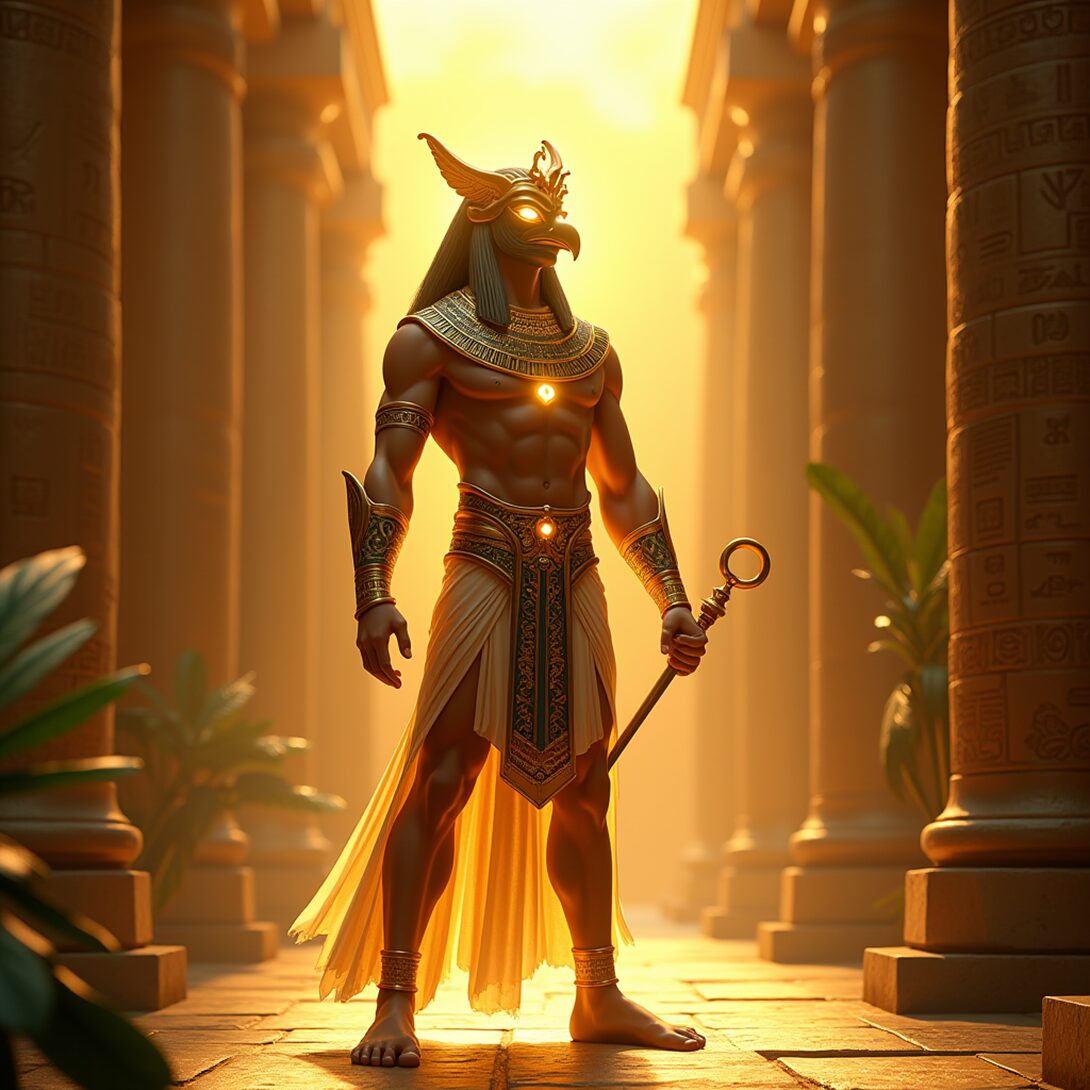
The sun god Ra (Amun-Ra) appearing in this article, and Sekhmet, the angry form of Hathor, are also introduced in strength order in the “Mythology, Religion & Legend Power Ranking.” Enjoy their depiction in the original text alongside their “strength.”
To Learn More
Conclusion
In this article, I explained the big picture of the Egyptian gods, true to the texts and inscriptions. How was it?
The supreme god Amun-Ra, born by merging; Thoth of writing and the calendar; the two-faced Hathor (Sekhmet); the gods of daily life such as the cat Bastet; and the experiment of monotheism, the Aten religious reform, and its failure — I hope you could feel the breadth of a pantheon that lasted 3,000 years by “merging rather than opposing.”
With this, the four-article series on Egyptian mythology’s original texts is complete. I also explain the original texts of other myths and religions. For the full list, see the complete index of the world’s myths and religions.
I hope you’ll read the next article too.
Also popular with readers
📚 Series: The Original Texts of Egyptian Mythology (5/5)