Thank you for visiting this site. This article covers a natural phenomenon that exists yet cannot be explained: “ball lightning.”
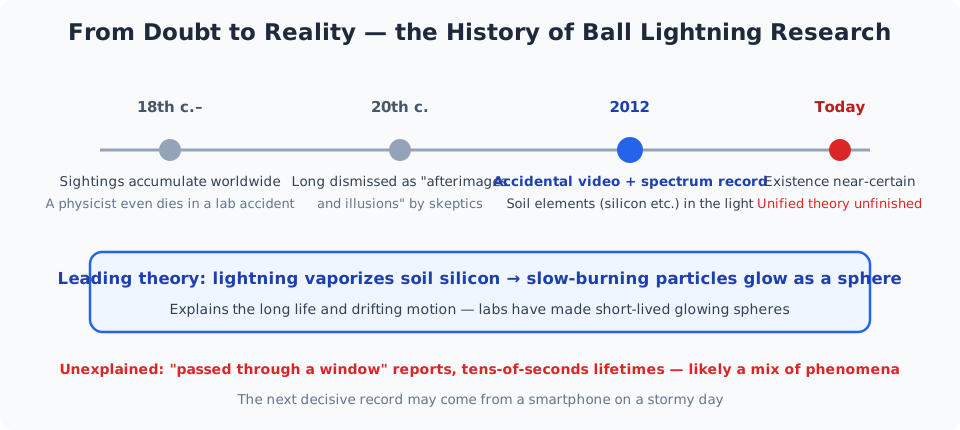
On stormy days, a glowing orb of orange or white light drifts gently through the air. Such sightings have been reported worldwide for centuries. The size ranges from a fist to tens of centimeters. It floats for seconds to tens of seconds, then fades quietly — or sometimes explodes. There are even testimonies of orbs passing through windowpanes. So strange were the accounts that scientists long suspected them to be “afterimages left by lightning flashes.” Then, in 2012, a Chinese research team accidentally captured a genuine ball lightning event with scientific instruments. Its existence was proven. Its identity remains unknown. Ball lightning is science’s homework left behind.
What Is Ball Lightning?
Ball lightning is a spherical luminous phenomenon said to appear mainly during thunderstorms. Some of the world’s folklore about floating “fireballs” and “will-o’-the-wisps” may in fact record ball lightning sightings. From centuries of reports, the typical portrait looks like this: a diameter of a few to tens of centimeters; colors of orange, red, white, or blue; drifting near the ground or in mid-air for seconds to tens of seconds; vanishing silently or with a bang. Some accounts describe it moving slowly, even against the wind.
The witnesses are far from few. In some surveys, several percent of the population answer “I have seen one” — scientists and engineers among them. In the 18th century, the physicist Georg Richmann — inspired by Franklin’s kite experiment to study lightning — is recorded to have been struck and killed by a ball of light that appeared during his experiment. If the record is accurate, ball lightning caused one of the earliest laboratory fatalities in the history of science.
Even so, mainstream science stayed cool toward it for a simple reason: there was not a single solid instrumental record. Photographs were uniformly blurry. It never appeared on demand and could not be reproduced. “An afterimage burned into the eye by a nearby lightning strike” simply looked like the more scientific explanation.
What Makes the Sightings “Impossible”
What makes ball lightning so troublesome is that the reported features clash with the ordinary physics of plasma (ionized gas).
First, the lifetime is too long. A blob of glowing gas born from a lightning discharge should cool and vanish almost instantly. Nothing explains a sphere shining stably for seconds to tens of seconds. Second, the motion is strange. Hot gas should rise as it becomes buoyant, yet ball lightning is reported to drift horizontally, sometimes skimming just above the ground. And the capstone: a whole family of testimonies claims “it passed through a closed window into the room.” No material sphere can pass through glass.
These “impossible” features are exactly what made ball lightning look suspect. Yet some witnesses are hard to dismiss. Famously, in 1963, a professor of electrical engineering aboard a night flight out of New York reported that just after turbulence, a glowing sphere about 20 centimeters across emerged from the cockpit side and drifted quietly down the cabin aisle — observed with an expert’s eye and reported in an academic journal. Even granting that some accounts are illusion or distorted memory, independent reports with matching features have accumulated worldwide for centuries — that cannot be ignored. Real or phantom? Settling it would require indisputable instrumental evidence.
2012: The Accident That Caught the Real Thing
The moment arrived by pure chance. In July 2012, a Chinese research team was conducting routine lightning observations on a high plateau. Their cameras and spectrograph (an instrument that splits light into components to identify what is glowing) were aimed at a nighttime thunderstorm when, immediately after a lightning strike, a glowing sphere formed near the ground, drifted a dozen-plus meters for about 1.6 seconds, and vanished — recorded in full by the equipment.
This is regarded as the world’s first scientific record of naturally occurring ball lightning captured in both video and spectral data (published in a physics journal in 2014). And the spectrum contained the decisive clue: shining clearly within the orb’s light were the emission lines of silicon, iron, and calcium — the ingredients of soil.
The finding also had experimental backing. In the 2000s, researchers had reported producing small glowing spheres that rolled across the floor for a few seconds by discharging electricity into silicon plates. Not natural ball lightning itself, but proof that “vaporized silicon can form a glowing ball.”
The observation strongly supported the “vaporized silicon” hypothesis proposed around 2000, which reasons as follows: when lightning strikes soil, silicon compounds in the ground vaporize at high temperature and are ejected as a cloud of fine particles; these particles react slowly (burn) with oxygen in the air, glowing as a sphere. Slow combustion explains the long life, and buoyancy explains the balloon-like drifting. That accidental 1.6 seconds gave one theory a pulse.
The Mystery That Remains — Still No Unified Theory
So is ball lightning solved? Unfortunately, not yet. The 2012 observation showed that “at least some ball lightning consists of glowing soil-derived particles,” but no unified theory explains all the sightings.
For instance, the testimonies that “it passed through a window” or “it appeared inside an aircraft cabin” cannot be explained by soil particles. For those, other families of hypotheses exist: microwaves passing through glass and igniting a plasma ball indoors, or the possibility that lightning’s intense magnetic fields stimulate the brain into hallucinating a ball of light (some “sightings” may be exactly this). In other words, what has been lumped together as “ball lightning” may actually be a mixture of several distinct phenomena and illusions.
Full laboratory reproduction also remains half-done. We can make spheres that glow for a few seconds, but not the long-lived, stable orbs of the reports. Existence: near-certain. Partial explanation: achieved. Complete picture: unfinished. Ball lightning keeps provoking physicists as one of nature’s “almost within reach” mysteries.
A Map of the Theories — What Each One Covers
Ball lightning theories tend to proliferate, so let’s organize what each major hypothesis can and cannot explain.
| Theory | Explains | Weakness |
|---|---|---|
| Vaporized silicon | Long lifetime, drifting motion; matches the 2012 spectrum | Cannot explain passing through windows or cabin appearances |
| Microwave plasma | Orbs appearing indoors through glass | Little observational support in nature |
| Magnetically induced hallucination | The subjective character of some “sightings” | Contradicts cases leaving physical traces (scorch marks etc.) |
Lined up this way, the current research picture emerges: the sightings lumped together as “ball lightning” are likely a mixture of several real phenomena and illusions, with each theory holding a different “post.” Outdoor orbs right after a lightning strike: the vaporized-silicon type. Indoor and in-cabin orbs: something electromagnetic. Some testimonies: tricks of the brain.
The historical record runs surprisingly deep. In 17th-century England, a detailed account describes “a great ball of fire” bursting into a church during a storm, killing and injuring parishioners. Ball lightning is sometimes confused with St. Elmo’s fire, the glow sailors feared at the tips of masts — but that is a sustained discharge at pointed objects, a different phenomenon from an orb drifting through open air. Sifting the genuine cases from centuries of records and pinning down their identity: ball lightning research is a rare field where historical archives and cutting-edge physics share a desk.
Questions About Ball Lightning
What Should I Do If I See One?
First, do not approach it. If the orb really is hot particles or plasma, contact risks burns or electric shock, and some reports describe explosive endings. Keep your distance and, if possible, record video with your smartphone. Notes on the time, place, and weather are precious too. In an age when everyone carries a camera, the next decisive scientific record may well come from an ordinary witness’s phone, not a researcher’s observatory. But film it safely — and remember that being outdoors in a thunderstorm is dangerous in itself.
How Much of It Is Illusion or Misidentification?
Some of it, certainly. The afterimages of intense lightning flashes, sparking power lines, misread sightings of Venus or aircraft, and the magnetic-hallucination hypothesis mentioned above — the mountain of “sightings” surely contains plenty of fakes. But the 2012 spectral observation confirmed that at least a genuine physical phenomenon of ball lightning exists. The right attitude is therefore neither “all real” nor “all illusion,” but sorting the genuine stones from the mixed gravel of reports. A fine case study in how to work with eyewitness testimony.
Is It a Separate Phenomenon from Lightning?
The current view is that it is a distinct phenomenon that accompanies lightning. An ordinary lightning bolt (a linear discharge) ends in an instant; ball lightning forms afterward and persists for seconds. On the vaporized-silicon theory, lightning is the “trigger,” and the orb itself is a burning cloud of particles that the strike carved out of the soil. Notably, the luminous phenomena of the upper atmosphere (sprites and their kin) were also once “ghost lights” known only from testimony — until better cameras confirmed them, and today they are respectable research subjects. Ball lightning is partway down the same road.
Related Mysteries
See the fellow nature-and-sky mysteries: “the sailing stones,” “the Tunguska event,” and “the Wow! signal.”



Summary
This article covered “ball lightning.”
The glowing orbs witnessed for centuries and suspected of being illusions were confirmed as a real physical phenomenon by the accidental spectral observation of 2012. The “soil ingredients” found in the light support the leading theory that lightning vaporizes silicon which then burns slowly. Yet the window-passing testimonies and the long lifetimes remain — no unified theory explains everything.
The charm of ball lightning is the lesson that “proving existence” and “identifying the cause” are two separate jobs. Like the sailing stones, will a decisive observation someday close the case? The one who captures that moment may well be you — smartphone raised, on a stormy day.
To return to the full list of mysteries, follow the link below.
Thank you for reading. We hope to see you in the next article.

Also popular with readers
📚 Series: World Mysteries (21/21)