
Thank you for visiting this site. This article covers a model case of a solved mystery: “the sailing stones.”
On the dry lakebed of Death Valley National Park in the United States, a strange sight spreads out before you: rocks weighing tens of kilograms — sometimes over 300 — “travel,” carving long trails into the ground. No human tracks, no animal involvement. And for decades, not one person ever witnessed a stone in motion. Magnetism? The paranormal? Speculation piled up for years — until 2014, when researchers armed with GPS units and time-lapse cameras finally caught the phenomenon red-handed. A supremely satisfying true story of a mystery losing to science.
What Are the Sailing Stones?
Sailing stones are rocks that glide across a dry lakebed while no one is watching. The name comes from the way they advance across the ground like sailboats.
The most famous stage is Racetrack Playa in Death Valley National Park, California. A playa is a lakebed that holds shallow water only after rain and otherwise bakes into a cracked clay plain. Across this dead-flat expanse, dozens of long drag-trails are inscribed, each headed by a rock. The longest trails run hundreds of meters. Some run straight, then turn at right angles, or U-turn. There are even paired trails where two neighboring rocks parted ways mid-journey.
That the rocks were moving was obvious from the changing trails. The phenomenon was known from the early 1900s, with academic reports by the 1940s. But the playa is a remote, harsh place, impossible to keep under constant watch, and for decades nobody caught the act itself. Theories ranged from “someone moves them at night” to “magnetic anomalies” to “unknown forces” — speculation and nothing more.
The Suspects — Wind, Ice, or Something Else
Scientists were not idle. From the mid-20th century, surveys patiently recorded the stones’ positions, and the suspects were narrowed to two.
The first was the strong-wind theory. When rain turns the playa surface to slick mud, the clay becomes astonishingly slippery — add a desert gale, and perhaps the rocks slide. But calculations showed that moving the big rocks would require hurricane-force winds, which the actual weather records did not support.
The second was the ice theory. Death Valley conjures scorching desert, but Racetrack Playa sits at altitude, and winter nights there drop below freezing. If pooled water froze and a rock became embedded in a plate of ice, its wind-catching area would multiply, making movement easier. The theory neatly explained parallel trails pointing the same way — but again, no decisive evidence.
It was not for lack of effort. In the late 20th century, one survey named 30 individual stones and tracked their positions for seven years. The stones did move — some by hundreds of meters — but the moment of motion itself was never captured. One named stone even went missing, only to be cheerfully “rediscovered” years later.
The debate had stalled. After all, no one had ever seen the crucial “moment of movement.” However elegant the hypotheses, nothing would settle without catching the act. So one research team made up its mind: “Let the machines keep watch until the stones move.”
2014: Caught in the Act at Last
Richard Norris of the Scripps Institution of Oceanography, his cousin James Norris, and their team began a meticulous “stakeout” in 2011. They placed rocks fitted with GPS trackers on the playa and installed a weather station and time-lapse cameras. Then: wait for nature to feel like moving. The researchers themselves braced for what they called possibly “the most boring experiment in the history of science.”
Then, in December 2013, fortune struck. Before the eyes of the two cousins, visiting the site for fieldwork, the stones moved.
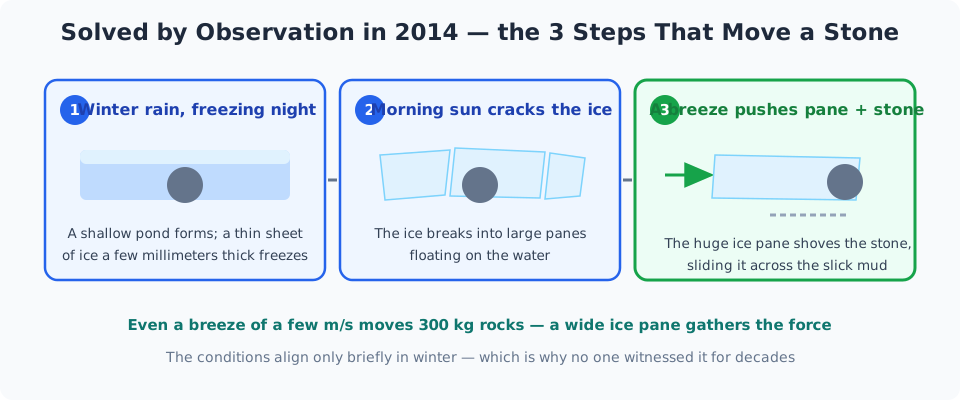
The observed mechanism was an exquisite chain of conditions. First, winter rain forms a shallow pond a few centimeters deep on the playa. At night, the pond’s surface freezes into thin ice sheets only a few millimeters thick. The next morning, as sunshine softens the ice, it begins breaking into large panes. Now let a gentle breeze of a few meters per second blow, and the huge floating panes begin to glide — shoving the rocks in their path, pane and all. The rocks slid quietly over the slick mud, carving those famous trails. Their speed: a few meters per minute — so stately that from a distance you might not even notice they were moving. The team recorded the entire sequence in GPS data and video, publishing the paper in 2014. Decades of mystery closed, completely.
The Stage Itself: the “Miraculous Plane” of Racetrack Playa
The stage that produced the mystery is a natural masterpiece in its own right. Racetrack Playa is a dry lakebed about 4.5 kilometers long and 2 kilometers wide, and its flatness is astonishing — end to end, the elevation barely varies. Such a perfect plane formed because fine mud washing down from the surrounding mountains settled quietly on the floor of a shallow pool for thousands of years.
When the water recedes, the mud surface dries and shrinks into a field of hexagonal cracks. It is precisely this delicate mud surface that preserves the stones’ trails so crisply. The rocks themselves originally tumbled down from a rock face at the playa’s southern end, and the contrast of black stones scattered across the white crack-patterned plane makes the place one of the world’s great landscapes.
But that delicacy is inseparable from fragility. Footprints in the muddy season, tire tracks from vehicles — they remain as scars that take years to fade. In recent years, vehicles driving onto the playa have gouged long tracks into it, causing real damage, and thefts of the stones have been reported. Now that the mystery is solved, the site’s value has shifted from “the inexplicable” to “an irreplaceable natural recording surface.” If anything, the reasons to protect it have multiplied.
What This Solution Teaches
The solving of the sailing stones distills the essentials of how to engage with mysteries.
First, the answer was not “magic” but “a combination of conditions.” Water, ice, sunshine, a breeze — all utterly ordinary ingredients that move a stone only when they stack in a specific order with exquisite timing. That is why the phenomenon is so rare, and why there were no witnesses. No hurricane winds, no magnetism required.
Second, “no one has ever seen it” does not mean “it cannot be solved.” What settled the case was not a stroke of genius but the dogged strategy of letting GPS and cameras keep watch. Like the Dyatlov Pass incident and Tunguska covered on this site, advancing tools crack old mysteries — and this is the most vivid success story of the lot.
And third: even solved, the sight of Racetrack Playa has lost none of its luster. Once you know the mechanism, the stone trails start to look like art carved by nature’s precise coincidences. The idea that a solved mystery loses its charm is a prejudice. If anything, I came to love these stones more after learning the trick.
Questions About the Sailing Stones
Can a 300-Kilogram Rock Really Move in a Gentle Breeze?
It can. The point is that the wind does not push the rock directly. What the wind pushes is a floating pane of ice tens of meters across. With that much area, even weak wind gathers substantial force, which concentrates on the rock at the pane’s edge — while underfoot lies clay soaked to an extreme slickness. Stack the conditions and even a big rock slides. Like a lever or a pulley, a small force does a big job through the right mechanism. A phenomenon with the delight of physics packed inside.
Why Do the Trails Curve, and Why Do Different Rocks Go Different Ways?
The way the ice breaks up, plus shifting winds, explains it. The ice is not a single sheet; it fractures into panes large and small, each drifting on its own. When the wind veers, a pane’s course veers, and the rock’s trail draws a curve. Neighboring rocks riding different panes head in different directions. The 2013–14 observations recorded exactly this: stones moving on the same day, each tracing subtly different paths. The eerie “will of the stones” turned out to be the shuffling of an ice puzzle.
If I Visit, Can I See Them Move?
Assume no. The stones move only during brief windows when winter’s specific weather conditions align. Even the research team waited two years with instruments in place. Racetrack Playa also lies beyond rough unpaved roads, and a visit takes real preparation. One important caution: the playa surface is extremely delicate, and footprints or tire tracks remain for years. Stone theft and vehicle scarring have already been problems. If you go, stay within the posted rules and keep clear of the trails. Humanity solved the mystery; now it is our turn to protect the landscape.
Related Mysteries
See the fellow natural mysteries “ball lightning” and “the Tunguska event,” and another case that science closed, “the Dyatlov Pass incident.”



Summary
This article covered “the sailing stones.”
Rocks that move while no one watches, carving trails into a desert lakebed. The identity of this decades-old enigma was thin winter ice, pushed by a gentle breeze, ferrying the stones along — an exquisite piece of natural teamwork. What settled it was the researchers’ obsessive stakeout: GPS and cameras waiting patiently for the moment of motion.
The case now serves as a benchmark for thinking about the world’s mysteries. “No witnesses” and “no explanation” are not proof of an eternal enigma. With the right tools and patience, mysteries yield. And a solved mystery, far from turning dull, delivers a deeper wonder. The moving stones teach that lesson with the receipts — their trails — etched into the ground.
To return to the full list of mysteries, follow the link below.
Thank you for reading. We hope to see you in the next article.

Also popular with readers
📚 Series: World Mysteries (20/21)