
Thank you for visiting this site. This article covers one of the 20th century’s greatest mountain mysteries: “the Dyatlov Pass incident.”
The Ural Mountains, Soviet Union, 1959. Nine experienced student mountaineers on a winter expedition were all found dead. What made the case extraordinary was the scene: the tent had been slashed open from the inside, and the nine had fled into minus-25-degree darkness without boots or coats. For trained mountaineers, that is close to suicide. What were they running from? After six decades of speculation, in 2021 science finally offered a compelling answer. Here is the case, step by step, up to its current state.
What Was the Dyatlov Pass Incident?
In late January 1959, a group of seasoned hikers — students and graduates of the Ural Polytechnical Institute — set out for the northern Urals, led by Igor Dyatlov, whose name the case would later carry. One member turned back with illness partway (the sole survivor, as it turned out), leaving seven men and two women — nine in all — to continue into the winter mountains.
On the evening of February 1, the group pitched their tent on the slope of Kholat Syakhl. With grim irony, the mountain’s name in the indigenous Mansi language means “Dead Mountain.” That night, something happened.
The tenth member who turned back devoted much of his life to uncovering the truth of his friends’ deaths, reportedly carrying the question “why was I the one spared?” to the end. The area is now called “Dyatlov Pass” after the leader, and a memorial plaque honors the nine.
When the group failed to return, searchers deployed. The tent, found in late February, was cut open from within, boots and cold-weather gear still inside. Footprints — in socks or bare feet — led down the slope. Roughly 1.5 kilometers below, under a great cedar, searchers found the remains of a fire and the first bodies. Three more, including Dyatlov, lay on the slope, having died trying to climb back to the tent. And in May, when the snow melted, the last four were found buried deep in a ravine.
What Made It So Strange — the Evidence
The case became legend because the scene defied comprehension.
First, the manner of flight. Trained mountaineers abandoning their equipment to run into a minus-25-degree night is unthinkable — unless something made staying in the tent seem even more dangerous. Second, the pattern of injuries. Most died of hypothermia, but three of the final four bore severe skull and rib fractures — massive internal trauma with comparatively light external wounds. The forensic examiner compared the force to “a car crash.” Third, some bodies showed missing tongues and eyes (explicable as natural changes in remains submerged for months in a snow-fed stream, but fuel for speculation nonetheless). And traces of radioactivity on some clothing poured fire on the conspiracy theories.
The Soviet investigation closed the case with the opaque phrase “a compelling natural force,” sealed the files, and reportedly restricted access to the area for years. The families received no real explanation. That opacity is what grew the case into a sixty-year mystery.
The Search Record — the Full Picture Emerged over Three Months
Part of the horror is that the bodies were not found at once but surfaced gradually over three months.
| When | What was found |
|---|---|
| Late February | The slashed tent, equipment still inside |
| Immediately after | Fire remains and two bodies under a cedar ~1.5 km downhill |
| Days to weeks later | Three bodies, including Dyatlov, on the slope — headed back toward the tent |
| Early May | The final four, under deep snow in the ravine |
The first five all died of hypothermia with minor injuries. The problem was the last four, found under four meters of snow — the severe fractures were concentrated among them. And they were wearing clothing taken from companions who had died earlier.
That distribution speaks volumes. The group with the injured retreated to the low ground of the ravine; the relatively unhurt built a fire; the strongest tried to return to the tent for equipment. The nine did not scatter in blind panic — they show every sign of dividing roles and fighting to survive. Wearing the dead’s clothes was the rational calculus of the freezing: inherit the gear, buy minutes of warmth. Combined with the avalanche account below, the picture is of mountaineers who fought coolly to the end. This case deserves to be read not as a ghost story but as a mountaineering disaster record.
The Theories — Avalanche to UFOs
Across the decades, every theory imaginable was proposed: avalanche, hurricane-force winds, secret weapons tests, an attack by the indigenous Mansi, escaped prisoners — up through UFOs and yetis. Each had strengths and fatal gaps.
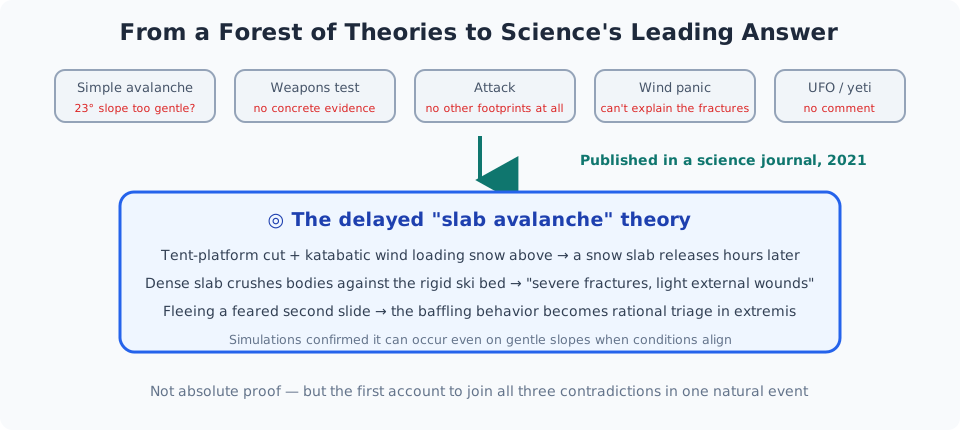
Even the leading candidate — the avalanche theory — carried a long-standing weakness: the slope at the site is about 23 degrees, considered too gentle for avalanches. The tent had not been swept away, and the footprints ran in orderly lines. The attack theory died on the absence of any footprints but the group’s own. The weapons-test theory fed on the sealed files and the radioactivity, but no concrete evidence ever surfaced. With nothing decisive, Russian prosecutors reopened the case in 2019 and concluded “an avalanche, plus poor visibility.” But the old question — an avalanche on that gentle slope? — remained unanswered.
2021: Science’s “Slab Avalanche” Scenario
The turn came in 2021, when Swiss researchers Johan Gaume and Alexander Puzrin published in a scientific journal. Both specialists in avalanche mechanics, they showed by simulation that a small, delayed slab avalanche could answer every objection.
Three points. First, the group had cut into the slope to level a platform for the tent — severing the snowpack’s support. Second, that night a strong katabatic wind (downslope wind) steadily deposited more snow above the cut. The load crept upward until, hours after the group went to sleep, a slab of consolidated snow broke free and struck the tent. Their physical model showed such delayed mini-avalanches can occur even on gentle slopes when conditions align. Delightfully, the model borrowed snow-animation technology from the movies and human-impact data from automotive crash testing.
With this scenario, the mysteries fall in sequence. A dense snow slab compressing bodies against the rigid bed of skis beneath them produces exactly what the examiner described: severe internal fractures with little external injury. The group, fearing a second slide, abandoned the tent with the injured, built a fire in the trees, and died trying to return. Read this way, the inexplicable behavior becomes a chain of rational decisions made to save wounded friends. The theory is not absolute proof and objections remain — but it is now widely accepted as the most coherent explanation on offer.
Questions About the Dyatlov Pass Incident
What About the Radioactivity and the Missing Tongues?
The radioactivity was a trace amount on some garments. Proposed explanations include contamination from a member who worked with radioactive materials and period lantern equipment; no evidence indicates any nuclear event at the site. The missing tongues and eyes occurred in bodies that lay in snowmelt water until spring — changes consistent with long submersion, decomposition, and microorganisms. The most shocking details make the best conspiracy fuel, but forensically they are not especially mysterious — that is the experts’ assessment.
Why Did It Stay Unsolved for 60 Years?
Several factors stacked. First, Soviet information sealing: a vague verdict plus closed files bred the suspicion of a cover-up. Second, the assumption that “avalanches don’t happen on gentle slopes” stalled the best natural explanation for decades — the understanding of delayed slab avalanches, and the computing power to verify them, arrived only recently. Third, the case’s details — radioactivity, the injuries, a mountain named “Dead Mountain” — were too perfect as a story. Every condition for a mystery’s long life was unfortunately present.
So Is the Case Now ‘Solved’?
More precisely: “the leading explanation has been found” — not a full legal or historical closure. Direct physical evidence of the avalanche (deposition traces from that night) can no longer be verified, and critical researchers remain. But the theory’s breakthrough is that it connects the three great contradictions — the cut tent, the crushing injuries without external wounds, the gentle slope — through one natural phenomenon, without strain. The case is transforming from a paranormal campfire tale into a story of snow physics and human judgment at the extremes. To me, that transformation is science at its very best.
Related Mysteries
See the fellow vanished-and-lost enigmas “the Mary Celeste” and “the disappearance of Amelia Earhart,” and the natural mystery of “the Tunguska event.”



Summary
This article covered “the Dyatlov Pass incident.”
Nine hikers who slashed their tent from within and vanished barefoot into the subzero dark. Crushing fractures, radioactivity, sealed files. To a case that bred every possible speculation, 2021 brought a simulation-backed scenario: the delayed slab avalanche. The cut made to pitch the tent, plus wind-loaded snow, produced a small slide hours later that struck the sleepers. Everything after becomes the rational conduct of people protecting their injured in unsurvivable cold.
Final proof may never come. Even so, this research — replacing sixty years of ghost stories with snow physics and human drama — teaches that science quietly closes in even on mysteries thought unsolvable. For the honor of the nine who died, this case deserves to be remembered not as a campfire tale, but as a lesson.
To return to the full list of mysteries, follow the link below.
Thank you for reading. We hope to see you in the next article.

Also popular with readers
📚 Series: World Mysteries (13/21)