
Thank you for visiting this site. This article covers the 20th century’s greatest cosmic event: “the Tunguska explosion.”
On the morning of June 30, 1908, deep in Siberia, a stupendous explosion occurred. About 2,150 square kilometers of forest — an area the size of a metropolis — was flattened in an instant; the flash and heat reached hundreds of kilometers; the shockwave circled the planet, twitching barometers worldwide. And yet when investigators finally reached the site, they found something bizarre: an explosion of this magnitude — with no crater, and not one fragment of meteorite. What exploded? The investigation of this “explosion without a culprit” became a century-long scientific mystery.
What Was the Tunguska Event?
Shortly after 7 a.m. on June 30, 1908, the blast occurred over the upper basin of the Podkamennaya Tunguska River in central Siberia.
The eyewitness accounts are searing. A man sitting on the porch of a trading post dozens of kilometers away testified that the sky split open, a fireball like a second sun raced across it, and the heat that followed made him feel “as if my shirt had caught fire.” The next instant the blast wave hurled him several meters and knocked him unconscious. The shockwave flattened people, shattered windows, and shook the ground hard enough that a distant train driver braked his train to a halt. Mercifully, the site’s extreme remoteness kept confirmed human casualties minimal.
Later estimates put the blast at 10–15 megatons TNT-equivalent — hundreds to a thousand times the Hiroshima bomb (estimates vary). An estimated 80 million trees went down. The shockwave circled the globe, and for several nights across Europe the night sky glowed brightly enough to read a newspaper at midnight. Yet Russia stood on the eve of revolution, with no capacity to investigate a remote wilderness blast — and the first serious expedition would not come for 19 years.
The Crime Scene, 19 Years Late — and No Culprit
In 1927, the Soviet mineralogist Leonid Kulik finally led an expedition to the site. His goal was concrete: find the great impact crater and recover precious iron meteorite. What awaited him defied every expectation.
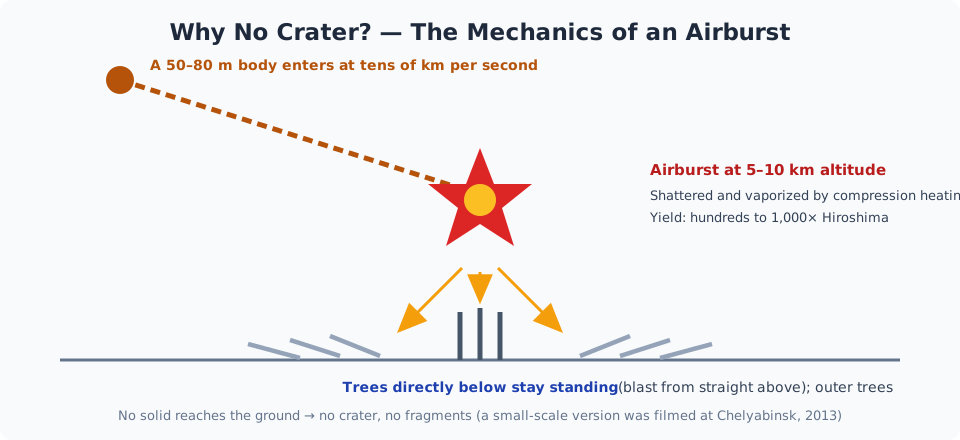
First, no crater anywhere. An explosion of that class should have gouged something like Arizona’s Meteor Crater. Second, not one meteorite fragment. And strangest of all was the pattern of the fallen forest: trees toppled radially outward from an apparent center — while at the very center, the trees still stood upright, stripped of their branches, as if crushed by a colossal force from directly above.
Kulik’s expeditions themselves became the stuff of legend: hundreds of kilometers of taiga beyond the railhead, crossed by sledge and on foot through bogs. One year, local guides — who feared the blast zone as a cursed place — refused to lead him on, and he had to turn back. He spent the rest of his life hunting the meteorite and never found it. A titanic explosion that left nothing in the ground: that contradiction is what made Tunguska a mystery for decades. And yet, all those strange clues were quietly pointing to a single answer.
The Answer: An Airburst — the Body That Never Reached the Ground
The scientific consensus today: a small body 50–80 meters across (a stony asteroid, or a comet nucleus) entered the atmosphere and shattered 5–10 kilometers above the ground — an airburst.
An object striking the atmosphere at tens of kilometers per second is compressed and heated so violently that it disintegrates and vaporizes before reaching the surface. Release that energy at one point, and you get blast and heat rivaling a nuclear weapon. This scenario resolves every clue at once: no crater, because no solid body struck the ground; no fragments, because it essentially vaporized; the central trees left standing, because the blast came from directly overhead. The radial treefall pattern matches airburst simulations precisely.
Later surveys found a poignant detail: trees that survived near the epicenter, and those that grew afterward, showed unusually accelerated growth — attributed to changes in the soil. Nature recorded not only the destruction but the recovery, in tree rings.
What sealed the understanding was the Chelyabinsk meteor of 2013: an asteroid roughly 17 meters across airburst over a Russian city, its shockwave shattering windows and injuring about 1,500 people — recorded by countless cameras. A miniature Tunguska, replayed in the modern age: the airburst went from hypothesis to observed fact. (A nearby lake was once proposed as the crater; evidence that the lake predates 1908 has left that theory unsupported.)
The Day the Whole Planet Felt It
Tunguska was not a local Siberian event. Collect the day’s records across a world map and you find the entire planet “felt” this explosion.
First, the shockwave. The atmospheric wave inscribed itself on barometers around the world, and those traces show the wave circling the globe. Seismographs registered the ground shock across continents. The observers of 1908 filed these records away without knowing what they were.
Stranger still, the glowing night skies. For days after the blast, from Europe to Central Asia, records describe night skies luminous enough to read newsprint without a lamp — sunlight scattered by fine dust and ice crystals the object strewed through the high atmosphere. A planet-wide afterglow. Observatories recorded reduced atmospheric transparency for months.
The 2013 Chelyabinsk comparison calibrates the scale:
| Item | Chelyabinsk (2013) | Tunguska (1908) |
|---|---|---|
| Estimated diameter | ~17–20 meters | ~50–80 meters |
| Blast scale | Dozens of Hiroshimas | Dozens of times larger still |
| Damage | ~1,500 injured by shattered glass | 2,150 km² of forest flattened |
Anyone who has watched the Chelyabinsk videos can extrapolate: dozens of times that violence, and the sheer luck that it detonated over uninhabited wilderness.
What Remains Open — and the Modern Lesson
Even with the framework settled, details remain contested. The biggest: was the body a stony asteroid or a comet? A comet (mostly ice) elegantly explains the near-total absence of residue; an asteroid meshes with reported detections of microscopic particles. Interpretation of particles from soils and tree resin remains an active debate. Either way, the big picture — an airburst of something from space — stands unshaken.
And Tunguska is not history. Bodies of this class are estimated to arrive once every few centuries to a millennium, somewhere on Earth. Had the 1908 blast occurred over a major city instead of empty Siberia, the toll defies imagination. Hence modern astronomy’s serious investment in planetary defense — cataloguing near-Earth objects, and even successfully crashing a spacecraft into an asteroid to shift its orbit. The anniversary of the blast, June 30, is now International Asteroid Day. A mysterious explosion from a century ago has become the reason humanity watches the sky.
Questions About the Tunguska Event
What About the UFO and Antimatter Theories?
Perennial favorites — and all without evidence, or need. “An exploding UFO power core,” “antimatter annihilation,” “a passing micro black hole” — each was invoked to explain the single oddity of the missing crater. But as shown, the natural phenomenon of an airburst explains every piece of evidence without strain — and Chelyabinsk put the phenomenon on video. A mystery that has an explanation does not need a wilder one. A textbook reminder of the first rule of dealing with mysteries.
With Witnesses Alive, Why Did Investigation Take 19 Years?
Because place and era conspired. The site lay hundreds of kilometers past the railhead, deep in taiga — merely reaching it was an expedition-grade feat. And Russia then plunged into World War I, revolution, and civil war. No one had capacity to investigate “a commotion of light and noise” in the wilderness. Even Kulik’s 1927 expedition was a threadbare, bog-blocked act of obsession. Gaps in science sometimes come not from nature’s secrecy but from human circumstance.
Will an Explosion Like This Happen Again?
Eventually, yes. Tunguska-class bodies (~50 m) are estimated at once per few centuries to a millennium; Chelyabinsk-class (~20 m), once per several decades. But despair is not warranted. Sky surveys strengthen every year, and in 2022 the DART spacecraft successfully altered an asteroid’s orbit — demonstrating the “find it, deflect it” pathway of planetary defense. Tunguska’s lesson is being applied. A century ago humanity could only fear the mystery; today we watch the sky and rehearse the countermeasures. That progress deserves plain pride.
Related Mysteries
See the fellow sky-and-nature mysteries “the Wow! signal” and “ball lightning,” and the mountain tragedy of “the Dyatlov Pass incident.”


Summary
This article covered “the Tunguska event.”
An explosion that flattened a metropolis-sized forest and rattled the world’s barometers — while leaving neither crater nor fragment. Its identity: an airburst — a 50-to-80-meter body shattering high above the ground. The upright central trees, the radial treefall: every strange clue at the scene pointed to this answer, and Chelyabinsk 2013 performed the modern demonstration.
The final asteroid-versus-comet question remains, but the event’s true legacy is the warning: it will happen again. As Asteroid Day symbolizes, humanity now watches the sky because of a century-old mystery. A riddle solved, converted into a lesson, built into a system that protects the future — Tunguska showed us the ideal life cycle of a mystery.
To return to the full list of mysteries, follow the link below.
Thank you for reading. We hope to see you in the next article.

Also popular with readers
📚 Series: World Mysteries (18/21)