Thank you for visiting this site. This article covers the archetype of treasure-hunt mysteries: “the Beale ciphers.”
Three cryptograms packed solid with numbers. Only one has ever been solved — and it contained a confession of vast buried gold and silver. The remaining two supposedly hold the treasure’s exact location and the list of its rightful heirs. That exquisite tease — “one step from riches” — has electrified codebreakers and treasure hunters for 150 years. And yet there is a powerful counter-case: the entire story may be an elaborate fabrication. Romance and suspicion, tightly braided — a mystery that is everything a mystery should be.
What Are the Beale Ciphers?
The Beale ciphers are three cryptograms said to record, among other things, the location of treasure buried in Virginia. They surfaced in 1885, in a small pamphlet published in a Virginia town — the sole origin of everything.
The pamphlet’s story: around 1820, a man calling himself Thomas J. Beale stayed at a local inn, left a locked box with the innkeeper, departed, and never returned. Years past the promised date, the aging innkeeper opened the box, was tormented for the rest of his life by the ciphers inside, and passed them to a friend. That friend, defeated after twenty years, published the story — hence the pamphlet. Inside the box: three cryptograms of pure number strings. Per the story, Beale’s party had struck enormous quantities of gold and silver in the West and buried them somewhere in Bedford County, Virginia.
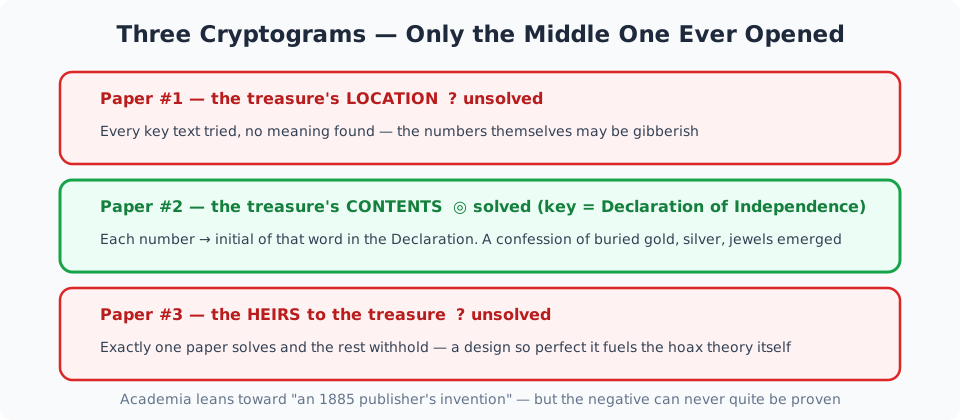
Each cryptogram has a role: Paper #1, the treasure’s location; Paper #2, its contents; Paper #3, the roster of heirs. Only Paper #2 has ever been read. The one that matters most — the location — remains a silent column of numbers.
The One That Was Solved — the Key Was the Declaration of Independence
Paper #2 fell to a classic technique called the book cipher. The mechanism is disarmingly simple.
You need a key document — and for Paper #2, the key turned out to be the United States Declaration of Independence. Number the Declaration’s words from the beginning; then replace each number in the cryptogram with the first letter of the word bearing that number. “73” means: take the initial of the Declaration’s 73rd word. Repeat, and meaningful English rises out of the digits.
The revealed text was sensational: a detailed confession of burying, in a stone-lined vault in Bedford County, thousands of pounds of gold, more of silver, plus jewels — worth on the order of tens of millions of dollars today. And it ended by noting that “the exact locality of the vault” was described in Paper #1. From that moment, the world’s eyes fixed on the unsolved first paper.
The Two That Won’t Break — and the Shadow of Doubt
People have given their lives to this cipher. In the early 20th century the Hart brothers spent decades between them on it; one, convinced he had solved it, dynamited the ground — and found nothing. Cryptographers, statisticians, and countless enthusiasts have followed. The tantalizing almost-solvability is the cipher’s spell.
Papers #1 and #3 are presumed to be book ciphers too — meaning the right key text would open them. The Declaration, the Bible, Shakespeare, period newspapers and famous documents — everything has been tried, and the computer era brought near-exhaustive sweeps. Still, no meaningful text has ever emerged.
As decryption stalled, a more fundamental suspicion gathered force: “perhaps the treasure and the ciphers alike are the pamphlet publisher’s invention.” The evidence stacks up. The story’s only source is the 1885 pamphlet, and no solid record confirms Beale ever existed. The letters attributed to Beale contain turns of phrase not yet current in the 1820s. Stylometric analysis suggests Beale’s letters and the pamphlet author’s prose may share one hand. And most damning: force-decode the unsolved Paper #1 with the Declaration, and amid the gibberish appears a run of letters in nearly perfect alphabetical order. Too tidy for chance, it reads as the trace of an author assigning filler numbers while running a finger down a document — strongly implying the number string is meaningless.
So the present standoff: the romance of “find the key, find the fortune” versus the sober analysis of “there was never anything inside.” Academically the hoax theory leads — but conclusive proof is missing on that side too.
And Still, People Keep Digging
Even with the hoax case this strong, the fever never breaks. In Bedford County, the treasure hunting continues today.
Over the decades, believers in one “solution” or another have torn up ground across the county — including people arrested for excavating strangers’ private land. Metal-detector hobbyists keep coming; for the locals it is half nuisance, half tourist economy. A cipher that almost solves, and tens of millions that might be under the next shovelful — the combination does not release its grip on the human mind.
What I find most delicious: even if it is a fabrication, the Beale cipher remains a superbly made puzzle. The design where exactly one paper solves; the choice of the Declaration as the findable key; the withholding of the location alone. If a 19th-century publisher engineered it all, then this is one of history’s great works of entertainment — a game that has kept the world playing for 150 years. Separate from any treasure, the riddle is first-class as a made object.
The Raw Numbers, and the Treasure They Describe
What do the cryptograms actually look like? All three run like this — bare strings of numbers:
71, 194, 38, 1701, 89, 76, 11, 83, 1629, 48, 94, 63, 132, 16, 111…
Paper #1 holds about 520 numbers, Paper #2 about 760, Paper #3 about 620 — no visible pattern anywhere. Yet the instant the Declaration was laid against Paper #2, it transformed into coherent English. Having witnessed that transformation once, people cannot stop believing the other two must also carry meaning.
The decoded treasure inventory is concrete: roughly 1,300 kilograms of gold, some 2,300 of silver, plus jewels obtained in exchange for silver to ease transport, packed in iron pots in a stone-lined vault. So concrete it smells fake, say the skeptics; so concrete it drives the hunters, say the shovels.
One suspected literary ancestor deserves mention: Edgar Allan Poe’s 1843 short story “The Gold-Bug” — a wildly popular tale of solving a cipher to unearth pirate treasure. The Beale pamphlet appeared roughly forty years later. The “cipher × buried gold” template was already in general circulation. If the pamphlet is fiction, its author borrowed a fashionable form with great skill.
Questions About the Beale Ciphers
Do You Think the Treasure Is Really Buried?
Speaking honestly: the odds favor “no.” The missing records of Beale’s existence, the anachronistic language, the stylometric match — the circumstantial case for fabrication is substantial. And yet proving the negative is impossible: until the county is excavated to bedrock, “there is no treasure” cannot be demonstrated. That “devil’s proof” structure is precisely the machine that keeps the hunt eternal. Dream freely — but do not dig on private property.
Why Did Only Paper #2 Get Solved?
Because its key was the Declaration of Independence — the most famous document anyone would try first. A book cipher is extremely robust until its key text is identified, and collapses instantly after. One can read Paper #2 as having been deliberately made solvable via an easy-to-find key. This is a pillar of the hoax argument: “one paper solves to prove the treasure exists; the rest withhold forever” is almost too perfect as reader-teasing narrative design. Coincidence, or stagecraft? Decide for yourself.
Are There Other ‘Treasure Ciphers’ Like This?
Yes — tales binding unsolved ciphers to treasure or terrible secrets exist worldwide. What most share: a single unverifiable source and little corroboration. The Beale ciphers are the archetype of the genre — “an unsolved cipher collateralized by a dream of gold.” By contrast, ciphers like Kryptos (covered on this site) have living authors and guaranteed solutions — honest unsolved puzzles. If you love riddles, check the provenance first. That rule serves across every mystery there is.
Related Mysteries
See the fellow unbroken ciphers “the Kryptos cipher” and “the Zodiac ciphers,” and the book no one can read, “the Voynich manuscript.”
Summary
This article covered “the Beale ciphers.”
Of the three cryptograms, only Paper #2 was ever solved — via the Declaration of Independence — and it described a fortune in buried gold and silver. That much is fact. But Paper #1, holding the location, has never opened. And strong linguistic evidence suggests the whole story was invented by the 1885 pamphlet’s publisher. Romance, or cold analysis?
To me the real treasure was never the gold — it is the design of the riddle itself, which has obsessed the world for 150 years. The tease of the single solvable paper; the un-disprovable structure. Fact or fabrication, the Beale ciphers are the finest specimen we have of how helpless human beings are before a puzzle that will not open.
To return to the full list of mysteries, follow the link below.
Thank you for reading. We hope to see you in the next article.
Also popular with readers
📚 Series: World Mysteries (9/21)