Thank you for visiting this site. This article covers a true story etched into the history of codebreaking: “the Zodiac ciphers.”
At the end of the 1960s in California, an unidentified serial killer calling himself “the Zodiac” mailed taunting letters and ciphers to newspapers. The first cipher was cracked, surprisingly, by an ordinary schoolteacher and his wife. But the second — “Z340” — defeated the FBI, military specialists, and hobbyists worldwide. Then, 51 years later in 2020, a three-person team of citizens from three countries finally broke it, stunning the world. Even so, two ciphers and the killer’s identity remain unknown. A heavy but fascinating story where real crime and cryptanalysis intersect.
What Was the Zodiac Case?
The Zodiac case was a series of murders in northern California between 1968 and 1969. The killer attacked young couples and others, murdering at least five people (his letters boasted of far higher counts, never substantiated).
What made the case unique was the killer’s theatrical performance. Naming himself “the Zodiac” and signing with a crosshair-like circle-and-cross symbol, he mailed letter after letter to newspapers — detailing his crimes, taunting police, and threatening to kill again unless printed on the front page. Enclosed with the letters came pages of cipher symbols.
The crimes themselves were staged with the same theatricality. At a lakeside attack on a couple, the survivor described a figure in a black executioner’s hood with the crosshair symbol drawn on his chest. After shooting a cab driver in the city, he mailed a piece of the driver’s shirt as “proof.” This theater of terror scarred American criminal history and pop culture alike — the villain of Dirty Harry was modeled on him.
Four principal ciphers exist, named by their symbol counts: Z408, Z340, Z13, and Z32. Hinting that “solving the cipher will reveal my identity,” the killer dragged police, media, and the public into a half-century decoding race.
A Teacher Couple Solved the First Cipher
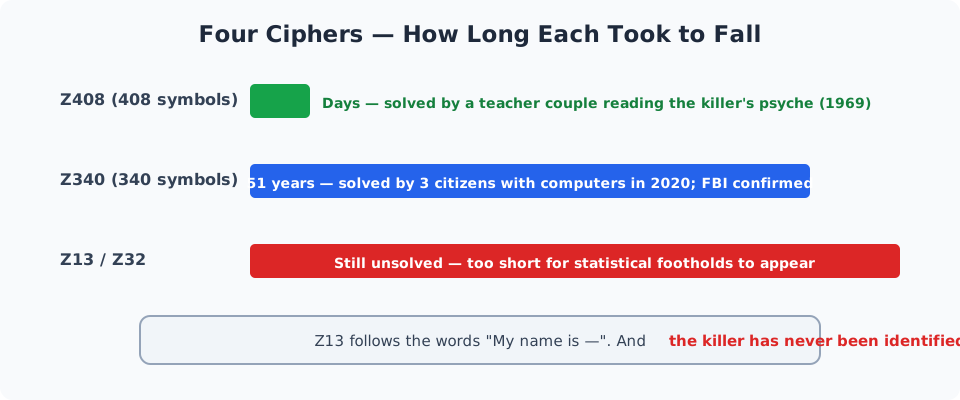
The first cipher, Z408, sent in the summer of 1969, was a 408-symbol production. Police and intelligence agencies got to work — but the first to crack it were high-school teacher Donald Harden and his wife Bettye, at their kitchen table, within days of publication.
Z408 was a homophonic substitution cipher — multiple symbols per letter, designed to defeat frequency analysis. Textbook-tough, but fortunately long, with plenty of material. The Hardens’ wedge was psychological: “an egotist will start with ‘I’” and “he will certainly use the word ‘kill.’” From those guesses, the symbol correspondences fell in cascade. Insight into human nature beat the professional agencies to the door.
The decrypted text opened with “I like killing people because it is so much fun” — a self-serving philosophy of murder. The hoped-for name was absent: “I will not give you my name,” it said. The cipher fell; the identity did not.
The 51-Year Solution: Z340 and Computational Grit
The second cipher, Z340, arrived that autumn — and was another animal entirely. Built from similar symbols, it resisted every technique that had worked before. The FBI, NSA, Navy cryptanalysts, and armies of amateurs tried for half a century without success.
The breakthrough came from a citizen team of the internet age: American software developer David Oranchak, an Australian mathematician, and a Belgian engineer, collaborating across borders online. They ground through roughly 650,000 candidate rearrangement schemes by computer. In December 2020, the door opened. Z340 was a double structure — homophonic substitution layered under a diagonal transposition — and contained the killer’s own enciphering mistakes, which had hidden the answer even from those on the right track.
The plaintext continued the taunts — “I hope you are having lots of fun in trying to catch me… I am not afraid of the gas chamber” — and again, no name. But the FBI officially confirmed the solution, and the 51-year decipherment entered history as a citizens’ triumph. Old unfinished business, settled by technology and stubbornness — for mystery lovers, few true stories are this satisfying.
What Remains: Two Unsolved Ciphers and the Killer Himself
Even with Z340 solved, the Zodiac case is not over. Two ciphers — and the central question of the killer’s identity — remain untouched.
The unsolved Z13 is a mere 13 characters following the plaintext words “My name is —”. Z32 concerns the location of a claimed bomb. Both are too short to exhibit the statistical patterns decryption needs — in principle, countless “plausible” readings can be constructed and none confirmed. Thirteen characters that seem to spell a name, possibly unreadable forever. The killer’s malice, distilled.
The killer, too, remains unidentified. Several strong suspects emerged over the decades, but neither DNA nor handwriting produced a conclusive match, and the case is officially open. Efforts to extract the killer’s DNA from stamps and envelopes continue, fighting a half-century of degradation and contamination, with no publishable result yet. Private groups periodically announce “we’ve identified him” — police have endorsed none of it. The case endures as the archetype of that dangerous pairing, “theatrical crime plus cryptography,” in both criminal and cryptologic history.
The Timeline of Crimes and Ciphers
Following only the ciphers loses the shape of the case, so here are the confirmed main events:
| When | Event |
|---|---|
| Dec 1968 | A young couple shot dead on a lakeside road (first confirmed crime) |
| Jul 1969 | Another couple shot, one killed; the killer phones the police immediately after |
| Aug 1969 | Z408 arrives split among three newspapers; the Hardens solve it within days |
| Sep 1969 | A hooded man attacks a couple at a lake; one dies |
| Oct 1969 | A cab driver shot dead in the city; a piece of his shirt later mailed as proof |
| Nov 1969 | Z340 arrives — unsolved for half a century |
| 1970s | Letters continue sporadically, then stop |
| Dec 2020 | The citizen team solves Z340; the FBI confirms |
Laid out this way, one sees that the murders cluster within about a year, while the theater of letters and ciphers ran on for years. The killer seems to have grown more attached to the thrill of toying with society than to murder itself.
Outside this timeline sit various unconfirmed crimes debated as possibly Zodiac’s. Since the killer himself inflated his count, the very boundary of which crimes are truly his remains an open research question. Confirmed fact, the killer’s self-report, and posthumous speculation — keeping those three layers separate is the minimum decency this case demands.
Questions About the Zodiac Ciphers
Why Did the Killer Send Ciphers at All?
Nothing is certain, but domination and self-display appear central. The Zodiac obsessed over outwitting police, commandeering front pages, and terrifying a whole society — and a cipher is the perfect prop, broadcasting “I am smarter than all of you” in rows of unreadable symbols. In truth, his cryptography was learnable from books of the day. Not a genius cryptographer — a criminal gifted at staging fear. That is likely the accurate portrait.
Is Z13 Really His Name?
Unknown. Z13 follows the plaintext “My name is —,” hence the expectation — but 13 characters cannot be verified. Fit a candidate name and call it “readable,” and an equally readable rival name can always be constructed. And there was never any guarantee he honestly encrypted his real name. A career taunter suddenly playing fair on the one card that matters? The doubt writes itself. Unsolvable — and untrustworthy even if solved. A doubly malicious thirteen characters.
Was It Luck That Amateurs Beat the Professional Agencies?
Not luck — different strengths. The Hardens beat the agencies with flexible psychological insight into the writer. The Z340 team had years of obsession focused on one cipher plus modern computing. Agencies are excellent, but they cannot staff one cold cipher for decades. As Cunningham’s law hints, leave a puzzle in the open, and someone, somewhere in the world, will solve it. A showcase of the internet era’s collective intelligence.
Related Mysteries
See the fellow cipher mysteries “the Kryptos cipher” and “the Beale ciphers,” and the vanished-criminal mystery “the D.B. Cooper case.”
Summary
This article covered “the Zodiac ciphers.”
Of the four ciphers mailed to the newspapers, Z408 fell within days to a teacher couple’s psychological insight, and Z340 fell 51 years later to three citizens’ computational analysis — the latter, FBI-confirmed, standing as a monument to the internet age’s collective intelligence. Yet Z13, with its whispered promise of a name, and Z32 remain unread. And the killer has never been identified, across more than half a century.
The case delivers the fascination of cryptography together with its weight: real victims stand behind these puzzles. Holding both — the thrill of the solving and the grief of the crimes — is the honest way to face a true-crime mystery. Whether technology and stubbornness will one day settle what remains: a case worth watching, quietly.
To return to the full list of mysteries, follow the link below.
Thank you for reading. We hope to see you in the next article.
Also popular with readers
📚 Series: World Mysteries (11/21)