
Thank you for visiting this site. This article covers the only unsolved hijacking in American criminal history: “the D.B. Cooper case.”
The night before Thanksgiving, 1971. A quiet man in a suit, tie, and sunglasses hijacked a passenger jet. He demanded $200,000 in ransom and four parachutes — and once he had them, he walked down the aft stairs of the flying aircraft and leapt into the rainy night sky. More than fifty years later, his identity, his fate, and the money’s whereabouts remain unknown. Pursued by the FBI for 45 years and never caught: “history’s most gentlemanly hijacker — and the only one who got away.” Here is the whole story, and the clues he left behind.
What Was the D.B. Cooper Case?
On November 24, 1971, a man calling himself “Dan Cooper” boarded a short flight from Portland, Oregon, to Seattle — a well-dressed white man appearing to be in his mid-forties. After takeoff he passed a note to a flight attendant: “I have a bomb in my briefcase.” The opened case did indeed contain what looked like a bomb.
The man was calm throughout — he ordered a bourbon and soda and paid for it properly, the attendants testified. His demands were precise: $200,000 in cash (several million in today’s money) and four parachutes. At Seattle he released all 36 passengers in exchange for the goods, then ordered the crew-only aircraft back into the air, toward Mexico — with strikingly technical stipulations: “low altitude, low speed, landing gear down, flaps at fifteen degrees, aft staircase deployable.”
Just after 8 p.m., over the forests of southwestern Washington, a cockpit indicator showed the aft staircase (airstair) had been opened. The aircraft bobbed slightly. From those stairs, with the money bag tied to his body, the man jumped into a freezing rainstorm. The fighter jets shadowing the airliner never saw a figure in the night clouds.
Incidentally, the name “D.B. Cooper” comes from a press mix-up with the initials of a different man briefly checked by investigators — and it stuck. A case whose very name is a misreport: fitting, somehow.
The Day, Hour by Hour
What distinguishes the case is how everything unfolded, calmly, within half a day.
| Time (approx.) | Event |
|---|---|
| 2:50 p.m. | ”Dan Cooper” boards with a one-way ticket; passes the note after takeoff |
| Just after 3 p.m. | Shows the “bomb”; demands radioed ahead to Seattle |
| Late afternoon | Aircraft circles while cash and parachutes are gathered on the ground |
| ~5:40 p.m. | Lands at Seattle; releases 36 passengers and 2 crew; receives money and chutes |
| ~7:40 p.m. | Takes off again with a skeleton crew; low-and-slow flight profile specified |
| ~8:13 p.m. | Pressure bump at the aft of the aircraft — the presumed moment of the jump |
Note the man’s unbroken composure. He threatened, yet treated the crew politely, paid for his drink, and released the passengers exactly as promised once his demands were met. That “keeping his word” produced the strangely gentlemanly villain of the attendants’ testimony.
The second key fact: the jump point is not precisely known. Nothing was visible at night; the estimate rests on radar tracks and the timing of the pressure bump, and once wind drift is included, the candidate zone spans vast forest. In 1978 a hunter found a placard from a 727’s aft stairs in the projected area — corroborating the flight path but leading nowhere on the man himself. The whole difficulty of the search lives in that phrase: a forest tens of kilometers across.
The Great Search, and the Money Nine Years Later
The FBI and the military combed the projected landing zone. No parachute, no body, no money — nothing. A night jump into freezing storm winds at 300+ km/h airspeed would test an expert; the FBI leaned early toward “unlikely to have survived.” But no proof of death surfaced either.
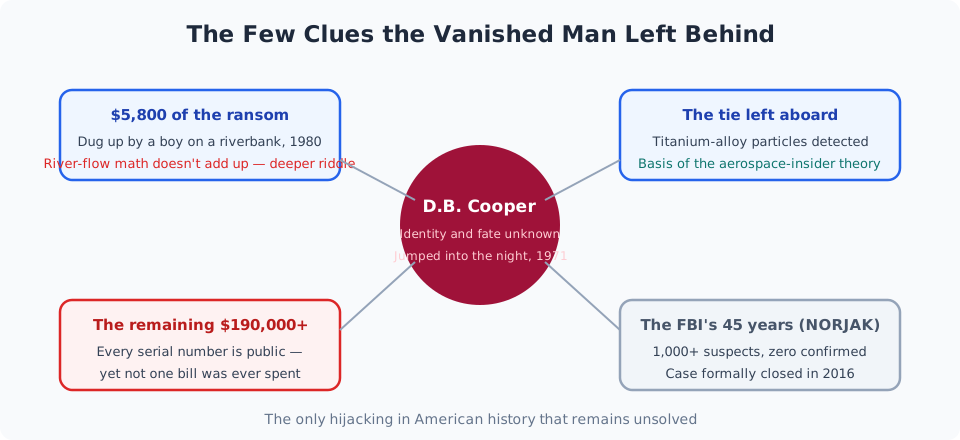
The turn came in 1980. An eight-year-old boy playing on a Columbia River bank dug out of the sand a rotting bundle of twenty-dollar bills — $5,800 in all. The serial numbers matched: part of Cooper’s ransom. Headlines everywhere — but the find deepened the puzzle. The spot was difficult to reconcile with river-flow calculations from the presumed jump zone. Buried by the man? Washed from his remains? Carried by floods? The bundle brought not an answer but a new question.
The remaining $190,000-plus has never surfaced. Every serial number is public — and not one bill has ever been recorded as spent.
The Suspects, and the Case Closed
The FBI’s investigation (codename NORJAK) ran 45 years and processed over 1,000 suspects.
The physical evidence from the cabin was meager: a black clip-on tie with a mother-of-pearl tie pin, and several cigarette butts. The butts might have become the DNA trump card — but were revealed to have been lost from evidence storage. The loss of what could have been the decisive exhibit remains the investigation’s great regret.
The suspect parade included a man arrested months later for a nearly identical copycat hijacking (whether copycat or Cooper himself is still argued), ex-military men with suspicious résumés, and deathbed confessors. Recently, analysis of titanium-alloy and rare-metal particles on the tie has fueled the theory that Cooper was an aerospace-industry insider. But with no fingerprint or DNA match, no suspect was ever confirmed.
In 2016 the FBI formally closed the case, citing the need to redirect resources — the only U.S. hijacking ever officially shelved without identifying the perpetrator. The file reopens if major physical evidence (especially the rest of the money or a parachute) appears — and civilian sleuths are still hunting.
Why Did This Case Become a Legend?
Though a crime, the D.B. Cooper story is told in America almost as folk-hero legend. The reasons reveal what makes the case singular.
First, nobody was hurt. Every passenger walked free; the bomb was never used (nor confirmed real). Second, the exit was too cinematic: stepping off a flying airliner into the night above the forest. Third, the spectacle of a vast institution mobilizing everything and failing to find one man. That “one against the system” narrative, meeting the mood of the era, made him a legend — the presumed drop zone still holds an annual “Cooper festival.”
But it must not be forgotten: this was a serious crime of threats against a flight crew. And in bitter irony, it triggered a wave of copycat hijackings that permanently changed aviation security — stricter screening, and a mandated device that locks the 727’s aft stairs in flight, named the “Cooper vane.” The hijacker’s name survives inside the machinery of aviation safety itself.
Questions About the D.B. Cooper Case
Do You Think Cooper Survived?
The FBI has consistently leaned toward “survival unlikely.” Night, storm, subzero temperatures, 300+ km/h slipstream, unknown forest below, light clothing — and one of the parachutes provided was a sewn-shut training dummy (he jumped with a different one). Conditions dangerous even for an expert. Yet with no body and no primary equipment ever found, survival cannot be ruled out either. If he lived, he spent his life holding unspendable, catalogued bills, unable ever to claim his own legend. Both endings carry the same odd melancholy — that is this case.
Was He Really an Aviation Expert?
Very probably. He chose a 727 — the model with aft stairs — and specified the speed, altitude, and flap settings suited to a jump. Attendants said he handled the parachutes with familiarity. Whether the knowledge came from military jump experience or the aviation industry became the axis for narrowing suspects — and the tie’s aerospace particles mesh with that reading. The cautious caveat: such information also circulated in trade publications of the era, so “certainly a professional” overstates it.
Could the Case Still Be Solved?
The possibility survives, on two keys. First, physical evidence: a parachute or remains from the forest, or more money from the river, could end it instantly via DNA. Civilian teams still run field searches and scientific analyses of the bills. Second, family testimony or effects: if the man is long dead, ransom bills or a ticket stub may yet surface in someone’s attic. Time was never the FBI’s friend — but advancing analysis is the mystery’s friend. In an age when particles on a fifty-year-old tie can suggest a man’s profession, the final puzzle piece falling into place is far from impossible.
Related Mysteries
See the fellow vanished-person mysteries “the disappearance of Amelia Earhart” and “the Dyatlov Pass incident,” and the unsolved-case cipher of “the Zodiac ciphers.”



Summary
This article covered “the D.B. Cooper case.”
A man who took $200,000 and parachutes and vanished from a flying aircraft into a night storm. The $5,800 that surfaced on a riverbank nine years later only deepened the riddle; 45 years of FBI work and a thousand suspects never reached an answer. The image of one man outwitting a giant institution without hurting anyone (or so it appears) is what transmuted a crime into a legend.
Still, new science — like the particle analysis of that tie — keeps shining thin light into that long-ago night. Did the man rot somewhere in the forest, or grow old somewhere, staring at bills he could never spend? A story that refuses to end, leaving its finale to the reader’s imagination — D.B. Cooper drifts through the American night sky still.
To return to the full list of mysteries, follow the link below.
Thank you for reading. We hope to see you in the next article.

Also popular with readers
📚 Series: World Mysteries (15/21)