
Thank you for visiting this site. This article covers aviation history’s great vanishing: “the Amelia Earhart mystery.”
The first woman to fly the Atlantic solo, and America’s national hero, Amelia Earhart. In 1937 she attempted her crowning challenge — a flight around the world along the equator. And near the end, on the leg toward a tiny island in the middle of the Pacific, she vanished with her aircraft after a final radio call: “gas is running low… we cannot see you.” The largest search of its era found nothing, and for nearly ninety years her fate has remained unknown. Crash, or castaway? This is the story of nine decades of searching and sifting.
Who Was Amelia Earhart?
Amelia Earhart was the most famous woman aviator of 1930s America. In 1932 she became the first woman to fly solo across the Atlantic — fifteen hours through weather and mechanical trouble — and awoke a global star. She went on breaking records, and as a symbol of women claiming new ground, she captivated audiences through lectures and books.
In 1937, at 39, she launched the summation of her career: a flight around the world along the equator, roughly 47,000 kilometers. Her companion was the veteran navigator Fred Noonan; their aircraft, a twin-engine Lockheed Electra. In about a month they flew more than two-thirds of the route without major incident, leaving only the Pacific crossings.
The fateful leg ran from Lae, New Guinea, to Howland Island — about 4,100 kilometers of open ocean ending at a flat island less than three kilometers long. Finding that pinprick in the vast Pacific was, with the navigation technology of the day, a tightrope act in itself.
The Final Calls: “We Cannot See You”
On July 2, 1937, the U.S. Coast Guard cutter Itasca waited off Howland Island to guide her in by radio. Earhart’s transmissions came in weak, then stronger and stronger — the plane was certainly approaching the island.
But there was a fatal problem: the communication ran one way. Itasca could hear her; she appeared to be receiving almost none of Itasca’s replies — a tangle of frequency misunderstandings and radio-equipment issues. In the morning her voice arrived: “We must be on you, but cannot see you… gas is running low.” Itasca poured smoke from its boilers to mark its position; the exchanges never connected. In her final transmission she reported “running on the line 157-337… north and south” — and then silence.
The U.S. government launched the largest search in history to that time, aircraft carrier included, and found not one fragment. The two were declared legally dead in 1939, and the case passed into legend.
There is a haunting postscript: for days after the disappearance, radio stations around the Pacific and distant shortwave listeners reported picking up what sounded like distress signals from the Earhart plane. The Navy initially redirected its search on their basis. Later review dismissed most as errors or hoaxes — but some reception records lead certain researchers to argue that “since the aircraft could not transmit while floating at sea, the signals imply it was on land somewhere.” The weight given to these “post-loss signals” is one of the main dividing lines between the crash theory and the castaway theory.
It Was Actually the Second Attempt
Little remembered: this circumnavigation was a second attempt, following a failure.
The first try, in March 1937, went westward as far as Hawaii — where, on takeoff for the next leg, the aircraft ground-looped violently on the runway and was wrecked. No one was hurt, but the Electra went back to the mainland for major repairs. At great cost the plane was rebuilt, the route reversed to eastbound to suit the shifting seasons — and the fateful second attempt began.
The restarted journey went beautifully. Oakland to Miami, down the South American coast, across the Atlantic to Africa, on through the Middle East, India, and Southeast Asia; by late June they reached Lae, New Guinea. In about a month they had covered nearly 90% of the route — some 35,000 kilometers. Three Pacific legs remained.
But the first of those three was the most dangerous stretch of the entire route: the 4,100 kilometers to Howland. That tiny island was the required stop because the aircraft could not fly farther without fuel. The U.S. government had even built a runway on Howland for this flight. Everything was prepared. Which makes the chain of small miscommunications at the end all the more painful.
Three Theories: Crash, Castaway, or Capture
The theories divide three ways.
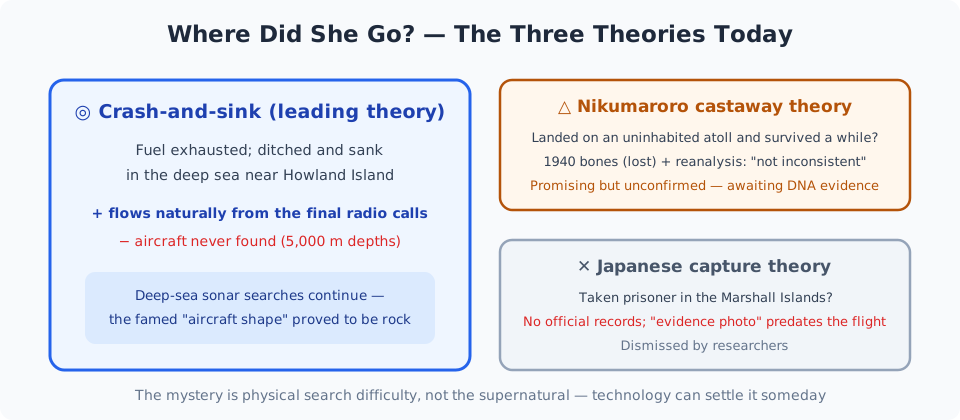
The leading one is the “crash-and-sink theory”: fuel exhausted, the Electra ditched near Howland and went down — the simplest reading, flowing naturally from the final transmissions (fuel low, island not in sight). Most historians and aviation specialists favor it. Its single weakness: the aircraft has never been found. The surrounding ocean is thousands of meters deep, making the search brutally hard.
Second, the “Nikumaroro castaway theory”: extending her reported “line 157-337” south leads to an uninhabited atoll (then called Gardner Island), where she may have landed and survived for a time. In 1940 partial human remains were found there; a doctor of the day judged them male — and then the bones were lost. Modern reanalysis of the surviving measurements concluded they were “not inconsistent with Earhart’s build,” reviving the theory. Search groups have also reported artifacts — a shoe sole, what may be a cosmetics jar — but nothing decisive.
Third, the “Japanese capture theory”: that she came down in the Marshall Islands and was taken prisoner. No supporting official record has surfaced on either the American or Japanese side, witness accounts are unreliable, and researchers treat it dismissively. The famous “evidence photo” was shown to predate the disappearance.
The Deep-Sea Search Continues
The hunt for Earhart goes on today — at depths of five thousand meters.
Several exploration companies have swept the seabed around Howland with sonar. Recently one team made global headlines with a sonar image of “what appears to be an aircraft” — and follow-up survey showed it to be a rock formation. Another miss. Yet the searching never stops, because — as the Titanic’s discovery after 73 years proved — advancing deep-sea technology keeps the hope of “someday” alive.
What draws me to this case is that its mystery consists of “the difficulty of searching” — not the supernatural. Too much ocean, too deep a seabed, too small an aircraft. Nothing inexplicable anywhere; only physical difficulty has kept the answer hidden for ninety years. Which means this mystery can and likely will be settled as technology advances. The day her aircraft is found may be nearer than we think.
Questions About the Earhart Disappearance
Why Couldn’t They Find the Island?
Bad luck stacked on hard limits. Ocean navigation then relied on celestial fixes and dead reckoning (position computed from speed and time), where errors inevitably accumulate over distance. The radio guidance meant to fix that failed amid frequency confusion. Cloud shadows on the sea that day reportedly mimicked small islands. Howland is a flat strip a few kilometers long — a slight offset and it never enters your field of view. Small troubles, individually minor, compounding into the irreversible — a painful real-world case of Heinrich’s law.
I’ve Heard She Secretly Survived and Returned?
A postwar folk tale, completely debunked. A book claimed Earhart had been rescued and was living quietly under another name, and named a real woman — who was an entirely different person, sued for defamation, and won. Nearly every famous disappearance attracts a “secretly alive” narrative. It is the classic myth generated by wishing, and a pattern worth memorizing for reading any mystery.
Whose Bones Were Found on Nikumaroro, Then?
Unresolved — because the bones themselves were lost in wartime confusion, making DNA testing impossible. Only the doctor’s measurements survive; modern forensic reanalysis of those found them “not inconsistent with” Earhart. But “not inconsistent” is not “identified” — another person remains possible. Should new artifacts yielding recoverable DNA emerge from the island, everything changes. For now the bones stand as promising but unconfirmed support for the Nikumaroro theory.
Related Mysteries
See the fellow vanishings “the D.B. Cooper case” and “the Mary Celeste,” and the sea legend “the Bermuda Triangle.”



Summary
This article covered “the disappearance of Amelia Earhart.”
Near the end of her flight around the world, the legendary aviator vanished just short of a tiny Pacific island, leaving the words “gas is running low.” Three theories: the leading crash-and-sink, the bone-and-artifact-fueled Nikumaroro castaway theory, and the poorly supported capture theory. Ninety years of searching have produced no aircraft, and the celebrated sonar “find” turned out to be rock.
Yet nothing supernatural shadows this mystery — only a wide, deep ocean and the limits of 1937 technology. Which is why advancing deep-sea exploration will, someday, raise the answer. Somewhere beneath the sea she last saw, the Electra still waits quietly to be found. I believe that — and I keep following the search news.
To return to the full list of mysteries, follow the link below.
Thank you for reading. We hope to see you in the next article.

Also popular with readers
📚 Series: World Mysteries (14/21)