Thank you for visiting this site. This article covers the device sometimes called “history’s most out-of-place invention”: “the Antikythera mechanism.”
In 1901, from an ancient shipwreck off a small Greek island, divers raised a corroded lump of bronze. Junk, at first glance. But inside it lay hidden trains of precisely meshing gears. It was made about 2,000 years ago — in an age after which precision geared machines would not appear anywhere on Earth for more than a millennium. Why did ancient Greece possess technology like this? Here is how far modern science has gotten in unmasking the device known as “the ancient computer.”
What Is the Antikythera Mechanism?
The Antikythera mechanism is a geared astronomical calculating device built in ancient Greece around the 2nd to 1st century BC, named for the island near its discovery site.
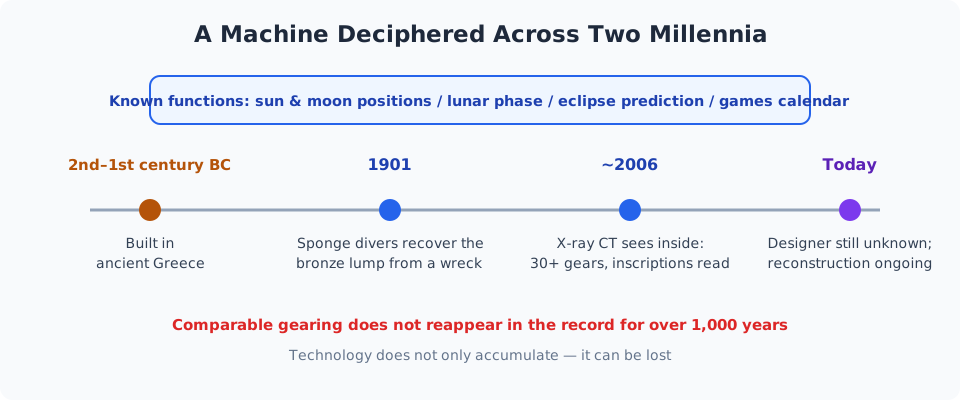
The discovery reads like an adventure novel. In 1901, sponge divers sheltering from a storm off Antikythera found an ancient Roman-era shipwreck lying tens of meters down. Diving then was mortally dangerous — the salvage cost lives. Up came magnificent bronze and marble statues, and among them, a cracked shoebox-sized lump of bronze. It drew little attention at first — until researchers noticed within its fragments gears, fine graduated scales, and Greek inscriptions, and the field erupted.
The device incorporated more than 30 bronze gears by current count. Turning a hand crank drove interlocking gear trains that moved pointers across dials. Gearing of such complexity does not reappear in the historical record until the astronomical clocks of 14th-century Europe — over a thousand years later. An artifact floating impossibly free of its era: that was the central mystery.
The wreck itself remains an archaeological treasure trove under active excavation. Jacques Cousteau’s team dived it in the 20th century; renewed campaigns since the 2010s have recovered further statue fragments and even human remains of the ship’s company. Missing pieces of the mechanism may still lie on the seabed. A 2,000-year-old shipwreck that is still a working dig — thrilling enough on its own.
The Astonishing Functions X-Rays Revealed
The corroded lump’s internal structure stayed obscure for decades. The turning point was the international research project around 2006 that applied modern X-ray CT scanning — slicing the interior optically without damage, counting gear teeth, even reading inscriptions hidden inside the corrosion.
The revealed functionality was breathtaking. Set the date with the crank, and the device displays the positions of the sun and moon in the sky and the moon’s phase. The rear dials predicted solar and lunar eclipses from known cycles. And beyond that: a dial tracking the years of the Panhellenic games — including the ancient Olympics. A universal calculator of sky and calendar.
The technical masterstroke is the lunar motion. Because the moon orbits in an ellipse, it appears to speed up and slow down. Using an ingenious pin-and-slot gear arrangement, the device mechanically reproduced this variation in the moon’s speed. The gear tooth counts encode astronomical knowledge directly as numbers — a physical record of the summit of Greek astronomy.
Who Built It, and What For?
Here begin the remaining mysteries. The designer is unknown.
Candidates exist: a workshop in the lineage of Archimedes, who reportedly built a geared planetarium; manufacture on Rhodes, home of the astronomer Hipparchus; links to Corinthian-family cities, suggested by the calendar scheme in the inscriptions. All circumstantial — nothing decisive. What is certain: this was no one-off prototype but the product of a mature craft tradition. The design is refined, implying a lineage of such devices already existed; ancient texts do mention machines reproducing the motions of the heavens.
Its purpose is equally debated: research instrument, teaching device, calendrical computer, or a “treasure of learning” for a wealthy patron. Astrological use has been suggested too. The ship appears to have been a treasure transport bound from the Rhodes region toward Rome — the mechanism itself perhaps a gift or commodity destined for a Roman grandee.
Why Did the Technology Disappear?
And the final mystery: with technology of this caliber in hand, why did precision gearing vanish from history for more than a thousand years?
The leading explanation is quietly sad. Devices of this kind likely lived within a narrow tradition held by a few workshops and scholars. Unlike books, they were not copied in quantity, and the bearers were few. Let war or upheaval cut that thin thread, and the technology simply dies. Much knowledge was indeed lost with the end of the ancient world.
There is also the view that the thread never fully snapped: traces of gear craft persisted in Byzantine and Islamic mechanical devices, possibly winding their way toward medieval Europe’s clockwork. Seemingly lost, perhaps barely connected. Either way, the mechanism forces a heavy truth on us: technological progress is not a one-way street — it can go backwards. It is the mirror image of the Moore’s law story, where progress continued because people kept believing and investing.
The Astronomy Carved into the Gears
To feel the machine’s depth, look at its known layout — a two-faced construction, dials front and back:
| Section | What it displayed |
|---|---|
| Front dial | Sun and moon positions on the zodiac, lunar phase, calendar |
| Rear upper spiral | The 19-year Metonic cycle reconciling solar and lunar calendars |
| Its subsidiary window | The years of the great games, including the Olympics |
| Rear lower spiral | The ~18-year Saros cycle predicting eclipses |
The keys are the two great cycles of ancient astronomy: Metonic and Saros. Nineteen years equal 235 lunar months, aligning moon phases with the seasons; similar eclipse patterns recur about every 18 years. Knowledge accumulated since Babylonian observation was baked into this device as gear tooth ratios — the number 235 literally embodied in meshing bronze.
The crown jewel remains the lunar speed mechanism: two gears mounted slightly off-axis, coupled by a pin riding in a slot, deliberately introducing a “wobble” into the rotation — the moon’s apparent acceleration and deceleration, rendered as mechanical unevenness. Modern mechanical engineers examining the design still whistle. And in the spaces between the dials are engraved fine inscriptions amounting to a user’s manual — proof that this was a tool built to be used.
Questions About the Antikythera Mechanism
Is It Really a ‘Computer’?
Not in the modern sense — but as “a machine that computes,” absolutely. Precisely, it is an analog computer: calculation performed physically, through gear ratios. Give it an input (a date) and multiple outputs follow mechanically — solar and lunar positions, eclipse predictions. It cannot be reprogrammed, but it is a special-purpose calculator with the mathematics of astronomy burned into its tooth counts. “A 2,000-year-old computer” carries some exaggeration — and lands on the essence anyway.
Isn’t It an ‘Out-of-Place Artifact’ (OOPArt)?
Not in the sense of “impossible for its time, therefore fake or paranormal.” The bronze and the script are authentically ancient; the excavation context is solid. Above all, decipherment of the inscriptions confirms that Greece at that time genuinely possessed the astronomy and engineering to build it. What the mechanism teaches is not “the ancients couldn’t have” but “we had underestimated what the ancients could do.” Not impossible — merely beyond our imagination until now. A fine corrective to how the word “OOPArt” gets used.
Can I See the Original or a Reconstruction?
The original fragments are held and displayed at the National Archaeological Museum in Athens — some 80 pieces, the main mass sheathed in green corrosion — alongside research-based reconstruction models whose gear trains actually turn. Researchers and enthusiasts worldwide have built working replicas, including one made of LEGO. A machine whose blueprints vanished two millennia ago, keeping time again in modern hands — a worthy continuation of its story.
Related Mysteries
See the fellow riddles of ancient ingenuity: “how the pyramids were built,” “Stonehenge,” and the undeciphered script “Linear A.”



Summary
This article covered “the Antikythera mechanism.”
The bronze lump raised from a shipwreck proved to be a 2,000-year-old astronomical computer: 30-plus gears reproducing the motions of sun and moon and predicting eclipses. The modern eye of X-ray CT read out the functions sleeping under the corrosion, one by one, and revealed the “ancient computer” for what it is. Meanwhile the identity of its designer, and the thousand-year disappearance of its technology, remain open.
The mechanism presses two truths on us: technology does not only accumulate — it can be lost; and the intellect of the ancients ran far higher than we assumed. Inside what looked like junk lay the finest science of its age. For that pure surprise, this is one of my favorite mysteries of all.
To return to the full list of mysteries, follow the link below.
Thank you for reading. We hope to see you in the next article.

Also popular with readers
📚 Series: World Mysteries (5/21)