Thank you for visiting this site. This article covers the mystery born on one of Earth’s loneliest islands: “the moai.”
On Easter Island (Rapa Nui), a speck in the South Pacific, stand about 900 colossal stone statues — averaging four meters and over ten tons, the largest reaching ten meters tall. Ocean in every direction; population and resources strictly limited. Who made these giants, why, and above all — how were they moved? On the transport question, the island preserves an uncanny piece of oral tradition: “the moai walked by themselves.” And a modern experiment showed the legend may have been closer to the truth than anyone guessed.
What Are the Moai?
The moai are giant human-form statues carved on Easter Island, mainly between the 13th and 16th centuries. The island’s Polynesian people (the Rapa Nui) cut them from soft volcanic tuff with stone tools at the Rano Raraku quarry. This island is one of the most isolated inhabited places on Earth — some 2,000 kilometers to the nearest inhabited neighbor. No outside workforce or materials could be brought in: everything was accomplished with the island’s own people and resources. That closed condition is what sharpens the mystery.
First, be clear on one thing: “who made them” is no mystery at all. Dozens of unfinished moai still lie in the quarry, the manufacturing process preserved mid-step — some barely outlined in the rock face, others attached only by a spine of stone, one cut from release. It is practically a display of work stages, complete with heaps of the basalt hand-axes used as tools. The makers were the islanders. Settled.
The finished moai stood on ceremonial platforms called ahu, backs to the sea, facing inland over the villages — understood as vessels of ancestral power watching over their descendants. Many wore a red stone topknot (pukao), and their eye sockets held inlaid eyes of white coral; only with eyes in place, it seems, did the statue receive its spiritual power.
The pukao and the eyes carry their own small mysteries. The pukao were carved of red scoria at a separate crater, Puna Pau, and weigh several tons to ten tons themselves. How do you place that on the head of a statue meters tall? Ramp-based methods have been modeled and tested. As for the eyes: long assumed to be mere hollow sockets, until a 1978 excavation turned up actual fragments of an eye made of white coral and red stone. A moai with its restored eye in place has an entirely different, startlingly living face.
The Central Mystery: Moving the Giants
Here the real puzzle begins. Moai were transported from the quarry as far as a dozen-plus kilometers to coastal platforms. Ten-plus tons of stone, on an island with no cranes and no wheels — how?
Moreover, the moai kept growing larger over time. In the quarry lies the never-finished largest of all: over 20 meters long, an estimated 200 tons. Had it been completed, moving it would have been nearly impossible. The escalation is thought to reflect rival clans competing through statue size — the ancestors’ images doubling as instruments of one-upmanship. A very human story.
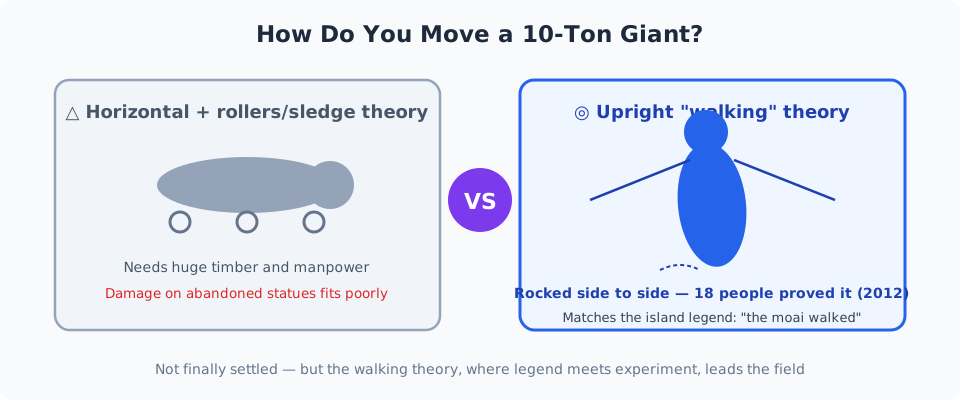
The long-favored theory: lay the statue down and drag it on wooden sledges or rollers. But it nagged. The method demands huge timber and manpower, and the damage patterns on statues abandoned mid-journey fit poorly with horizontal transport.
Attention turned to the legend. The islanders had always said “the moai walked, by mana (spiritual power).” In 2012, archaeologists Terry Hunt and Carl Lipo tested the legend in deadly earnest: a full-scale, ~5-ton moai replica, kept upright, steadied by three ropes from the sides and rear, and rocked side to side to advance — the way you walk a refrigerator. The result was stunning: just 18 people moved it about 100 meters in 40 minutes. The statues’ forward-leaning bases, it was noted, are precisely shaped for this gait. The legend’s “walking” may be the folk memory of that rocking march. The roller theory retains defenders and the debate is not closed — but the “walking” theory, where legend and experiment interlock, stands as one of archaeology’s most elegant hypotheses.
Did the Civilization ‘Destroy Itself’? The Collapse Story Revised
The moai carry one more great controversy: why did the island’s civilization decline?
The long-dominant narrative was “ecocide” — the islanders felled every tree to move moai, ruining the soil, losing their boats, sliding into famine, war, and population collapse. A parable of environmental self-destruction, made famous worldwide. The loss of the island’s palm forest is real, confirmed by pollen analysis.
But recent research has substantially revised the story. Deforestation owed much not only to human axes but to stowaway rats devouring the palm nuts. And the first European visitors in the 18th century described islanders who were not starving wretches but a functioning society farming ingeniously. The catastrophic population crash came later — driven mainly by introduced disease and slave raids following European contact. “Foolish islanders destroyed themselves” was always too simple. The toppled moai (felled, it is believed, in internal conflicts) have in many cases been re-erected. That restoration carries a Japanese connection: the island’s grandest platform, Ahu Tongariki with its fifteen statues, had been scattered by a tsunami — and in the 1990s a Japanese crane company donated equipment and expertise to a years-long restoration. The iconic fifteen-statue lineup in every travel photo stands today thanks to the islanders and cross-border help together.
The Island’s True Tragedy: The Contact Era
Alongside the ecocide revision, know what happened after European contact. The timeline carries its own weight:
| Year | Event |
|---|---|
| 1722 | Dutch explorer Roggeveen arrives (on Easter Day — hence the name) |
| 1770s | Spanish visitors, then Captain Cook’s expedition |
| 1860s | Peruvian slave raids carry off great numbers of islanders |
| After | Introduced epidemics rage; the population collapses |
| ~1877 | The island’s population bottoms out around 110 people |
Roggeveen, the first chronicler, saw standing moai with islanders living among them. In the early 18th century, the civilization was not “destroyed” at all. Then the 19th century delivered the double blow of slavery and epidemic. Among those taken were the elders who carried the rituals and traditions — and with the people went the island’s memory of itself.
The island also preserves wooden tablets carved with an enigmatic script called “rongorongo” — undeciphered to this day, because everyone who could read it was lost. No small part of the moai’s mystery is a mystery that was made — by tragedy. That perspective deserves to be kept in view.
Questions About the Moai
Is It True the Moai Have Bodies?
True. The famous “head-only” moai are the statues standing on the quarry slopes of Rano Raraku, where centuries of accumulating sediment have buried their torsos. Excavation reveals full bodies below ground, some with carvings on their backs. The “moai = giant head” image comes from these buried figures. Statues erected on platforms were always visible in full. A world-famous image turning out to be just the visible fraction — a recurring theme in the mystery business.
Why Did They Stop Making Them?
Not known with certainty, but the accepted view is that the society’s structure and religion changed. At some point the giant statues stopped, and a new competitive ritual took the island’s center: the “birdman” rite, in which the first to retrieve a seabird egg won a year’s authority. From authority vested in ancestors’ images to authority won by living competitors. Resource pressure and social upheaval likely stand behind the shift, but the details remain an open research question.
So How Much of the Mystery Is Solved?
“Who,” “when,” and “why they were made” are essentially settled: the islanders, for ancestor veneration, carved at the quarry — with abundant physical evidence. “How they were moved” now favors the walking theory after the experiment, without final closure. And “why production stopped, and how the society changed” — including the ecocide revision — remains debated. The more we learn, the more the simple story breaks down and a more human, complicated history comes into view. The moai are the perfect example of that pattern.
Related Mysteries
See the fellow ancient-civilization mysteries: “how the pyramids were built,” “the Nazca Lines,” and “the Antikythera mechanism.”

Summary
This article covered “the moai of Easter Island.”
The nine hundred giants were carved by the islanders themselves, in veneration of their ancestors. On the great transport question, the experiment that took the legend “the moai walked” at face value demonstrated that an upright statue, rocked side to side, can be walked forward by 18 people. Legend and science shaking hands — one of the most satisfying scenes in the history of mysteries.
Meanwhile, the famous parable of “the island that deforested itself to death” has been deeply revised: the rats, and then the imported disease and violence. Beneath the tidy morality tale lay a more complicated and far sadder history. Chase the mystery of the giants, and you arrive at both the islanders’ ingenuity and history’s cruelty. The moai are that kind of deep mystery.
To return to the full list of mysteries, follow the link below.
Thank you for reading. We hope to see you in the next article.

Also popular with readers
📚 Series: World Mysteries (4/21)