
Thank you for visiting this site. This article covers one of the world’s most famous ancient mysteries: “the Nazca Lines.”
Across the arid tableland of southern Peru sprawl hundreds of gigantic figures, tens to hundreds of meters long — a hummingbird, a monkey, a spider, a condor. Too large to grasp except from the air, yet drawn around 2,000 years ago, in a world without aircraft. Who drew them, how, and for what? Here is the twist: “how” is essentially solved; the genuine mystery is “why.” This article carefully separates what is known from what is not.
What Are the Nazca Lines?
The Nazca Lines are an enormous collection of giant figures drawn on the dry plateau of southern Peru — animal and plant figures, dead-straight lines running for kilometers, and geometric shapes like trapezoids, spread across a vast area.
The artists are identified as the people of the Nazca culture, which flourished here from around the turn of the era to about AD 600. They were far more than line-drawers: they left brilliantly colored pottery, refined textiles, and underground aqueducts that carried water beneath the desert — a culture of high technical skill. The famous hummingbird spans about 100 meters; some straight lines run for kilometers. Standing on the ground, the figures read as nothing but shallow furrows and paths. Only from the air — or the surrounding hills — does the whole become visible.
The lines became world-famous only after airplanes began flying in the 20th century, when commercial pilots noticed strange markings below and reported them. The astonishment at those vast images has powered a century of fascination with the question: “how could people who could not fly draw pictures meant to be seen from the sky?"
"How They Drew Them” Is Essentially Solved
Dispose of the solved mystery first. The drawing method is surprisingly simple.
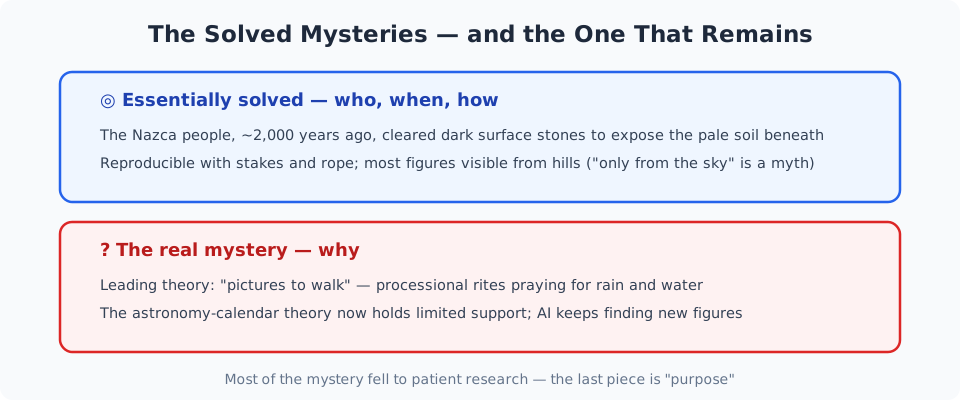
The plateau’s surface is covered with dark, oxidized stones, and beneath them lies pale-colored soil. So: clear away the dark surface stones, and a bright line appears. No pigment, no carving — a giant canvas drawn by subtraction. And because the region is an extreme desert where rain almost never falls, lines once drawn have persisted for millennia.
The method for scaling up figures accurately has been confirmed by reenactment: enlarging a small template using stakes and rope — elementary surveying, no special tools required. No alien assistance, no flight technology. Moreover, many figures are fully visible from surrounding hills and rises. “Visible only from the sky” is, in fact, an exaggerated myth.
The Real Mystery: “Why”
Method solved, the great question remains: why pour such colossal labor into giant drawings, generation after generation? No settled answer exists — but there are strong candidates.
The theory that once ruled was the “astronomical calendar”: championed by Maria Reiche, the German-born researcher who devoted her life to studying and protecting the lines, it held that the lines point to solar and stellar events. Romantic — but later verification found the astronomical alignments fall within what chance would produce, and today the theory holds only limited support.
Whatever the verdict on her theory, without Reiche the lines might not exist today. For half a century she lived in the desert, surveying the figures at her own expense, sweeping the lines clean with a broom, and physically defending them from vehicles — and it was she who raised the world’s alarm when the Pan-American Highway was cut through some figures. Locals called her “the Lady of the Lines,” and revere her still. The story of the person who guarded the mystery deserves remembering alongside the mystery itself.
The currently favored theories center on “water and ritual.” In this land of extreme aridity, water was life and death. Many figures cluster at locations tied to water sources and channels, and the lines show traces of foot traffic. The hypothesis: processions walked the figures and lines in rites of prayer — for rain, for water. The lines were not pictures to look at but pictures to walk. Not yet decisive — but as the desperate prayer of a people living on parched earth, it makes the staggering labor suddenly comprehensible.
The Lines Are Still Multiplying
The delightful thing about Nazca: research is live, and new figures keep being discovered.
Recent discovery has been led, remarkably, by a Japanese research team. The Yamagata University group, working the area for many years, added AI image analysis to aerial photography and fieldwork, finding figure after figure that human eyes had missed. Recent reports describe hundreds of new geoglyphs identified in AI-assisted batches — the catalog is still growing.
Most new finds are not hummingbird-scale giants but modest figures of a few to a dozen meters — humans, livestock. Analysis shows many of these small figures sit beside paths, positioned to be seen by people walking — an important clue for the “walking ritual” interpretation. A 2,000-year-old mystery, gradually taking shape under the newest AI: that pairing of old and new is part of Nazca’s charm.
What Is Actually Drawn There?
Meet the famous figures and their approximate sizes:
| Geoglyph | Approximate size |
|---|---|
| Hummingbird | ~96 meters |
| Condor | ~135 meters |
| Monkey | ~110 meters |
| Spider | ~46 meters |
| Lines and trapezoids | Hundreds of meters to kilometers |
Numbers undersell it: the hummingbird alone would swallow a football pitch whole. More remarkable still, many figures are drawn in a single unbroken line — entrance to exit, one continuous path, like a one-stroke drawing. A feature that resonates powerfully with the walked-ritual theory.
The choice of animals rewards attention too. Hummingbird, monkey, spider — most of these creatures do not live on the dry Nazca plateau, but in the wet forests far beyond the mountains. Deliberately drawing the creatures of water-rich lands is counted among the supporting evidence for the “prayer for water” reading.
Nazca has cousins worldwide: Chile’s desert holds the 80-meter “Atacama Giant,” and an English hillside carries the roughly 3,000-year-old “Uffington White Horse.” Humans in different eras and places independently arrived at the idea of the earth as canvas. Among them all, Nazca stands apart in sheer number and preservation.
Questions About the Nazca Lines
Is the Alien Story True?
Folklore. The “alien runway” notion spread through a late-1960s bestseller and has no evidential basis. As shown above, the technique reproduces with stakes and rope, using nothing but the local ground itself, and many figures are visible from the hills — collapsing the premise that “humans couldn’t see them, so humans couldn’t draw them.” The deeper problem with the theory is its foundation: the assumption that ancient people could not have done something this sophisticated. The actual Nazca people left superb ceramics and textiles. Enjoy mysteries by all means — but be wary of any theory whose engine is underestimating the ancients.
Won’t the Lines Disappear?
Nature erases them very slowly — humans are the serious threat. Near-zero rainfall has preserved the lines for millennia. But vehicles driving across the pampa and trespassing feet scar the surface instantly, and the scars persist just as long. Real incidents of damage from trucks and intruders have occurred. The site is now World Heritage-protected, with viewing restricted to overflights and observation towers. Not being the generation that ruins what survived 2,000 years — that is the first duty.
So How Much of the Mystery Is Solved?
In summary: “who,” “when,” and “how” are essentially settled. The Nazca people, beginning about 2,000 years ago and continuing for centuries, drew by clearing the dark surface stones — archaeologically solid. The remaining question is “why,” where water-and-ritual theories lead without final confirmation. “Mystery” suggests total ignorance; in truth, most of this mystery has been solved by patient research. What remains is the last piece — and new discoveries keep feeding the search.
Related Mysteries
See the fellow monuments of ancient peoples: “the moai of Easter Island,” “Stonehenge,” and “how the pyramids were built.”



Summary
This article covered “the Nazca Lines.”
The giant figures of the Peruvian desert were drawn by the Nazca people some 2,000 years ago, by the simple, reliable method of clearing dark surface stones. Reproducible with stakes and rope; viewable from the hills. “How” is no longer a mystery. The true question is “why” — with the leading answer being “walking rituals” of prayer for water on a parched land.
And this mystery is live: AI keeps surfacing new figures, and the purpose question advances step by step. The patient unraveling is, to my mind, far more thrilling than any alien tale. Next time you see the Nazca figures, imagine not only the view from above — but the view of the people who walked those lines, praying.
To return to the full list of mysteries, follow the link below.
Thank you for reading. We hope to see you in the next article.

Also popular with readers
📚 Series: World Mysteries (2/21)