Thank you for visiting this site. This article covers antiquity’s greatest construction mystery: “how the pyramids were built.”
The Great Pyramid of Khufu at Giza is a colossus nearly 150 meters tall, assembled from about 2.3 million stones averaging 2.5 tons each. It was built about 4,500 years ago — no cranes, no trucks, not even iron tools. How was it raised by human muscle alone? The question has long been narrated as an “eternal mystery.” In reality, excavation and experiment have carried the answer most of the way home. This article corrects the myths and maps how far the research frontier has come.
What Exactly Is Mysterious About It?
First, frame the problem. The Great Pyramid was built around 2500 BC, in a construction period of roughly 20 years. Some 2.3 million blocks in total — arithmetic says over 300 stones quarried, hauled, and set every single day for 20 years without rest.
The mystery splits into three: ① who built it; ② how the megaliths were moved; ③ how they were lifted so high. Question ① has been essentially settled by excavation. Question ② received a compelling answer by experiment. The remaining core is ③ — the lifting. Worth noting: the Great Pyramid held the title of tallest structure on Earth for roughly 3,800 years after completion — unbeaten until the cathedral spires of medieval Europe.
The pyramid mystery, in other words, is not “a paranormal unknown” but “a gigantic puzzle solved nearly to the last piece.” Let’s go through it in order.
The Slave Myth Was Wrong
The long-standing image — “pyramids built by slaves under the whip” — familiar from the movies, is a misconception overturned by excavation.
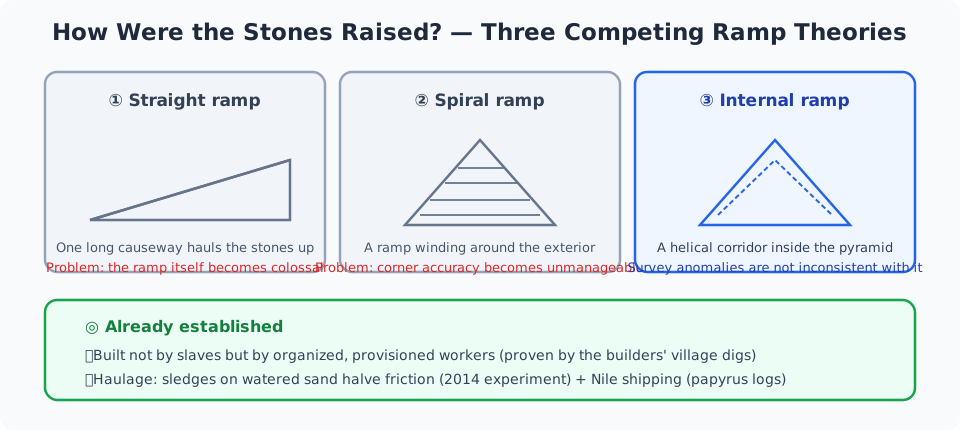
The decisive evidence came from digs of the builders’ village and cemetery near the pyramids. They revealed workers who were issued bread, beer, and meat, and received medical treatment for injuries. The workers were buried with honor beside the pyramid itself — unthinkable treatment for slaves.
Current archaeology holds that construction was carried out by organized labor crews, including farmers in the off-season. When the Nile’s flood made fieldwork impossible, they went to work for the king. Teams of thousands, organized in gangs, guaranteed food and lodging — in effect a national public works program. Graffiti on the stones proudly records gang names. The pyramid arose from a society in which laboring for the king was an honor and a livelihood — not from coercion.
Moving the Megaliths — the Key Was Water
Next: how do you haul 2.5-ton blocks? The key turned out to be almost comically ordinary — water.
Egyptian murals depict colossal statues hauled on wooden sledges by large crews — and, intriguingly, show a figure pouring water on the ground ahead of the sledge. Long dismissed as a ritual gesture, the pouring gained its true meaning in a 2014 Dutch experiment: dampening sand to the right degree binds the grains and nearly halves the friction on a sledge.
On dry sand, a berm piles up before the runners; on wet sand, the surface firms and the sledge glides. Properly watered sand alone slashed the required manpower. The Nile did the rest: distant stone traveled by boat on the flood-season river and canals to near the site, as confirmed by the discovery of contemporary work journals on papyrus.
Those journals were themselves a discovery for the ages. In 2013, papyri unearthed at a Red Sea site included the duty log of a foreman named Merer who worked in Khufu’s reign — plainly recording his crew’s routine of loading fine white limestone at the quarry across the river and delivering it to Giza over several days by boat. The construction site’s own voice, arriving across 4,500 years. Not legend, not analogy — an actual person’s work log describing the building of the pyramid. Evidence rarely comes stronger.
The Lifting — Three Ramp Theories and New Finds
The hardest problem: how were stones raised more than 100 meters? The leading framework is ramps, in three competing designs.
First, the straight ramp: one long inclined causeway toward a pyramid face — but reaching the upper courses would make the ramp itself a construction project rivaling the pyramid. Second, the spiral ramp, wrapping the exterior: economical in material, but it obscures the corners essential for surveying accuracy. Third, the French architect’s bold internal ramp theory: that builders raised stones through a helical tunnel corridor inside the pyramid itself — and some internal survey data shows anomalies not inconsistent with it.
Alongside the lifting puzzle stands the marvel of the interior design. The King’s Chamber is roofed with granite beams of dozens of tons each, topped by stacked relieving chambers that shunt the overburden’s weight aside. Together with the corbelled Grand Gallery, the design encodes the structural engineering needed to stand for 4,500 years. Not just how to stack — how to make it last.
Physical evidence keeps arriving. In 2018, at an Egyptian quarry site, archaeologists found the remains of a steep ramp flanked by stairways and post holes — showing that period stone-hauling up sharp inclines was more advanced than assumed. And in 2017, an international project imaging the pyramid with muons (subatomic particles) discovered a large unknown void above the Grand Gallery. Whether that space bears on the construction method is a question under live investigation right now.
The Precision, in Numbers
The pyramid’s awe is not only bulk — it is surveying precision that staggers professionals. The figures:
| Item | Value |
|---|---|
| Original height | ~147 meters |
| Base side length | ~230 meters |
| Variation among the four sides | Within tens of centimeters |
| Deviation from true north | Under 0.1 degrees |
| Number of blocks | ~2.3 million |
Dwell on the orientation. The four faces align almost perfectly with the cardinal directions — in an age with no compass. The builders are believed to have derived true north from the stars and solar shadows, to a precision modern surveyors salute. Drawing a 230-meter square on the ground with error measured in centimeters: that foundation is what has kept the structure standing for 4,500 years.
Subtler still: each apparently flat face carries a slight concavity, making the pyramid technically closer to eight-sided. Designed or emergent, it is debated — but either way, the image of “primitive people piling rocks by brute force” cannot survive these numbers. The pyramid is the collected mathematics, astronomy, and civil engineering of its age.
Questions About the Pyramid’s Construction
What About the Alien / Lost-Civilization Theories?
Baseless folklore. Their entire foundation is the assumption “ancient people couldn’t have done this” — but as we’ve seen, the human evidence is stacked deep: the workers’ village, the papyrus logs, the quarries, the haulage experiments. Egypt even preserves collapsed failures and design-revision pyramids, letting us trace the step-by-step evolution of the technology. Not instant perfection — improvement through failure. Nothing could be more human. The true wonder is the organizational power and engineering intelligence of ancient people.
Why Build It So Enormous?
The pyramid is understood as the king’s tomb and a colossal apparatus for his rebirth as a god. Egyptians believed the pharaoh ascended to join the gods after death; the pyramid’s shape has been read as solar rays in stone, or a stairway to heaven, and the orientations of interior passages reflect stellar beliefs. Equally important, the gigantic state project itself unified the nation and manifested royal authority. Religion, politics, and engineering fused — the crystallized strength of the state.
So How Much of the Mystery Is Actually Solved?
“Who” is solved. “How they moved the stones” is nearly solved. “How they lifted them” is a contest of strong hypotheses. Organized workers, wet-sand sledges, and Nile shipping are established with evidence. Only the lifting method — straight, spiral, or internal ramp — awaits final adjudication, while new scientific eyes like muon imaging keep narrowing the field. I look forward to the day the actual 4,500-year-old construction site is concretely reconstructed.
Related Mysteries
See the fellow ancient-civilization mysteries “the Nazca Lines” and “Stonehenge,” and the ancient super-technology of “the Antikythera mechanism.”


Summary
This article covered “how the pyramids were built.”
The pyramids were raised not by whipped slaves but by organized workers, paid in bread and beer, who worked with pride. The megaliths glided on sledges over watered sand and traveled the Nile by boat. All of that stands on excavated, experimental evidence. What remains is the lifting question, where three ramp theories compete while technologies like muon imaging tighten the search.
“Mystery” tempts us toward supernatural answers — but the pyramid’s real story is that human organization and ingenuity accomplished what looks impossible. The intelligence of people 4,500 years ago is far more interesting than any alien. That is my firm opinion.
To return to the full list of mysteries, follow the link below.
Thank you for reading. We hope to see you in the next article.

Also popular with readers
📚 Series: World Mysteries (3/21)