Thank you for visiting this site. This article covers the world’s most famous “devil’s sea”: “the Bermuda Triangle.”
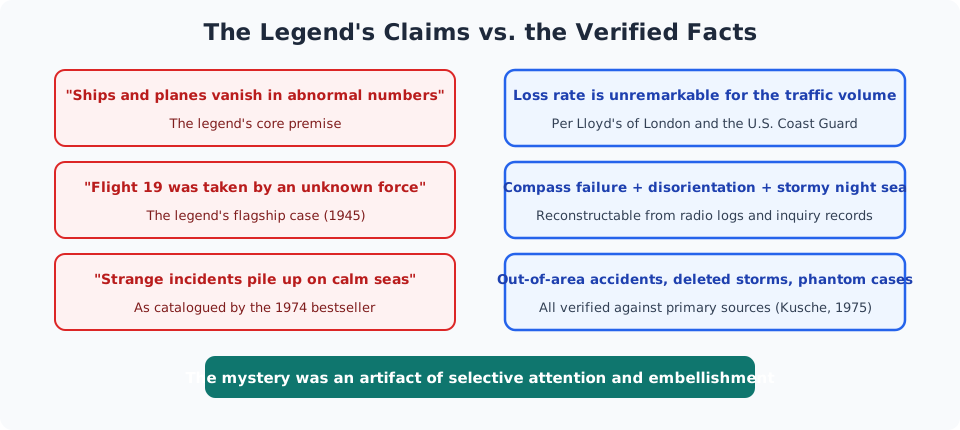
In the triangle of ocean bounded by Florida, Bermuda, and Puerto Rico, ships and planes keep vanishing without a trace — everyone has heard the legend. Let’s state the conclusion up front: statistically, the accident rate in this area is not unusually high compared with any other stretch of ocean. The insurers say so; the Coast Guard says so. So where did the legend come from, and how did it grow? This article follows the making — and unmaking — of a mystery. As stories go, that one is first-rate in its own right.
What Is the Bermuda Triangle?
The Bermuda Triangle is the popular name for the western Atlantic region whose vertices are Florida, Bermuda, and Puerto Rico. The name is surprisingly recent — coined by an American magazine article in 1964.
The legend claims that from the 19th century to the present, numerous ships and aircraft have vanished here without distress calls or wreckage. Proposed causes have ranged from magnetic anomalies and methane eruptions to giant vortices, lost super-civilizations, and UFOs.
What made the legend global was a bestseller published in 1974. Selling millions of copies worldwide, it presented case after “inexplicable” case in dramatic prose, hinted at connections to lost Atlantis, and turned the Bermuda Triangle into common knowledge across the planet — television and magazines recycled it for decades. But then someone went and checked the book’s claims, one by one.
The Legend’s Flagship: The Real Flight 19
At the legend’s center stands the “Flight 19” incident of December 5, 1945. Five U.S. Navy torpedo bombers (14 crew) vanished during a training flight out of Florida, and a flying boat sent to search (13 crew) vanished after them. As a synopsis, it sounds like pure occult.
The radio transcripts and inquiry records tell a different story. The flight’s instructor reported compass failure mid-flight and badly misjudged his position. Convinced he was over the Florida Keys when he was almost certainly over the open Atlantic, he led the formation away from land and out to sea. Night fell, the weather deteriorated, the fuel ran out. The formation is presumed to have been forced to ditch into a dark, rough ocean. That aircraft lost in a stormy night sea were never found is tragic — and not strange.
The search plane’s “disappearance” has an explanation too: that model was notorious for fuel-vapor ignition accidents, and that very night a passing tanker observed a mid-air explosion and an oil slick on the water. Flight 19, in other words, was not a “mysterious vanishing” but “a grievous accident compounded of disorientation and weather.” The legend was built by carving the malfunction, the misjudgment, and the storm out of the story.
The Verification That Exposed the Legend Factory
In 1975, Larry Kusche — an American librarian and pilot — published a tenacious work of verification. For every incident in the bestseller, he went back to primary sources: contemporary newspapers, weather records, and accident reports. The results were devastating.
Many of the legend’s “strange cases” happened outside the triangle entirely, or omitted the recorded storm raging that day, or — in the worst instances — could not be confirmed to have happened at all. A ship that “vanished from a calm sea” had actually foundered in a gale. The famous “derelict found untouched” bore little resemblance to its legend. Kusche concluded: “the mystery is a manufactured artifact of careless research and deliberate embellishment.”
The statistics agree. Lloyd’s of London and the U.S. Coast Guard have long held that given the traffic volume, the region’s accident rate is unremarkable. This is one of the world’s busiest sea lanes, a hurricane corridor, swept by the fast Gulf Stream that scatters wreckage. Conditions that make accidents more likely, more visible, and less traceable — no supernatural ingredient required.
Even the legend’s heavyweight — the 1918 loss of the USS Cyclops, a Navy collier that vanished with over 300 aboard — changes complexion under scrutiny. She was overloaded with dense manganese ore, running with one engine disabled, and heavy weather was reported along her route. Sister ships of the same class later sank in storms the same way. A structural weakness meeting bad conditions is the prevailing view. In the era before mature radio, a ship overwhelmed quickly at sea vanishing without a distress call is exactly what one would expect. Restore the period context, and the “mysterious disappearance” gains an ordinary outline.
Case Files: The Famous Incidents, Verified
Beyond Flight 19, the celebrated cases change expression under the light. A sample:
| Incident (year) | The legend’s telling | What verification found |
|---|---|---|
| USS Cyclops (1918) | Vanished instantly with 300 souls | Overloaded with ore; engine trouble; heavy weather reported |
| Star Tiger airliner (1948) | Vanished mid-flight without warning | Night ocean flight into headwinds with thin fuel margins |
| DC-3 airliner (1948) | Gone without a trace just before arrival | Departed with faulty batteries; radio contact impaired |
| SS Marine Sulphur Queen (1963) | Vanished with 39, no distress call | An aging, weakened conversion with a history of fires |
A pattern emerges: every case carried unglamorous pre-existing risk factors — mechanical trouble, bad weather, structural weakness. The legend deleted those factors from the telling and kept only “inexplicable disappearance.”
To be fair: with no wreckage recovered, no one can pronounce on each final moment, and the period inquiries often closed with “cause undetermined.” But “undetermined” is not a synonym for “supernatural.” In the age before radar and reliable radio, ships and planes lost in storms at sea leaving no trace was, sadly, ordinary. The drab right-hand column of that table is the closest thing we have to the truth of the “vanishings.”
Why Did People Believe in the Devil’s Sea?
With the trick exposed, the important question remains: why did so many people believe for so long? The full cast of this site’s cognitive bias series takes the stage.
First, selective attention: only “accidents inside the triangle” get collected, while the enormous daily traffic passing through safely goes uncounted. Watch the numerator and ignore the denominator, and any sea becomes a devil’s sea. Then confirmation bias: believers remember the fitting cases and never glance at the refutations — the statistics, the accident reports. And finally the power of story: “lost in a storm” cannot compete with “taken by an unknown force” for memorability, retellability, and book sales. As Brandolini’s law describes, building an attractive legend is cheap; verifying and correcting it costs many times more. Kusche’s patient verification actually paid that cost — work that deserves respect.
Questions About the Bermuda Triangle
Isn’t the Methane Hydrate Theory Real Science?
The hypothesis itself — a collapsing methane hydrate deposit releasing gas that lowers the water’s buoyancy enough to sink a ship — is experimentally interesting. But there is zero evidence any specific accident here happened that way. More fundamentally: since the statistics show no anomalous cluster of losses in the first place, there is nothing special requiring explanation. “A cause that could work in principle” and “the thing actually happened” are separate questions — a distinction useful across every mystery in this series.
What About Compasses Going Haywire from Magnetic Anomalies?
The old claim — “here, true north and magnetic north coincide, deranging compasses” — describes something that is perfectly ordinary in many parts of the world and not an anomaly at all. Magnetic declination is routinely corrected by every navigator on Earth. The compass trouble reported by Flight 19’s instructor was equipment failure, not oceanic sorcery. Sprinkle technical vocabulary over a mundane phenomenon and it starts sounding mystical — a standard trick of legend-building.
So There’s Nothing to Fear in These Waters at All?
Nothing to fear as a “devil’s sea” — but it is genuinely demanding water. A hurricane corridor with fast-changing weather, powerful currents, shoals and reefs. In other words, exactly like every ocean on Earth: preparation and weather information are what keep people alive. Countless aircraft and vessels cross it uneventfully every single day. Fear the storm, not the triangle. That entirely unmagical conclusion is what fifty years of verification built.
Related Mysteries
See the sea-and-sky vanishings “the Mary Celeste” and “the disappearance of Amelia Earhart,” and the psychology of believing what we wish: “confirmation bias.”



Summary
This article covered “the Bermuda Triangle.”
The devil’s triangle turns out to be a statistically unremarkable but naturally demanding crossroads of ocean traffic. Its flagship case, Flight 19, was a compass failure and disorientation ending in tragedy. The legend’s “strange cases” resolve, on inspection, into a patchwork of out-of-area accidents, deleted storms, and events that never happened.
The legend lived so long because of selective attention, confirmation bias, and the gravitational pull of “the mystery is the better story.” The Bermuda Triangle is thus both a sea mystery and a superb textbook on how humans manufacture mysteries. Next time you hear of a “zone of mysterious disappearances”: first check the denominator, then the primary sources. That habit alone will unmask most of the world’s legends.
To return to the full list of mysteries, follow the link below.
Thank you for reading. We hope to see you in the next article.

Also popular with readers
📚 Series: World Mysteries (17/21)